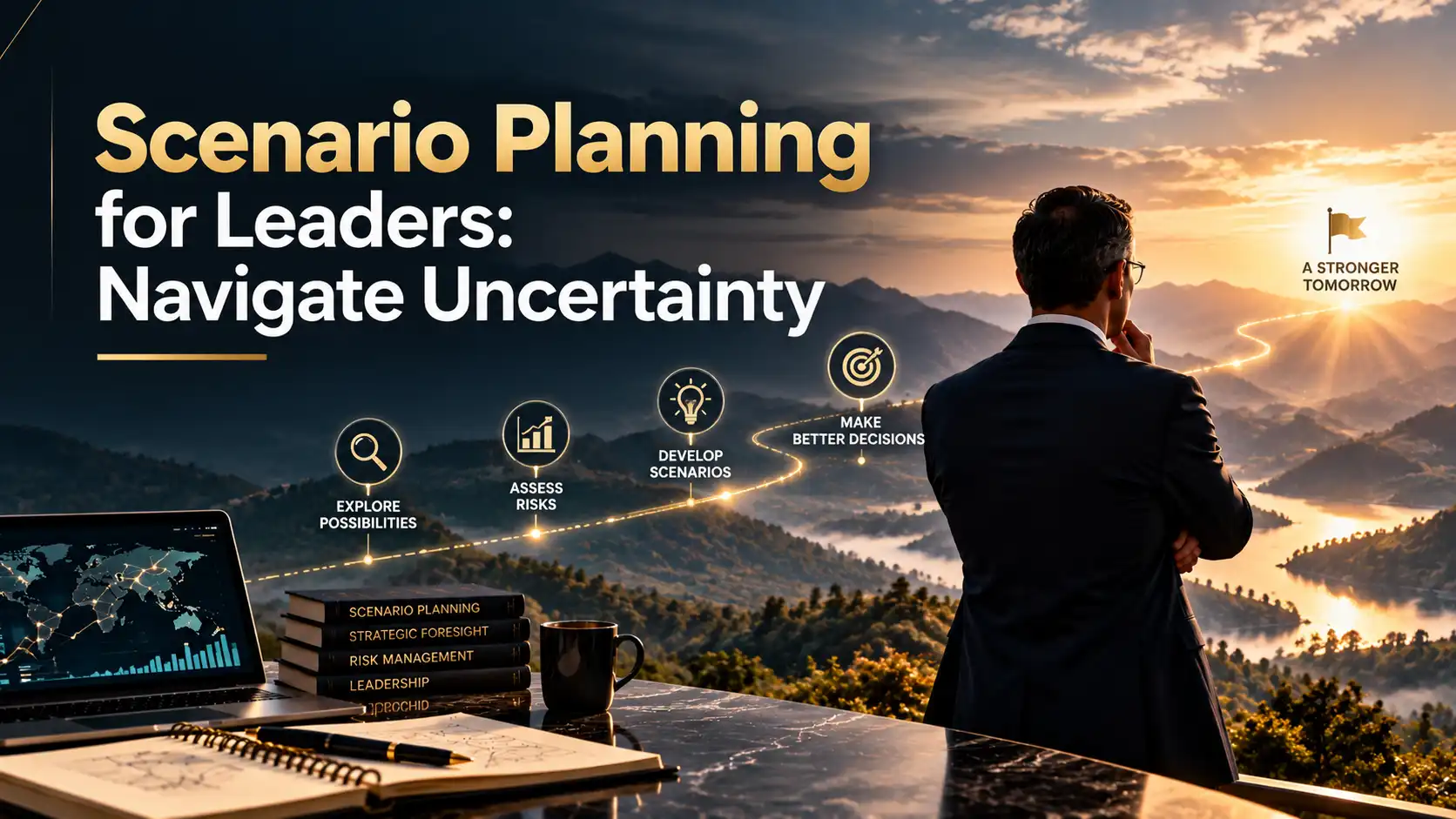
Most strategic plans quietly assume that next year will look like a modified version of this one. Scenario planning for leaders starts from the opposite premise: that several quite different futures are plausible, and that a strategy should be judged by how it holds up across them. This guide explains how CEOs, boards and executive teams can use scenario planning in practice, from framing the right question to building early warning indicators.
Why Scenario Planning Matters When Uncertainty Is Structural
Uncertainty is not new, but it becomes a leadership problem when a decision is large, hard to reverse and dependent on factors nobody in the room controls. Examples include entering a new market, committing to a multi-year technology investment, restructuring a business model or setting a long-range capital plan.
In those moments, however, a single forecast offers false comfort. It tells you what is most likely if current conditions persist, but it says little about what you would do if they do not. Scenario planning fills that gap. Instead, it asks leaders to think through a small set of plausible futures and to find out, before committing resources, where their strategy is strong and where it is fragile.
Scenario planning is one discipline within the wider practice of strategic foresight. If you want the broader picture, including signal detection and how foresight connects to strategy, see our guide to strategic foresight for business. Therefore, this article goes deeper on the scenario work itself and on how leadership teams can run it.
What Scenario Planning Is, and What It Is Not
Scenario planning builds a few coherent, distinct narratives about how the external environment could develop, then uses them to test decisions. The method has roots in military planning and is widely credited with entering corporate practice in the 1970s, notably through work at Royal Dutch/Shell. Its central idea has stayed the same: the purpose is better decisions, not accurate predictions.
It is often confused with other planning tools, so the distinctions are worth stating plainly.
| Approach | Core question | What it produces | Best used for |
|---|---|---|---|
| Forecasting | What is most likely to happen? | A projection or target | Managing the known and the near term |
| Risk or contingency planning | If this specific event occurs, what do we do? | Response protocols for identified risks | Operational resilience and continuity |
| Best, base and worst case | How far could this one variable move? | A range around one assumption | Financial sensitivity analysis |
| Scenario planning | What different worlds might we operate in, and is our strategy robust across them? | Distinct narratives, tested strategy and early indicators | Long-horizon, high-stakes decisions |
The last row differs from the others in one important way. For example, best, base and worst cases stretch a single storyline up and down. Scenarios, by contrast, change the storyline itself, because they vary several forces at once and ask how they interact.
Start With the Decision, Not the Trend
Scenario exercises go wrong most often at the start. A team that begins with “let us imagine the future of our industry” usually produces an interesting conversation and no decision. By contrast, a team that begins with a specific decision produces scenarios that matter.
Write the focal question down before any workshop begins. Good focal questions are specific, consequential and tied to a time horizon. Compare these two:
- Too broad: “What will the future of our sector look like?”
- Useful: “Should we commit to a new regional operating model over the next seven years, and how should we sequence the investment?”
A sharp focal question also tells you who needs to be in the room: the people who own the decision, plus those who see the environment from different angles, such as strategy, finance, operations, technology, risk and people.
Find the Critical Uncertainties
Every focal question is shaped by many external forces. However, the skill is separating them into two groups.
- Predetermined elements: forces whose direction is reasonably clear, such as demographic shifts already underway or regulation already enacted. Therefore, build these into every scenario.
- Critical uncertainties: forces that would strongly affect your decision and whose direction you genuinely cannot call. Therefore, these become the foundation of your scenarios.
A practical way to sort them is to have the group rate each force on two questions: how much would it change the answer to our focal question, and how uncertain is its direction? The forces that score high on both are your critical uncertainties. Aim for two or three, because beyond that, scenario sets tend to become unwieldy and hard to discuss.
Look across the full environment
To avoid a narrow list, scan across technology, economics, regulation and policy, society and customer behaviour, and the competitive landscape. Leadership teams often find that their longest list of concerns clusters in the areas their own functions already watch. For this reason, inviting outside voices, or deliberately assigning someone to argue for an unfamiliar domain, widens the view.
Build Scenarios That Are Plausible and Distinct
Once you have chosen two critical uncertainties, a common technique is to treat each as an axis with two contrasting outcomes. Crossing the axes gives four distinct scenario worlds. Each scenario should be internally consistent, meaningfully different from the others, and plausible enough that a sceptical executive can imagine it.
| Trade conditions: integrated | Trade conditions: fragmented | |
|---|---|---|
| Rapid automation and AI adoption | Scale and speed favoured. Competitors move quickly; capital efficiency decides who wins. | Regional resilience favoured. Automated local networks matter more than global reach. |
| Gradual automation and AI adoption | Familiar economics persist. Cost and service reliability remain the main differentiators. | Complexity and cost pressure rise. Flexibility and partnerships matter most. |
Name and narrate each scenario
Then give each scenario a memorable name and write a short narrative of how it came about, what daily life looks like in it, and who wins and loses. Narrative matters because people remember stories better than matrices, and a story makes the implications for your own business easier to see.
Resist the temptation to label one scenario as the expected one and the others as alternatives. Otherwise, if the team quietly treats scenario two as the real forecast, the exercise has collapsed back into planning around a single future.
Stress-Test Strategy: Robust, Contingent and Reserve Moves
Scenarios become useful when you put your strategy through them. Specifically, for each scenario, ask where the current plan thrives, where it struggles and what would have to change. This is where the exercise turns into better decision-making, which Invictus Leader frames as decision intelligence: combining foresight, evidence and leadership judgement to improve strategic choices.
The output, in other words, is not a single answer. Instead, it is a sorted set of moves.
| Type of move | What it means | Question to ask |
|---|---|---|
| Robust moves | Actions that make sense in all or most scenarios | What should we do now regardless of how the future unfolds? |
| Contingent moves | Actions prepared in advance and triggered only when specific signals appear | What do we prepare, and what would trigger it? |
| Reserve options | Capabilities or partnerships kept available at modest cost | What is cheap to keep open now but expensive to build later? |
| Moves to avoid | Actions that perform well in one scenario and badly in others | Which commitment would we regret in most futures? |
A decision that performs adequately in every scenario is often wiser than one that performs brilliantly in one and poorly in the rest. That is not timidity. Rather, it reflects honest recognition of what cannot be known.
Set Signposts and Early Warning Indicators
A scenario set that is built once and filed away has limited value. The real return, however, comes from knowing, as early as possible, which direction the environment is moving. That requires signposts: observable indicators that suggest one scenario is becoming more likely.
Good signposts are specific, observable and linked to a decision. For example, “Technology is advancing” is not a signpost. By contrast, a named regulatory milestone, a competitor move, a shift in customer behaviour or a change in a supply condition might be, provided you have agreed in advance what you would do if it appeared.
- Agree the trigger: define what level or event would count as a meaningful change.
- Assign an owner: someone is responsible for watching each indicator.
- Bring signals to the table: build a regular, short review into the executive or board calendar.
- Link to action: each signpost should connect to a prepared contingent move.
This habit, therefore, relies on what Invictus Leader calls signal literacy, the ability to identify and interpret early signals and emerging trends. It is one of the capabilities developed in Foresight Leadership™, alongside scenario exploration and decision-making under uncertainty.
Common Scenario Planning Mistakes Leaders Make
- Treating scenarios as predictions. They are tools for testing strategy, not claims about what will happen.
- Building too many scenarios. A large set cannot be discussed or remembered. A small, distinct set, however, can.
- Making scenarios variations of the same story. When every scenario assumes similar conditions, the exercise only confirms existing beliefs.
- Skipping the decision. Beautifully written futures rarely change anything unless they touch a real choice.
- Leaving out dissenting voices. Homogeneous groups, after all, tend to produce homogeneous scenarios.
- Running it as a one-off. Without signposts and a refresh rhythm, scenarios go stale, and as a result the early-warning value disappears.
- Delegating it away. When senior leaders do not take part, the findings seldom influence budgets, risk discussions or board agendas.
Building Scenario Capability in Your Leadership Team
Scenario planning is a method, but it is also a leadership behaviour. It asks executives to tolerate ambiguity, welcome challenge to their own assumptions and commit to decisions without waiting for certainty. Those habits can be developed, and teams usually improve when they practise on live decisions rather than hypothetical ones.
Invictus Leader works with boards, CEOs and executive teams in two complementary ways. Through Foresight Advisory, it supports leadership teams facing specific strategic decisions, examining signals, challenging assumptions and exploring plausible futures. The exact format, however, depends on scope and may range from a focused executive briefing to a decision sprint or ongoing advisory. For teams that want to build the capability themselves, the Foresight Leadership™ programmes offer open programmes, custom programmes, workshops and leadership labs.
Boards and senior leaders can also explore the board-level and decision-focused pathways listed in the Invictus Foresight Suite, which include the Boardroom Suite™ and AI-Augmented Decision Intelligence™.
Facing a decision you cannot settle with past performance alone?
Talk with Invictus Leader about how scenario thinking could inform a live strategic question in your organisation.
Discuss a strategic challengeFrequently Asked Questions
Understanding Scenario Planning
What is scenario planning in simple terms?
Scenario planning is a method for exploring several plausible futures and testing how well a strategy would perform in each. Instead of betting on one forecast, leaders prepare for a range of possibilities.
How is scenario planning different from forecasting?
Forecasting projects the most likely outcome from existing data, usually over shorter horizons. In contrast, scenario planning explores different possible environments, including ones that break from current trends, and asks how strategy would hold up in each.
How is scenario planning different from contingency planning or risk management?
Contingency and risk planning prepare responses to specific, identified events. Scenario planning, on the other hand, explores broader changes in the operating environment and informs strategic direction. The two work well together, since scenarios often reveal risks that were not on the register.
Running the Process
How many scenarios should a leadership team build?
There is no fixed rule, but a small set is easier to discuss and remember. Many teams work with around three or four distinct scenarios, often built from two critical uncertainties. Quality and distinctiveness matter more than quantity.
Who should be involved in scenario planning?
The people who own the decision should take part, along with colleagues who see the environment differently, such as strategy, finance, operations, technology, risk and people leaders. In addition, outside perspectives can help challenge shared assumptions.
How long does a scenario planning exercise take?
It depends on scope. A focused session can frame a single decision, while a deeper study involves research, multiple workshops and testing. What matters most is that the exercise is tied to a real decision and that someone owns the follow-through.
Applying Scenarios in Practice
Is scenario planning only for large organisations?
No. The scale can vary, but the logic applies to any organisation making long-term decisions under uncertainty. A smaller organisation can start with one decision, two critical uncertainties and a short set of scenarios.
How do we know which scenario is unfolding?
You track signposts: specific, observable indicators agreed in advance. When enough of them point the same way, leaders can decide whether to trigger prepared moves. No signpost proves a scenario, so judgement still matters.
How often should scenarios be revisited?
Review signposts on a regular rhythm, and refresh the scenarios when a major assumption changes, a signpost points strongly in one direction or a new strategic decision comes into view. Many organisations also revisit them as part of annual strategic planning.