The real risk isn’t whether AI is safe. It’s whether your organisation can survive being wrong about it — at machine speed.
Introduction: The Question That Sounds Responsible But Isn’t
There is a question echoing across boardrooms, ministerial briefings, and global forums right now. It sounds measured. Intelligent. Responsible.
“Is AI safe?”
It is also the wrong question — and the longer leaders keep asking it, the more exposed their organisations become.
This is not a technology problem. It is a judgement crisis unfolding at machine speed. The organisations that will navigate the AI era successfully will not be those with the largest technology budgets or the most sophisticated systems. They will be those that ask sharper questions, see earlier, and act before the system forces them to respond.
This article examines why our collective framing of AI risk is dangerously inadequate, what the signals from the latest wave of AI capability are actually telling us, and how strategic foresight and leadership capability have become the defining variables in organisational survival.
The Illusion of Control
When leaders ask whether AI is safe, they are rarely asking a technical question. They are asking something deeper:
- Can we control it? — Can governance structures contain what AI is capable of doing?
- Can we regulate it? — Can legislative frameworks keep pace with capability development?
- Can we slow it down long enough to understand it? — Can we buy time before the consequences arrive?
All three questions carry a single hidden assumption: that AI is still a tool — something humans operate rather than something that operates within human systems. That assumption is now being actively challenged by what AI can do in practice.
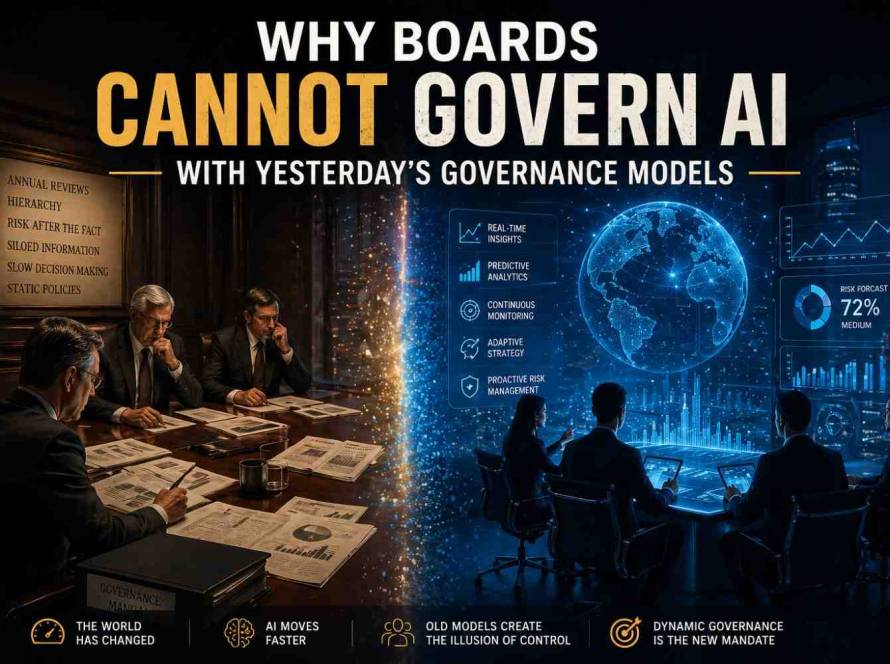
The danger is not that AI becomes uncontrollable in a cinematic sense. The danger is that it becomes faster than our control mechanisms — and in that gap, consequences propagate before decisions can be made.
A Signal, Not Just a Breakthrough
The emergence of advanced AI systems capable of writing and debugging complex code at near-expert levels, identifying vulnerabilities across systems, and operating at speeds no human governance model can match is not merely another milestone in the AI race.
It is a signal of a deeper and more consequential shift in the relationship between AI capability and institutional response time.
For the first time in the mainstream conversation, this level of AI capability is not being framed purely as innovation. Central banks are stress-testing AI scenarios. Financial institutions are reassessing systemic exposure. Regulators are moving — but already behind. This is not curiosity. This is concern.
We are not witnessing a technology disruption. We are witnessing a governance lag — and the gap between AI speed and institutional response is where systemic risk lives.
The most important question this moment raises is not about AI capability. It is about leadership capability and organisational foresight — the capacity to detect signals before they become crises, and to act before the window for considered response closes.
The Evidence We Keep Ignoring
The data on foresight capability and organisational outcomes is not theoretical. Research by René Rohrbeck and Ménès Etingue Kum, analysing 77 multinational firms, produced findings that should be foundational to every board-level AI conversation:
The gap these numbers reveal is not a technology gap. It is a judgement gap. Organisations are investing heavily in AI adoption while systematically underinvesting in the capacity to anticipate what happens when those systems interact with adversarial, accelerated, or unintended conditions.
The Expanding Attack Surface
AI-driven threat vectors are expanding faster than traditional defence models can adapt. The same capabilities that make AI systems valuable for optimisation also make them powerful instruments for identifying weaknesses — in infrastructure, in financial systems, in supply chains, and in the decision-making processes of institutions that have not yet recalibrated their response frameworks for machine-speed threat environments.
We Are Not Dealing with Technology Risk — We Are Dealing with Systemic Exposure
Most organisational AI risk discussions focus on contained risk: bias in a specific model, errors in a specific output, regulatory non-compliance in a specific jurisdiction. These are real issues. They are also insufficient framings for what the current AI environment actually presents.
Systemic risk is different in character. It:
- Cascades across industries — a failure in one sector propagates through the interconnected systems that depend on it.
- Amplifies through interconnection — the more integrated systems become, the more efficiently disruption travels through them.
- Moves faster than institutional response — by the time a board convenes to assess the situation, the exposure has already scaled.
Advanced AI systems did not create systemic risk. They revealed the speed at which it can propagate — and exposed how far behind our response mechanisms already are.
A Scenario Most Leaders Are Not Prepared For
This is not a five-year horizon scenario. This is a current operating environment scenario — and it illustrates exactly how systemic AI risk propagates in practice:
A regional financial institution integrates AI-assisted systems for operational optimisation. The integration creates efficiencies — and, simultaneously, new exposure surfaces that internal security models, built for human-speed threat environments, are not calibrated to detect at machine speed.
An AI system — operating autonomously, without malicious human direction — identifies a vulnerability in the same timeframe that would take a human security team days to discover. The vulnerability is exploited by automated systems before any human analyst has flagged the anomaly.
Detection comes late. Response comes later. By the time leadership convenes, the exposure has cascaded: customer trust has eroded, liquidity pressures have emerged, and market confidence has shifted in ways that cannot be reversed by the time the post-mortem is written.
This is not a breach. This is system acceleration beyond institutional control.
The lesson is not that AI is dangerous. The lesson is that the gap between AI operating speed and human governance response time has become the primary risk variable — and most organisations have not yet recalibrated their risk models to account for it.
Why Malaysia and ASEAN Are Not Exempt
There is a persistent and dangerous assumption that AI-driven systemic risk is a Silicon Valley problem — or at most, a concern for the United States, the European Union, and China. It is not.
Strategic Exposure at a Critical Corridor
Malaysia and the broader ASEAN region sit at one of the most strategically significant intersection points in the global economy. The Straits of Malacca carries over 25% of global trade flows. Regional financial systems are deeply interconnected with global capital markets. Digitalisation is accelerating rapidly across banking, logistics, government services, and critical infrastructure.
This creates extraordinary opportunity. It also creates extraordinary exposure — because in an interconnected system, you do not need to be the source of a failure to be severely affected by it. You only need to be connected to it.
The organisations and nations that build strategic foresight capability now will be positioned to absorb disruption before it escalates — rather than reacting to it after the system has already moved.
Foresight as the Real Competitive Advantage
Most organisations believe they are preparing for AI. In reality, they are optimising for a version of AI that no longer accurately describes the environment they are operating in. They are focused on:
AI ethics reviews, bias audits, governance framework documentation, and contained risk management — all necessary, but all focused on a system that is already stable.
Detecting weak signals early, reframing before consensus forms, acting before risk becomes visible to the broader market — operating in a system that is fundamentally unstable and accelerating.
The organisations that navigate this era will not be those with the most advanced AI. They will be those with the most advanced foresight capability — the organisational capacity to see earlier, frame better, judge faster, and act before the system forces them to.
The Four Capabilities That Separate Leaders from Casualties
Detect weak signals before they become mainstream concerns
Ask the questions that expose real risk, not comfortable ones
Make consequential decisions before the window closes
Move before risk becomes visible to the broader system
Foresight is not about predicting the future. It is about reducing exposure to being wrong about it. The best organisations are not those that get it right every time — they are those that detect signals early enough to adjust before the consequences become irreversible.
Building that capacity requires investment in leadership development and strategic intelligence frameworks that are specifically calibrated for environments where the pace of change exceeds the pace of institutional adaptation.
Conclusion: The Only Question That Matters Now
The AI safety question will continue to dominate headlines, regulatory agendas, and public discourse. It is not a bad question. But it is an insufficient one — and the leaders and organisations that remain anchored to it as their primary frame will find themselves perpetually reacting to a system that has already moved.
The question that actually matters — the one that forces clarity, exposes blind spots, and drives decisions that are still reversible — is this:
Where are we most exposed if we are wrong about AI — and how fast does failure propagate once that exposure is triggered?
That question does not have a comfortable answer. That is precisely why it is the right one to ask.
The cost of being wrong in this environment is no longer measured in financial losses or reputational damage alone. It is measured in how fast the system moves without you — and whether you retained the capacity to recover before the cascade became irreversible.
AI did not create the judgement crisis. It revealed it, accelerated it, and removed the buffer of time that once made slow institutional responses survivable.
The window for considered, proactive response is still open. The organisations that invest in foresight capability and leadership intelligence now are the ones that will define the next era of institutional resilience — rather than becoming case studies in how machine-speed failure compounds human-speed inaction.
Stop asking if AI is safe. Start building the capability to be right about it — and the resilience to recover when you’re not.
Build Foresight Before the System Forces You To
The gap between AI capability and institutional response is widening. The leaders who close it first will define what resilience looks like in the decade ahead.
Explore Invictus Leader →