For decades, organisations treated talent development as a functional task — a training need to fulfil, a competency gap to close, a succession problem to solve. That approach made sense when markets moved slowly, roles were stable, and leadership assumptions remained predictable for years at a time. That world no longer exists. At Invictus Leader, we have been rethinking what it means to build human capability in an era where the future is not linear — and where the cost of getting it wrong is structural, not merely operational.
This article outlines the philosophy and methodology behind Human Capability Architecture — how we design capability for the present moment, for the emerging next, and for the genuinely nonlinear futures that organisations may face whether or not they are ready for them.
Why Traditional Talent Development Is No Longer Enough
Traditional talent development improved activity. It did not always strengthen capability under volatility. Organisations built development programmes around visible needs — training calendars, competency frameworks, annual learning hours — while the real pressures remained largely invisible until they became crises.
The operating environment has changed faster than most talent systems were designed to handle. Five forces, in particular, are reshaping what human capability must mean in practice:
Decision windows are compressing. Judgment cycles that once spanned weeks now span hours, demanding faster yet deeper cognitive processing.
Trust, engagement, and workforce expectations are shifting. Organisations that miss these signals face erosion of the relational fabric that enables execution.
Supply chains, labour realities, and leadership priorities are all being reconfigured by a world that is less predictable and more interconnected in its risks.
The result is a widening gap between what most development systems were designed for and what organisations actually need: leaders and teams capable of operating with confidence, judgment, and resilience in conditions that were never anticipated in their original capability frameworks.
The Core Insight
“Many organisations still design capability as though the future will resemble the past. That may now be one of the biggest strategic blind spots in leadership — and one of the most consequential competitive disadvantages a business can carry into the next decade.”
How We Design Human Capability Differently: Six Principles
Since 2023, across advisory engagements with clients globally, one pattern became consistently clear: the organisations most at risk were not necessarily those with the weakest training programmes. They were those designing capability around visible needs while remaining blind to invisible pressures — decision fragility, leadership fatigue, trust erosion, and role misalignment.
Human Capability Architecture, as we practise it at Invictus Leader, is built on six interconnected principles.
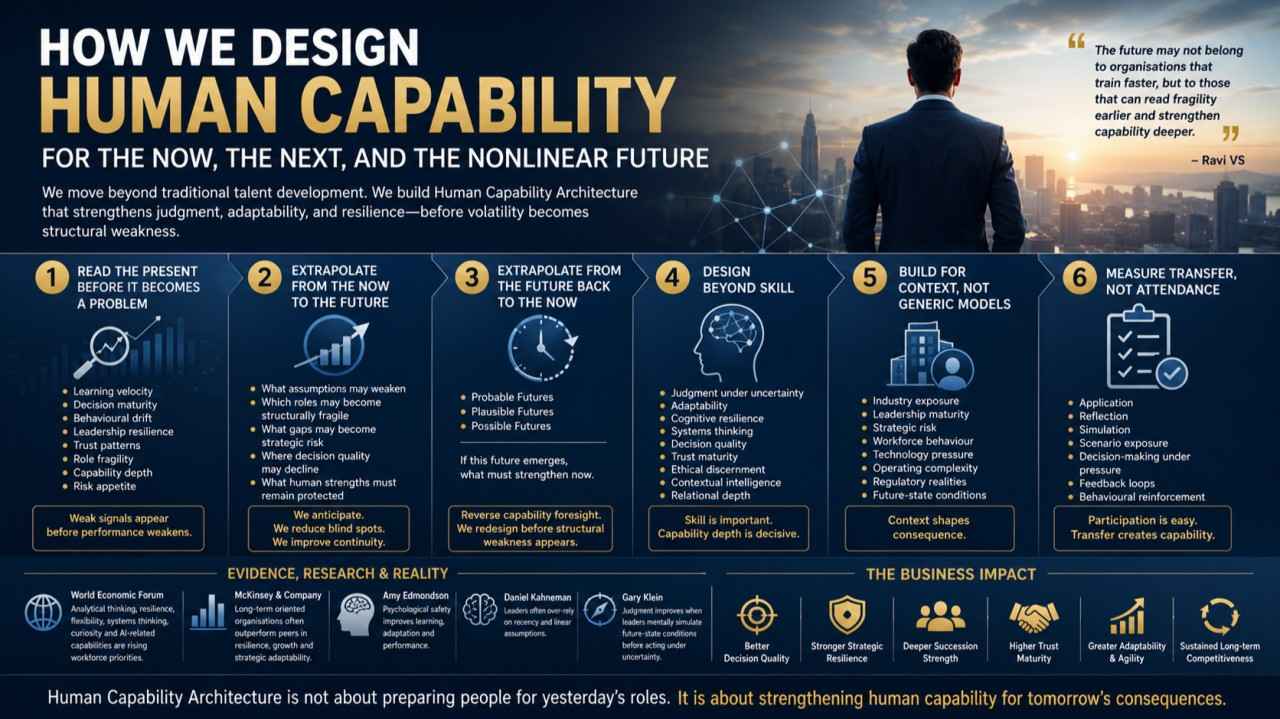
Read the Present Before It Becomes a Problem
Most organisations wait for visible breakdown — declining performance, weak succession depth, retention pressure — before intervening. By then, intervention is reactive and more costly. We begin with present-state visibility: learning velocity, decision maturity, behavioural drift, leadership resilience, trust patterns, and capability depth. Weak signals often appear long before organisational symptoms. Identifying them early is where strategic advantage begins.
Extrapolate from the Now to the Future
Once present-state visibility is clearer, we ask: if current patterns continue, what will emerge? This is forward capability foresight. Which roles may become structurally fragile? What capability gaps may become strategic risk? Where may decision quality decline? What human strengths must remain deliberately protected? Answering these questions improves anticipation, reduces blind spots, and strengthens organisational continuity.
Work Backwards from the Future to the Now
This is where advisory depth becomes most valuable. We work across three horizons: probable futures (likely if current trajectories continue), plausible futures (realistic through weak signals and structural drift), and possible futures (emerging through disruption or nonlinear pressure). Then we ask the harder question: if this future emerges, what must strengthen now? This reverse capability foresight is where capability asymmetry begins to form.
Design Beyond Skill
Upskilling, reskilling, and competency mapping remain useful — but increasingly insufficient. A highly skilled leader may still fail under ambiguity. A digitally trained workforce may still struggle with judgment under pressure. The issue is no longer only skill; it is capability depth. Our work focuses on judgment under uncertainty, cognitive resilience, systems thinking, trust maturity, ethical discernment, and contextual intelligence.
Build for Context, Not Generic Models
No two organisations operate under the same pressure profile. Capability cannot be designed in abstraction. It must be contextualised to industry exposure, leadership maturity, strategic risk, workforce behaviour, technology pressure, and future-state conditions. Generic frameworks often fail precisely because they ignore context — and context shapes consequence.
Measure Transfer, Not Attendance
Many organisations still measure development by activity: courses completed, hours logged, certifications earned. These show participation — not stronger capability. Capability is built through application, reflection, simulation, scenario exposure, decision-making under pressure, and behavioural reinforcement. That is where capability transfer becomes visible and measurable.
The Deeper Shift: From Competency to Capability Depth
The language of talent development has long been dominated by competency frameworks. These were designed for slower environments, clearer roles, and relatively stable strategic assumptions. In a world where volatility is structural rather than cyclical, that language has become a ceiling rather than a foundation.
The capabilities that matter most in nonlinear conditions are rarely the ones on a standard competency map. They include:
These are not soft skills. They are structural capabilities — the ones that determine whether an organisation can hold its execution quality when conditions stop being predictable. Building them requires a fundamentally different design logic than traditional training: one grounded in consequence, context, and genuine transfer rather than content delivery and completion rates.
What Science and Market Evidence Confirm
The principles behind Human Capability Architecture are not merely conceptual — they are increasingly reinforced by a growing body of research and market evidence.
Supporting Research
- The World Economic Forum consistently identifies analytical thinking, resilience, flexibility, systems thinking, curiosity, and AI-related capability as the most critical rising workforce priorities.
- McKinsey & Company research has repeatedly demonstrated that long-term oriented organisations outperform peers in resilience, growth, and strategic adaptability over multi-year periods.
- Amy Edmondson’s foundational work shows how psychological safety — a deeply relational capability — directly improves learning, adaptation, and performance under pressure.
- Daniel Kahneman demonstrated that leaders frequently over-rely on recency bias and linear assumptions — precisely the cognitive patterns that fail under nonlinear conditions.
- Gary Klein’s research shows that judgment measurably improves when leaders mentally simulate future-state conditions before acting under uncertainty — the basis of our reverse foresight methodology.
Across our own advisory engagements, the pattern is consistent: organisations that redesign capability around judgment, adaptability, context, and resilience identify fragility earlier — and that directly affects decision quality, succession depth, strategic resilience, execution continuity, and long-term competitiveness.
The Real Strategic Question for Leaders Today
Most organisations are still developing talent for the roles they currently have. Stronger organisations are beginning to design human capability for the futures they may face — including futures they have not yet named.
Human Capability Architecture is no longer only a people issue. It is a strategic issue. The question is not simply what employees need to learn this quarter. The deeper question is: what human capability must remain deeply strong when the future becomes increasingly nonlinear?
The Next Competitive Asymmetry
The future may not belong to organisations that simply train faster. It may belong to those that can read fragility earlier, strengthen judgment more deeply, and redesign capability before volatility becomes structural weakness. That is where the next competitive asymmetry is forming — and where the gap between prepared and unprepared organisations will become most visible.
Is Your Organisation’s Capability Architecture Built for What’s Coming?
Many organisations are still designing capability for the past. If you want to understand where fragility may be forming in your leadership and talent systems — and what to do about it before it becomes visible — we would be glad to explore that with you.
Explore Our Advisory Work →Conclusion
The organisations that will navigate nonlinear futures most effectively are unlikely to be those with the most training hours on record. They will be those that chose to look further — to read the present with greater precision, to anticipate structural fragility before it became visible, and to build capability depth that holds under genuine pressure. Human Capability Architecture is the methodology we have built to support exactly that. If that challenge resonates with where your organisation is heading, the conversation at Invictus Leader begins there.