Humanity has an uncomfortable pattern: we often see danger long before we respond to it. The signals appear, the warnings emerge, the data accumulates — and yet meaningful action rarely happens until disruption becomes painful. At Invictus Leader, our ongoing strategic foresight work reveals that this is not merely a leadership problem. It is a deeply human one — and understanding it has become one of the most urgent tasks of modern civilization.
Most Crises Are Not Surprises
One of the greatest misconceptions in leadership is the belief that crises emerge suddenly from nowhere. In reality, many crises arrive after years of visible signals. Financial collapses often show stress patterns years earlier. Infrastructure failures reveal warning signs before breakdown. Organizational collapse usually begins long before the public notices it. Mental health deterioration rarely happens overnight. Even geopolitical instability often escalates gradually before becoming globally visible.
The issue is rarely the absence of information. The issue is delayed response.
Visible Signals Already Present Today
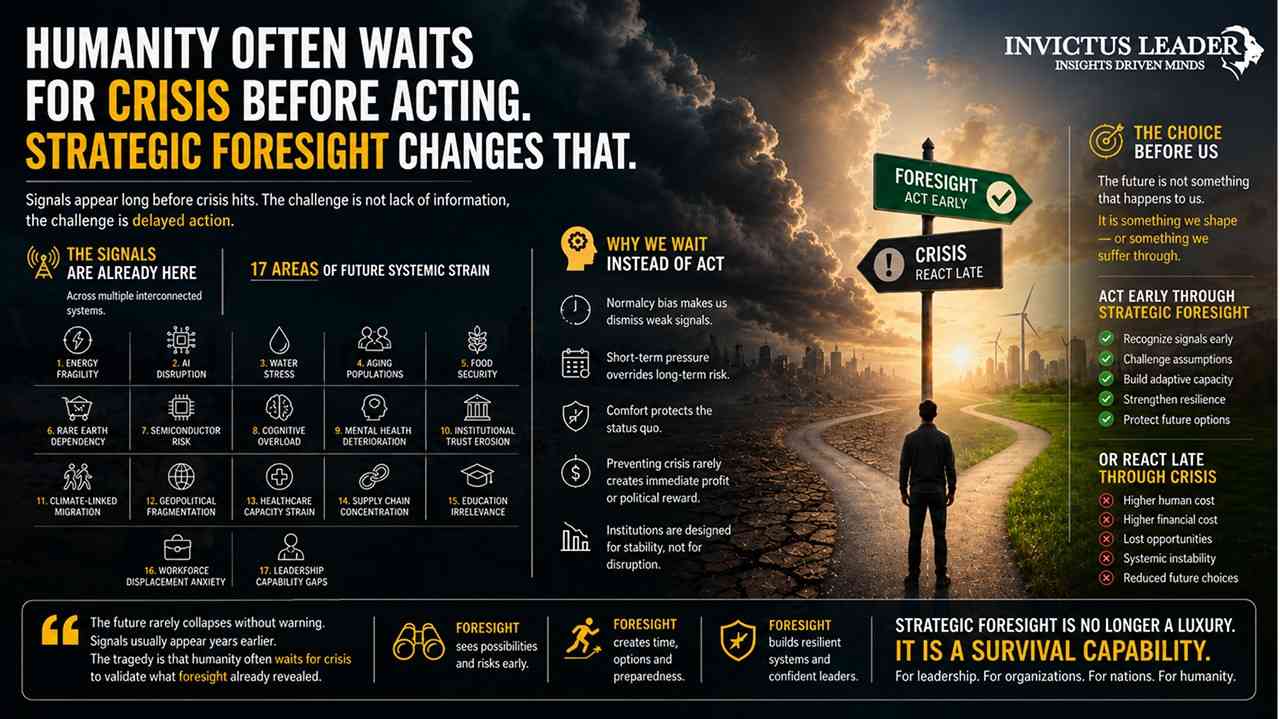
The frightening reality is that many future crises are already visible in signal form today. Yet large-scale action often remains reactive rather than anticipatory. Why? Because responding early carries political, economic, institutional, and psychological cost. Preventing crisis rarely creates headlines. Preventing collapse rarely creates immediate profit.
Human Cognitive Biases At Work
Behavioral economists and cognitive scientists have long documented why humans consistently underestimate long-term threats when immediate discomfort is absent:
Comfort Preserves Systems. Pressure Rewires Them.
This may be one of the most important strategic foresight lessons of our era. During stable periods, organizations optimize for efficiency, governments defend legacy structures, institutions preserve existing models, and leaders focus on quarterly pressure and immediate performance. Innovation becomes incremental.
But under pressure, decision cycles collapse, bureaucratic resistance weakens, capital reallocates rapidly, collaboration accelerates, risk appetite changes, and old assumptions die quickly. The velocity of innovation is often directly tied to the intensity of existential pressure.
World War II
Accelerated radar, aviation, nuclear science, and early computing.
The Cold War
Accelerated semiconductors, satellites, aerospace, and space exploration.
COVID-19
Accelerated biotechnology, telemedicine, AI-supported healthcare, and digital infrastructure.
COVID did not suddenly make humanity more intelligent. It compressed time. It removed the luxury of delay. mRNA technology existed long before COVID. The difference was urgency. Pressure changes funding velocity, regulation, collaboration, political will, and what societies are willing to prioritize.
Today, energy instability and AI infrastructure demand are accelerating Small Modular Nuclear Reactors, AI-optimized energy grids, sodium-ion battery systems, geothermal expansion, green hydrogen ecosystems, long-duration energy storage, fusion research investment, and decentralized energy infrastructure. The future rarely arrives politely. It often arrives through pressure.
The Real Crisis May Be Human Behavior Itself
Humanity has never had more data, dashboards, predictive analytics, AI systems, consultants, strategic reports, or scenario models. Yet many institutions remain fundamentally reactive. Why? Because information alone does not create foresight.
“Strategic foresight is not prediction. It is the disciplined ability to identify emerging patterns, systemic fragilities, and plausible disruptions early enough to improve preparedness, adaptability, and decision quality.”
Foresight requires interpretation, judgment, systems awareness, signal contextualization, and uncomfortable decision-making before urgency becomes visible. That is extraordinarily difficult — especially inside political systems driven by election cycles, corporations driven by quarterly pressure, institutions built around legacy assumptions, and societies conditioned toward immediate gratification.
The World Is No Longer Moving At Institutional Speed
This may be the defining leadership challenge of our time. Historically, organizations often had years to respond to emerging shifts. Today, weak signals can escalate into systemic disruption within months. COVID demonstrated this. AI demonstrated this. Supply chain disruptions demonstrated this. Energy volatility is demonstrating this now.
Electricity demand from data centers, AI systems, and digital infrastructure is expected to rise sharply over the coming years. Simultaneously, geopolitical fragmentation is increasing pressure on semiconductors, rare earth minerals, shipping corridors, technological sovereignty, and energy resilience. The world is no longer moving at institutional speed. It is moving at systemic speed. Technology is accelerating exponentially. Human decision systems are not.
Key Insight
The greatest risk today is no longer lack of information. The greatest risk is the inability to interpret signals early enough to act before pain forces action. That is the true role of strategic foresight — not predicting headlines, but building adaptive capacity before pressure arrives.
Strategic Foresight Is No Longer Optional
For years, strategic foresight was treated as a future trends discussion, a scenario planning exercise, a strategic retreat activity, or a corporate innovation luxury. That era is over. The compression of global systems has fundamentally changed the role of foresight. Today, strategic foresight is becoming a leadership survival capability, an organizational resilience capability, a governance capability, and a national capability.
Nations That Acted Early — What Foresight Looks Like In Practice
Some nations and institutions have already demonstrated that anticipatory action is possible:
Singapore
Invested heavily in water resilience decades before scarcity became critical.
Nordic Countries
Built stronger systemic resilience models around energy, governance, and long-term strategic planning.
Taiwan
Recognized semiconductor concentration risk early and positioned itself strategically within the global technology ecosystem.
These examples prove that foresight-driven action is possible. The challenge is that such behavior remains the exception rather than the global norm.
Leadership Will Now Be Measured Differently
Anybody can lead during stability. Real leadership is increasingly becoming the ability to recognize weak signals early, challenge dangerous assumptions, identify invisible fragilities, prepare before emotional urgency appears, and make difficult decisions before crisis validates them.
Through ongoing strategic foresight work at Invictus Leader, we continue to observe multiple interconnected pressure zones showing increasing signs of future systemic strain across leadership, infrastructure, governance, technology, resources, and human capability systems. Many are not isolated risks. They are converging risks. The signals are already visible.
Conclusion: Knowledge Is Not Enough
The tragedy is that humanity may already possess enough knowledge to prevent many future crises. The deeper problem is that knowledge alone has never been enough to trigger action. Historically, pain has been the real accelerator. And that may be one of civilization’s greatest vulnerabilities.
The future rarely collapses without warning. Signals usually appear years earlier. The question is whether leadership, institutions, and societies can learn to respond before crisis becomes the only remaining teacher. The concern is no longer whether disruption will emerge. The deeper concern is whether institutions, leadership systems, and societies can develop the foresight capacity to respond before pressure escalates into crisis once again.
That is why strategic foresight is no longer a strategic luxury. It is becoming one of the most vital capabilities of modern leadership, governance, and civilization itself. The time to act on visible signals is always before they become crises — and that window is available right now.
Invictus Leader · Strategic Foresight
Build Foresight Capacity Before Crisis Demands It
Explore how Invictus Leader’s strategic foresight frameworks help organizations recognize emerging signals, challenge legacy assumptions, and prepare for disruption before it arrives.
Explore Invictus Leader →