Why what we call a people problem is often a thinking problem.
There Is One Sentence I Keep Hearing
Over the last three decades of working with CEOs, boards, HR leaders, government agencies, and managers across industries, I have heard it repeated in boardrooms, strategy sessions, and performance reviews. The words change. But the message remains the same.
“People don’t want to work anymore.”
“The younger generation is different.”
“Nobody takes ownership.”
“We have a talent problem.”
Perhaps. But perhaps there is a more uncomfortable question that most leaders are not yet willing to ask.
What if the problem is not the people?
Back When General Motors Ruled America
There was a time when General Motors dominated the American automobile industry. It was the giant. The benchmark. The company everyone else looked up to. Then came Toyota.
Its cars were smaller. Cheaper. And more reliable. American manufacturers grew worried. Protection was demanded. Tariffs were discussed. Rules were tightened.
Toyota could have chosen confrontation. Instead, it chose collaboration. And in doing so, one of the greatest leadership experiments in modern history began.
The Defensive Response
Demand protection. Seek tariffs. Tighten rules. Compete through restriction.
Toyota’s Response
Choose collaboration. Partner with the competition. Learn. Share knowledge. Grow together.
The Factory Nobody Wanted
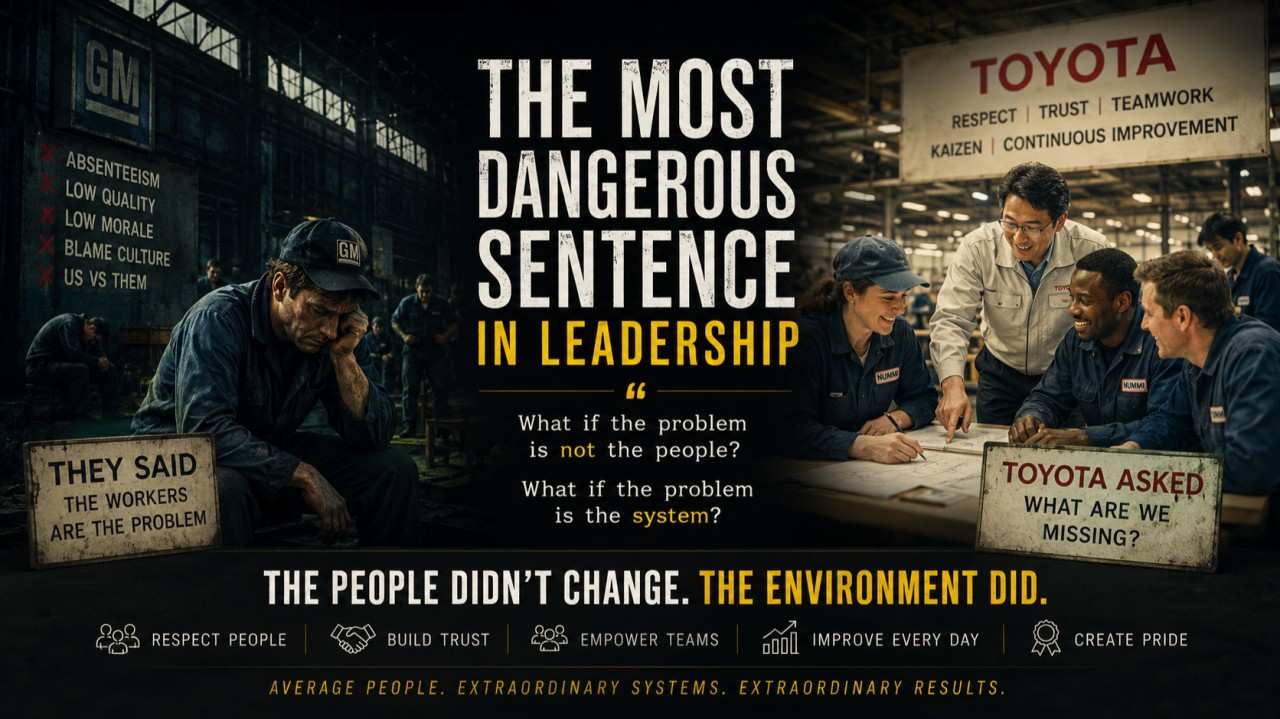
Together, General Motors and Toyota reopened an old plant in Fremont, California — a joint venture that would come to be known as NUMMI (New United Motor Manufacturing, Inc.). The factory had a terrible reputation. Its history read like a leadership cautionary tale.
The State of the Fremont Plant
- Absenteeism was chronically high
- Product quality was consistently poor
- Relations between management and workers had broken down entirely
- Workers frequently skipped work without consequence
- Others openly and routinely challenged supervisors
- Many executives had already reached their verdict: the workers were the problem
The factory was considered beyond repair. Most executives had already written off the workforce. The conclusion had been reached before the question had even been properly asked.
“Toyota saw something different.”
Toyota Asked a Different Question
This is where the story becomes one of the most powerful leadership case studies of the twentieth century — not because of what Toyota built, but because of the question it chose to ask.
Most Organisations Ask
“Who do we replace?”
Toyota Asked
“What are we missing?”
That single difference in framing changed everything. Toyota rehired most of the same workers — the same people, the same union, the same factory, the same difficult history. But it introduced something completely different: a different philosophy, a different culture, a different environment, and a fundamentally different way of thinking about what people are capable of when placed inside a well-designed system.
Selected workers and supervisors were sent to Japan. Not to learn how to work harder. But to learn how to think differently. They experienced what many of them had never encountered before in a workplace setting.
Trust
Respect
Teamwork
Problem-Solving
Continuous Improvement
Then Something Remarkable Happened
The Fremont factory — once considered irredeemable — became one of the highest-performing automobile plants in North America.
Quality Improved
Dramatically and consistently
Productivity Increased
Substantially across all metrics
Absenteeism Dropped
The chronic problem disappeared
Relationships Improved
Between management and workers
The same people who had once been labelled troublesome, disengaged, and beyond help suddenly became examples of excellence — cited as models of what a motivated, empowered workforce could achieve.
The Question That Changes Everything
What exactly changed?
Not the workers
Not the location
Not the union
Not the machines
The environment changed. The system changed. The thinking changed.
Perhaps the Problem Was Never the People
This is the question that every senior leader must be willing to sit with. How many employees have we blamed too quickly? How many generations have we misunderstood and written off? How many talented individuals have quietly disengaged — not because they were broken, but because the environment suffocated them?
How many organisations are spending considerable time and resources searching for better people while completely ignoring the broken systems that are producing the very behaviours they are trying to eliminate?
Because behaviour does not exist in isolation. People respond to the environments in which they operate.
Fear destroys initiative. When people are afraid to make mistakes, they stop trying new things. Caution replaces courage. Compliance replaces creativity.
Distrust destroys ownership. People do not take genuine responsibility for outcomes within systems that do not trust them with genuine authority.
Micromanagement destroys accountability. When every decision must be approved, people stop making decisions. They wait. They defer. They disengage.
Short-term thinking destroys long-term preparedness. Organisations that optimise exclusively for this quarter cannot build the capabilities they will need for the next decade.
Broken systems create broken behaviours. And no amount of motivational speeches, team-building exercises, or replacement hiring can compensate for poor organisational design. This is not a human problem. It is a systems and thinking problem.
This Is Not a Human Problem
It is tempting to blame people. People are visible. Systems are not. People are easy to criticise. Assumptions are harder to confront. But history repeatedly teaches us something profound and slightly uncomfortable.
Extraordinary people trapped inside broken systems eventually become average.
Average people placed inside extraordinary systems often become exceptional.
Strategic Foresight Begins With Better Questions
Over the years, I have observed two kinds of leaders. The difference between them is not intelligence, experience, or even ambition. It is the questions they choose to ask when things go wrong.
That is where strategic foresight truly begins. Not with answers. But with better questions. Because the quality of our future depends, above all else, on the quality of our thinking today.
The Most Dangerous Sentence in Leadership
Perhaps the most dangerous sentence in leadership is not “We have a people problem.” It is believing that statement without first examining the system that produced it.
Because the history of leadership is full of organisations that have spent enormous energy trying to change their people. Far fewer have had the courage — or the self-awareness — to change themselves.
The Real Leadership Question
Most organisations are trying to transform people. Very few are willing to transform the assumptions that created the problem in the first place.
And perhaps that is why the future rarely belongs to those who blame. It belongs to those who redesign.
Because sometimes the greatest disruption we face is not technology. It is not Artificial Intelligence. It is not demographics. It is not geopolitics. It is the assumptions we refuse to question.
Are You Ready to Examine the System — Not Just the People?
At Invictus Leader, we work with senior executives and leadership teams to challenge the assumptions, redesign the systems, and develop the strategic foresight needed to build organisations that are genuinely ready for what comes next — not just what worked in the past.
Conclusion: The People Are Not Broken. The System Is.
The story of the Fremont factory is not simply a story about Toyota. It is a story about what happens when leadership is willing to ask a genuinely different question. When an organisation stops asking “who do we replace?” and starts asking “what are we missing?” — the possibilities that emerge are often extraordinary.
The same workers. The same factory. The same union. A completely different outcome — because the environment, the system, and the thinking changed.
For every leader reading this: the next time you find yourself reaching for a people explanation — pause. Ask whether you have fully examined the system that produced the behaviour you are trying to change. Ask whether the assumptions you are operating under still hold. Ask the question that most leaders are too busy, too comfortable, or too certain to ask.
Key Takeaways from This Article
- What organisations label a “talent problem” is very often a thinking problem at the leadership level
- Toyota’s NUMMI experiment proved that the same people can perform exceptionally when placed inside a well-designed system
- Fear, distrust, micromanagement, and short-term thinking create the very behaviours leaders then blame on their people
- The most dangerous sentence in leadership is believing “we have a people problem” without first examining the system
- Strategic foresight begins not with answers, but with the quality of the questions leaders choose to ask
- The future belongs to those who redesign — not those who blame
About The Future Preparedness Series
This article is part of a series exploring why many organisations are preparing for the future using assumptions that no longer hold.
Coming Next — Article One: We Thought It Was a Talent Problem. It Wasn’t.
Frequently Asked Questions
Common questions about the most dangerous sentence in leadership, organisational systems, and the thinking behind genuine future preparedness.
What is the most dangerous sentence in leadership according to this article?
The most dangerous sentence in leadership is not a single phrase like “we’ve always done it this way” — it is the belief: “We have a people problem.” Specifically, the danger lies in accepting that statement without first rigorously examining the system, culture, and assumptions that produced the behaviour being labelled as a people problem. Leaders who skip this examination consistently misdiagnose their most critical organisational challenges.
What is the NUMMI factory experiment and why does it matter for leadership?
The NUMMI (New United Motor Manufacturing, Inc.) experiment was a joint venture between General Motors and Toyota that reopened a notoriously underperforming factory in Fremont, California in the 1980s. Toyota rehired most of the same workers who had previously been labelled troublesome and unproductive — and through a completely different management philosophy built around trust, respect, teamwork, and continuous improvement, transformed the plant into one of the highest-performing automobile factories in North America. The same people. A completely different system. A completely different result. For leaders, the lesson is clear: the system and the culture determine performance far more than the individuals within them.
How do broken organisational systems produce poor employee behaviour?
Behaviour does not exist in isolation — it is a response to the environment in which people operate. Broken systems produce broken behaviours through predictable mechanisms: fear destroys initiative, distrust destroys ownership, micromanagement destroys accountability, and short-term thinking destroys long-term preparedness. When organisations observe these behaviours and attribute them to individual character flaws rather than systemic causes, they compound the problem by replacing people rather than redesigning the environment that produced those behaviours in the first place.
What is the difference between a people problem and a thinking problem in leadership?
A people problem assumes that the root cause of an organisational challenge lies in the individuals involved — their attitude, capability, or motivation. A thinking problem, by contrast, recognises that the root cause lies in the assumptions, frameworks, and mental models that leaders are applying to understand and diagnose the situation. Most so-called people problems are actually thinking problems: the leader’s assumptions about why people behave as they do, what motivates people, and what kind of environment people need to perform at their best are simply wrong or outdated.
What questions do the most effective leaders ask when performance problems arise?
The most effective leaders resist the instinct to immediately ask “who is responsible?” or “who do we replace?” Instead, they ask: What are we missing? What assumptions are we making? Could the problem we are trying to solve not be the real problem? These questions represent a fundamentally different orientation to leadership — one rooted in curiosity and systemic thinking rather than attribution and blame. They are the questions from which genuine strategic foresight and organisational transformation emerge.
Why do organisations consistently blame people instead of examining systems?
There are several reinforcing reasons. First, people are visible and systems are not — it is cognitively easier to point to an individual than to map and question an invisible web of processes, incentives, and cultural norms. Second, examining systems requires leaders to confront their own assumptions and decisions, which is uncomfortable and threatening to identity. Third, replacing a person feels like action — it gives the impression that something decisive is being done. Examining a system, by contrast, is slower, more ambiguous, and offers no clear moment of resolution. The path of least resistance is almost always to blame the person.
What did Toyota do differently at the Fremont factory that General Motors had not?
Toyota introduced an entirely different management philosophy — one built on trust, respect, genuine teamwork, structured problem-solving, and continuous improvement (Kaizen). Workers and supervisors were sent to Japan not to learn to work harder, but to experience a fundamentally different relationship between management and workforce. Toyota treated workers as intelligent participants in the improvement of the system, not as interchangeable units to be managed and monitored. This shift in the operating philosophy — not any change in the people, machinery, or location — produced the dramatic transformation in performance that followed.
How does strategic foresight connect to the quality of questions leaders ask?
Strategic foresight is the capacity to anticipate the future with sufficient clarity and nuance to make better decisions today. It begins not with data or technology, but with the quality of the questions a leader is willing to ask. Leaders who ask “who failed?” are oriented toward the past. Leaders who ask “what assumptions are we making?” are oriented toward genuine understanding. And leaders who ask “could the problem we are trying to solve not be the real problem?” are operating at the level of strategic foresight — challenging not just the surface challenge, but the mental models through which the challenge is being perceived.
What assumptions do most organisations refuse to question about their people and performance?
The most common unexamined assumptions include: that younger generations are inherently less motivated or committed; that disengagement is a personal choice rather than an environmental response; that high absenteeism reflects individual character rather than systemic failure; that talent scarcity is an external market condition rather than a reflection of what the organisation offers; and that the values and working preferences of previous generations represent a universal standard against which all employees should be measured. Each of these assumptions, when left unexamined, leads organisations to invest in the wrong solutions and miss the real problems entirely.
How can leaders begin to shift from blaming people to redesigning systems?
The shift begins with a deliberate practice of questioning. Before attributing any performance challenge to individual failure, leaders should ask: What system, process, or culture produced this behaviour? What incentives are people responding to? What is the environment actually rewarding or punishing? What assumptions have we built into our management approach that may no longer hold? From there, practical steps include conducting honest audits of existing processes and incentive structures, actively seeking input from people at all levels of the organisation, and engaging in leadership development that builds the capacity for systems thinking and self-examination. The organisations that do this consistently are the ones that build genuinely future-ready cultures.