Introduction: The Moment Everything Changed
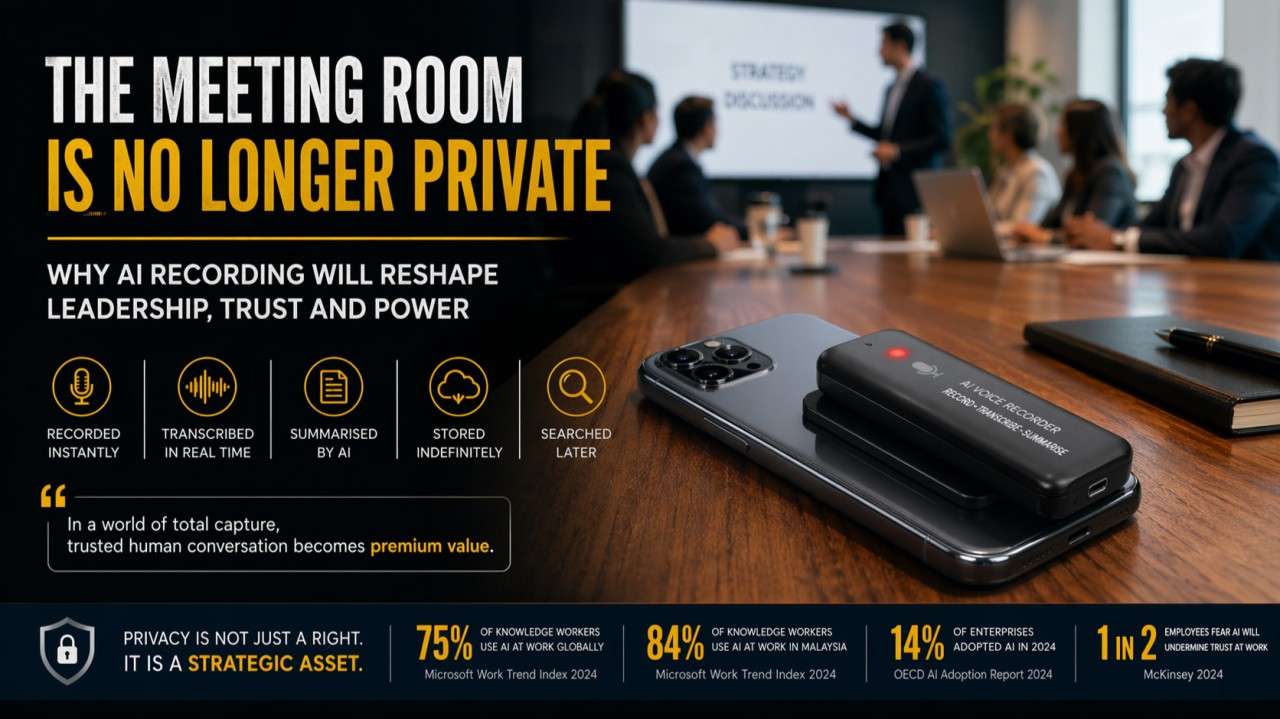
During a recent Invictus Foresight Dialogue, something small happened that revealed something very large. A participant had placed a phone on the table. When it was picked up to illustrate a scenario, it felt unusually heavy. Attached magnetically to the back was a separate device — not a battery pack, not a phone case, but a dedicated recording and dictation unit. Its sole purpose: capture every word spoken in the room, transcribe it in real time, summarise the conversation, and convert live human exchange into searchable, permanent data.
No consent had been requested. No announcement had been made. When concern was raised, the response was almost reflexive:
“It is common now.”
That sentence — casual, matter-of-fact, utterly untroubled — may prove to be one of the defining statements of the AI era. Because many things become common long before society decides whether they are wise. And what happened in that room was not merely a breach of courtesy. It was a signal of a structural shift now unfolding inside every boardroom, meeting room, coaching session, and leadership retreat across the world: the meeting room is no longer private.
The Silent Shift Most Leaders Have Not Understood
For decades, the meeting room operated under an unspoken contract. People spoke freely. Others forgot selectively. Notes were incomplete by nature. Context lived in memory. Tone mattered. Nuance survived because it was never captured in full. Some things — rightly — remained in the room.
That model is disappearing with remarkable speed.
We are entering an age where any workplace conversation can now be recorded automatically, transcribed instantly, summarised by AI, archived permanently, searched at will, forwarded widely, analysed for behavioural patterns, and resurfaced years later entirely stripped of the context in which it was first spoken.
This is not merely a productivity tool. It is a structural redesign of how power operates inside organisations — and most leaders have yet to fully reckon with what that means for the people they lead, the conversations they depend on, and the culture they are quietly shaping with every policy they choose not to make.
The implication runs far deeper than legal compliance or IT governance. It reaches into the very psychology of how human beings think, speak, take risks, and lead — when they know, or merely suspect, that everything they say may eventually be data.
AI Adoption Is Rising Faster Than Governance
The evidence is not anecdotal. The global workplace has moved into AI experimentation at a pace that governance frameworks have consistently failed to match.
(Microsoft Work Trend Index, 2024)
(Microsoft, 2024)
Critically, Microsoft’s research also found that many employees were actively bringing their own unapproved AI tools into the workplace — creating governance and data risks that most organisations had not anticipated, let alone addressed. OECD data further confirms that while enterprise AI adoption has risen sharply across member countries, governance maturity has consistently lagged behind deployment speed.
When technology adoption outpaces policy, culture becomes the casualty. The tools arrive before the norms. The norms arrive before the governance. The governance arrives after the damage has already been done.
Trust Is an Economic Asset — Not a Soft Concern
Most executives, when confronted with the rise of ambient AI recording, instinctively ask one question: “How can AI improve our productivity?”
A more strategically intelligent question is this: “What happens to our organisation when employees believe that every word they speak may be captured, stored, and eventually used?”
That question goes to the economic heart of organisational performance. And the answer is uncomfortable. Innovation requires unfinished, half-formed, occasionally wrong ideas spoken aloud. Strategy requires genuine dissent and the freedom to think dangerously before committing. Leadership requires candour that would look reckless in transcript form. Coaching requires the vulnerability of admitting what you do not yet know. Learning requires the freedom to make mistakes without those mistakes becoming permanent record.
When people suspect — even without certainty — that silent recording may be occurring, behavioural change is immediate and measurable. They become careful rather than creative. Polite rather than honest. Defensive rather than exploratory. Performative rather than genuine. The room still looks normal from the outside. The agenda still runs on schedule. But psychologically, the meeting has already failed before it begins — because the psychological safety that makes real conversation possible has quietly dissolved.
The room still looks normal. But psychologically, the meeting has already failed — because the safety that makes real conversation possible has quietly dissolved.
McKinsey research confirms what many leaders sense but few articulate: while organisations are pushing for faster AI adoption, employees remain deeply concerned about trust, inaccuracy, and data security. Those concerns are not irrational. They are accurate responses to a genuinely changed environment. At Invictus Leader, the view has long been that psychological safety is not a human resources metric — it is a strategic performance variable, and one that ambient AI recording is now quietly placing under serious threat.
The New Corporate Risks No One Put on the Risk Register
Uncontrolled AI recording does not merely affect culture. It creates concrete, material risks that many boards have not yet fully assessed — and almost none have formally priced into their enterprise risk frameworks.
Intellectual Property Leakage
Strategy discussions, product roadmaps, pricing decisions, M&A deliberations, and internal vulnerabilities can be stored outside company-controlled systems — invisible to legal and IT teams.
Legal Exposure
Recording consent laws vary significantly across jurisdictions. Cross-border and hybrid teams substantially increase compliance complexity in ways most legal departments have not yet mapped.
Cultural Erosion
Once employees assume ambient surveillance, trust declines quietly and persistently — not in a dramatic event, but in the slow daily withdrawal of candour, risk-taking, and genuine dialogue.
False Precision
AI-generated summaries frequently produce confident-sounding output that omits nuance, misreads tone, and presents incomplete context as settled fact — with consequences that can persist long after the original conversation.
Leadership Paralysis
Executives begin to avoid the difficult, ambiguous, exploratory conversations that leadership genuinely requires — because every sentence risks becoming discoverable, quotable data stripped of all context.
Three Plausible Futures — And the One Most Organisations Are Sleepwalking Into
Strategic foresight requires us to look beyond the immediate discomfort and reason about where current trajectories are genuinely leading. Three distinct futures are plausible from where we stand today.
Default Capture World
Every meeting is recorded as standard. AI assistants join calls automatically. Transcripts become the default form of corporate memory. Efficiency metrics improve. Candour falls. Dissent disappears. And organisations optimise for the conversations that were safe to have — not the ones that needed to happen.
Trusted Zones Economy
Boards, innovation teams, medical professionals, legal practitioners, and leadership groups establish formally protected no-recording environments. Trust becomes a deliberate competitive moat. Organisations that preserve genuine dialogue consistently outperform those that traded candour for data capture.
Memory Warfare
Archived transcripts are resurfaced years later in internal disputes, regulatory investigations, political conflicts, litigation, and media leaks. Exploratory conversations become permanent liabilities. The past never fully leaves — and organisations discover that what they recorded in the name of productivity became the evidence used against them.
Many assume the future premium asset is more data. A more considered view suggests the opposite may be true. In a world of ambient recording, private strategic thinking becomes genuinely scarce. Scarcity creates value. The organisations that win may not be those who recorded everything — but those who understood precisely what should never be recorded.
What Smart Organisations Should Do Now
This is not a call to reject technology. AI recording and transcription tools have real, legitimate value when governed well. The issue is not the capability — it is the absence of deliberate, intelligent frameworks for when and how it should be used. Regenerative leadership demands that organisations get ahead of this, rather than waiting for a crisis to force their hand.
Governance: Build the Policy Foundation
- Establish explicit, written consent policies for any AI recording of meetings or conversations — and make them visible, not buried in policy documents.
- Define categories of conversation that are explicitly recording-prohibited: strategy sessions, coaching conversations, board deliberations, sensitive HR matters.
- Approve only enterprise-grade AI tools with clear data residency, retention, and deletion policies — and prohibit the use of personal devices for organisational recording.
- Set formal deletion schedules and retention rules. Not every transcript needs to exist indefinitely — and many should not.
Leadership: Protect the Conversations That Matter Most
- Create deliberately device-free strategic sessions where genuine exploratory thinking can occur without the inhibiting presence of recording.
- Separate brainstorming and ideation from formally documented decisions — not every stage of thinking should be treated as an official record.
- Protect coaching, mentoring, and sensitive one-to-one conversations as explicitly confidential — and signal that protection clearly and consistently.
Culture: Build Trust Before Technology Erodes It
- Educate teams on the ethics of AI note-taking — what is appropriate, what is not, and why the distinction matters beyond mere compliance.
- Clarify privacy expectations explicitly and repeatedly — because silence on the subject is itself a policy, and not a wise one.
- Build trust deliberately and proactively, before technology scales distrust accidentally — because recovering lost psychological safety is far harder than preserving it.
Conclusion: Privacy Was Always a Strategic Asset
Technology is not the enemy. Undisciplined adoption is. The issue is not whether AI can transcribe a meeting. The issue is whether leaders understand what is genuinely lost when every spoken word becomes searchable data — and whether they are willing to make the conscious, courageous choices to prevent that loss from becoming permanent.
Yesterday, it was one device attached to a phone in a workshop room. Tomorrow it may be every boardroom, every classroom, every hospital consultation, every negotiation room, and every leadership retreat on the planet. And many organisations will only realise too late that what they called a productivity upgrade was quietly dismantling the very foundation their performance depended on.
Privacy was never merely a legal matter. It was a strategic asset. It was a leadership discipline. It was the invisible architecture of trust that allowed organisations to think dangerously, speak honestly, and lead courageously — without fear that every word would one day be data.
The organisations that win may not be those who recorded everything. They may be those wise enough to know precisely what should never be recorded.
For leaders committed to building organisations where trust is not an accident but a deliberate strategic choice, exploring the principles behind genuine foresight-led leadership remains one of the most important investments of this era. The meeting room may no longer be private by default. But by design, it still can be.
Ready to Lead in the Age of Ambient AI?
Explore frameworks and foresight principles designed to help leaders build trust, protect strategic thinking, and navigate the AI era with clarity and integrity.
Explore Invictus Leader