


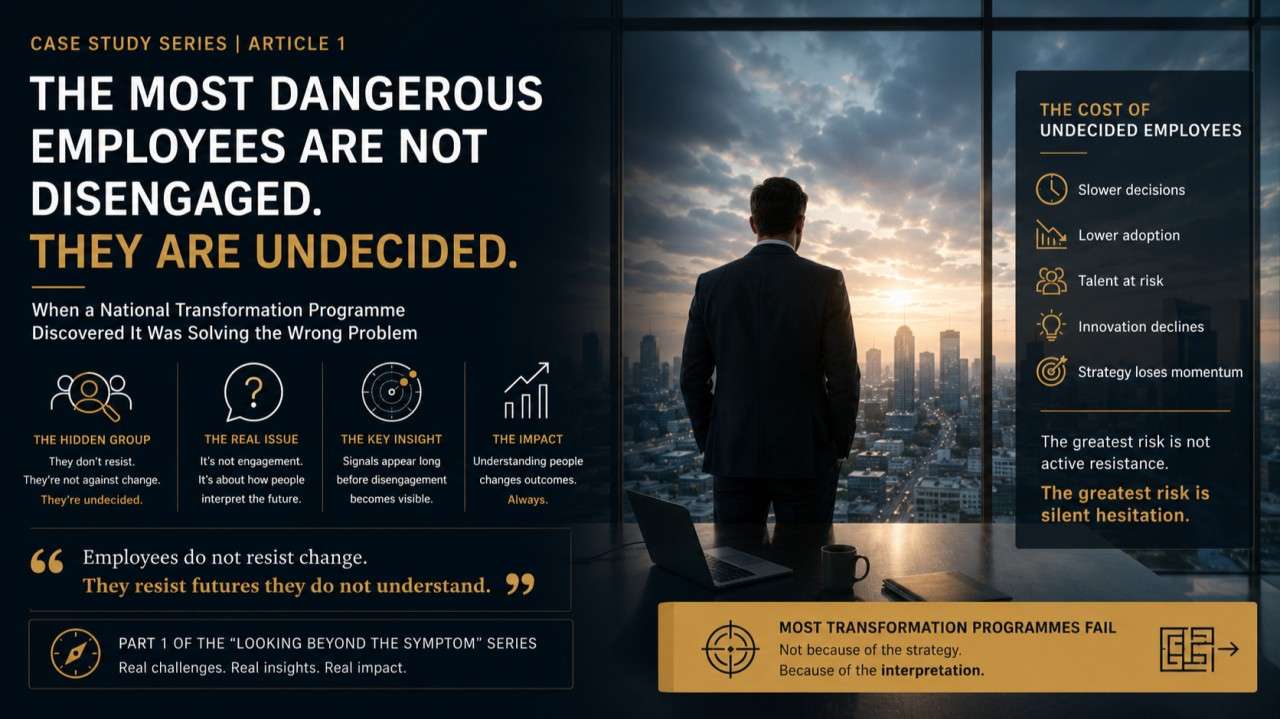
Introduction: The Employee Risk No One Talks About
Ask most executives about their workforce risks and they will point to actively disengaged employees — the ones who complain loudly, underdeliver consistently, or are visibly checked out. Disengagement is a recognized problem. It has a name, a cost estimate, and a growing library of solutions. But there is a category of employee that rarely appears on the risk radar, and that invisibility is precisely what makes them so dangerous: the undecided employee.
These are not disengaged workers. They have not given up. They have not quit quietly or loudly. They are still present, still capable, and still watching — weighing whether your organization deserves their best, their loyalty, and their future. They sit at an inflection point, and which way they tip will determine far more about your organization’s performance, culture, and resilience than you might expect.
This article examines why undecided employees represent the most underestimated threat in the modern workplace, what drives their ambivalence, and what executive leaders can do to turn that uncertainty into enduring commitment — before someone else does.
Understanding the Employee Engagement Spectrum
Workplace engagement has traditionally been mapped across three broad categories. Understanding these distinctions is the foundation for grasping why undecided employees occupy such a uniquely critical position.
Global research paints a sobering picture of where most employees actually fall. According to ManpowerGroup’s Right Management research, while 53% of leaders believe their employees are fully engaged, only 37% of employees report full engagement — with 41% actively disengaged. That gap between perception and reality is where undecided employees hide in plain sight. Leaders assume capability means commitment. It rarely does.
Why Undecided Employees Are the Real Threat
The disengaged employee has already reached a verdict. They have made their decision — consciously or not — to withdraw. That clarity, while destructive in its own right, is at least identifiable. The undecided employee has reached no verdict at all. They are actively assessing, and the outcome of that assessment depends almost entirely on what leadership does next.
Here is why this matters more than most organizations realize:
1. They Are Often Your Most Capable People
Undecided employees are frequently mid-to-senior performers who have enough talent and self-awareness to know their worth. They are not passive — they are evaluating. They see organizational friction, leadership gaps, and limited growth pathways with crystalline clarity. Research consistently shows that the mid-tenure window — roughly years three to five — is when employees are both most productive and most vulnerable to disengagement, precisely because they are experienced enough to see what is broken but lack the authority to fix it. These are not passengers. They are pilots who have not yet decided whether to fly your plane or someone else’s.
2. Their Departure Is Silent and Devastating
Unlike actively disengaged employees who signal their unhappiness loudly before leaving, undecided employees typically leave without adequate warning. One day they are attending meetings, delivering work, and appearing committed. The next, they submit a resignation that blindsides leadership. The organization loses institutional knowledge, client relationships, and team momentum overnight — with no opportunity to course-correct.
3. They Influence Others Before They Leave
Undecided employees occupy a unique social position in organizations. They are credible, respected, and connected. When they begin privately signaling their ambivalence to peers — and they invariably do — the effect is contagious. Research from Gallup confirms that disengagement spreads. A single undecided employee with strong informal influence can shift the cultural temperature of an entire team long before any formal exit occurs.
4. They Are Recruiters’ Prime Targets
Talent acquisition professionals know exactly who undecided employees are. They are the LinkedIn profiles with impressive tenures, strong performance signals, and an open-to-opportunities indicator that is easy to read between the lines. Competitors and headhunters actively pursue people sitting on the engagement fence. If your leadership culture is not actively providing compelling reasons to stay, the external market will gladly provide compelling reasons to leave.
Key Insight
The cost of employee disengagement to the global economy is estimated at $8.8 trillion — equivalent to 9% of global GDP, according to Gallup. The undecided segment represents a significant and preventable portion of that loss, because their exit is not yet inevitable.
Early Warning Signs of an Undecided Workforce
Identifying undecided employees before they tip toward disengagement — or departure — requires a different kind of organizational awareness. They will not announce their ambivalence in a survey, and they rarely discuss it in one-on-ones. But the signals are present if leaders know what to observe.
Behavioral Indicators to Watch
- Conditional participation: Contributing in some contexts while visibly pulling back in others — engaged in technical work, withdrawn from strategy conversations or culture-building activities.
- Reduced discretionary effort: Meeting expectations precisely, but no longer going beyond them. The employee who once proposed ideas now waits to be asked.
- Shifts in communication frequency: Taking longer to respond to messages, becoming quieter in team discussions, or gradually disengaging from informal social interactions.
- Increased professional visibility externally: Updating LinkedIn, attending industry events with unusual frequency, networking beyond their usual scope.
- Surface-level positivity masking ambivalence: Employees who appear agreeable in meetings but privately express doubt to trusted peers are among the most difficult to identify — and the most likely to be undecided.
- Career conversation avoidance: Deliberately deflecting discussions about promotion, development, or long-term role evolution within the organization.
The challenge for organizational leaders is that many of these signals overlap with high-performance focus or healthy work-life boundaries. Context and pattern recognition matter more than any single indicator. The key question to ask: is this person’s energy directional — are they moving toward something within this organization, or simply remaining in place?
The Organizational Cost of Not Deciding — for Leaders, Not Just Employees
The framing of “undecided employees” often places the burden of decision on the individual. But organizations have their own version of indecision — a failure to create the conditions that compel people to choose commitment over ambivalence. Leadership indecision and organizational ambiguity are primary drivers of employee ambivalence. When leaders fail to decide, employees are forced to decide instead.
What Organizational Indecision Looks Like
- Unclear career pathways and development frameworks that leave employees guessing about their future
- Change initiatives launched without adequate communication, creating uncertainty that skilled employees interpret as instability
- Inconsistent recognition practices where performance is rewarded selectively and unpredictably
- Leadership messaging that speaks to engagement without creating the structural conditions for it
- Managers who are themselves disengaged — Gallup research confirms that 70% of team engagement is directly attributable to the manager, and fewer than 44% of managers globally receive appropriate management training
37%
of employees globally report being fully engaged at work
70%
of team engagement variance is attributable to the direct manager
$8.8T
in annual global GDP lost to employee disengagement (Gallup)
When an undecided employee tips into full disengagement, the financial cost begins to compound. Replacement costs for a single mid-level employee routinely reach 50–200% of annual salary when recruitment, onboarding, lost productivity, and cultural disruption are factored together. Multiply that across a workforce where the undecided segment is consistently underestimated, and the scale of the opportunity becomes starkly clear.
The Leadership Role in Converting Undecided Employees
The most important variable in an undecided employee’s decision is not compensation, not perks, and not remote work flexibility. It is leadership. More specifically, it is the quality of the relationship between an employee and the people who hold formal power over their experience at work. This is not a soft finding — it is one of the most consistently replicated results across decades of organizational research.
What Leaders of Undecided Employees Must Do Differently
Create Psychological Safety for Honest Conversation
Undecided employees will not surface their ambivalence unless they believe it is safe to do so. A culture where concern is punished with increased scrutiny — or worse, overlooked — pushes uncertainty underground. Executive leaders who create genuine forums for candid dialogue give undecided employees a reason to express, rather than suppress, their doubts. Expression is the first step toward resolution.
Make Development Pathways Visible and Real
One of the most powerful drivers of undecided status is a perceived ceiling. When employees cannot visualize a compelling future for themselves within the organization, they begin to construct one elsewhere. Leadership development programs, mentoring structures, and transparent promotion criteria are not HR amenities — they are retention architecture for your most capable people.
Connect Individuals to Organizational Purpose
Research repeatedly identifies meaning as a core engagement driver. Employees who understand not just what they do but why it matters — and how their specific contribution connects to something larger — are significantly more likely to choose commitment over ambivalence. This requires leaders who can articulate organizational purpose with precision and sincerity, and who take the time to translate that purpose into individual context.
Act on Feedback, Not Just Gather It
Organizations that survey employee sentiment without visibly acting on what they learn accelerate disengagement rather than address it. Undecided employees watch what happens after they speak. If nothing changes, the cost of expressing concern becomes clear — and future honesty becomes far less likely. The act of listening is only as valuable as the follow-through it produces.
Proven Strategies to Re-Engage Undecided Talent
Converting undecided employees into genuinely committed contributors requires deliberate, sustained leadership action — not a one-time initiative or an annual engagement survey. The following strategies represent what leading organizations do consistently to shift ambivalence toward alignment.
Intentional Stay Conversations
Replace exit interviews with proactive stay conversations. Ask directly: what keeps you here? What would make this role more compelling? What would make you leave? These are not comfortable conversations — they are necessary ones.
Real-Time Engagement Sensing
Annual surveys do not capture the moment an undecided employee begins to tip. Pulse surveys, ongoing manager check-ins, and informal culture sensing must become embedded practices — not periodic events.
Manager Development as Priority One
Given that managers account for 70% of engagement variance, equipping them with the emotional intelligence, coaching capability, and feedback skills to lead undecided employees is arguably the highest-leverage organizational investment available.
Structured Recognition Architecture
Recognition that is specific, timely, and connected to organizational values does more to reinforce commitment than generalized praise. Undecided employees need to feel that their contribution is seen, understood, and valued — not just noted.
Transparent Growth and Career Mapping
Organizations that make internal mobility pathways visible — rather than available only to those who already know the right people — give undecided employees a concrete reason to see their future here, not elsewhere. Clarity is a retention tool.
Culture as a Daily Leadership Practice
Culture is not created by values posters or offsite workshops. It is created by the aggregate of leadership behaviors on an ordinary Tuesday. Undecided employees are culture-watchers. What they observe in how leaders behave under pressure, ambiguity, and conflict will form their final verdict.
The Role of Organizational Authenticity
There is one final factor that underpins all of the above: authenticity. Undecided employees are perceptive. They distinguish between organizations that genuinely invest in their people and those that deploy engagement as a performance. The former inspires commitment; the latter accelerates departure. Leadership advisory and organizational development efforts that help executives operate with authentic, consistent intent are not optional extras in this environment — they are strategic necessities.
Organizations with high levels of trust between employees and leadership see measurably better engagement, retention, and performance outcomes. Trust is not a byproduct of good intentions. It is built through behavioral consistency, transparent communication, and the courage to have difficult conversations before a resignation forces them.
Is Your Organisation Losing Its Best People to Ambivalence?
At Invictus Leader, we partner with executive teams to build leadership cultures that convert undecided employees into your most committed contributors — before the market does it for you.
Conclusion: The Decision That Matters Most Is Yours
The most dangerous employees in your organization are not the ones who have already left in spirit. They are the ones who have not yet decided — the talented, capable, visible contributors who are still watching, still weighing, and still open to being genuinely inspired by the place they work.
Disengaged employees are a known cost. Undecided employees are a hidden opportunity — but only for organizations with the leadership maturity to see them clearly and act decisively. The window to influence their decision is real, but it is not indefinite.
Every day that passes without intentional leadership attention is a day that the external market gains ground. The organizations that thrive in the coming decade will not be those with the most sophisticated engagement surveys. They will be those with leaders who create the kind of clarity, trust, and growth that make the decision to stay the easiest one an employee ever makes.
The question is not whether your undecided employees are deciding. They already are. The question is whether your leadership culture is part of that conversation — or absent from it entirely.
Frequently Asked Questions
Below are the most common questions organizations ask about undecided employees, workforce engagement, and leadership strategies for building high-commitment cultures.
An undecided employee is someone who is still capable, still present, and still contributing — but has not made a firm psychological commitment to the organization. Unlike a disengaged employee who has largely withdrawn their effort and emotional investment, an undecided employee is actively weighing whether to deepen their commitment or begin the process of leaving. They are in a state of active evaluation, which means their outcome is still influenceable by leadership — making them fundamentally different from, and in many ways more valuable than, already-disengaged workers who require far more effort to recover.
Actively disengaged employees are visible. Their disruptive behavior, low output, and negative communication patterns are observable and addressable. Undecided employees, by contrast, often appear externally engaged while internally weighing their options. Because they are frequently among the most capable and credible people in the organization, their eventual departure — when it comes — is often a surprise that triggers cascading consequences: talent loss, team disruption, client relationship gaps, and morale damage. The hidden nature of their ambivalence is precisely what elevates their risk profile above that of employees whose disengagement has already become apparent.
The most common drivers of undecided status in high performers include: unclear or stalled career pathways, insufficient recognition for contributions, organizational ambiguity or poor communication during change, a breakdown in trust with direct management, a perceived gap between stated values and observed leadership behavior, and a growing sense that the organization is not investing in their growth at the same rate they are investing in the organization. These factors often compound during the mid-tenure years (three to five years) when employees are experienced enough to see systemic problems clearly but may lack the positional authority to address them.
Identifying undecided employees requires behavioral observation and conversational intelligence rather than survey data alone. Watch for: reduced discretionary effort despite baseline performance remaining intact; increasing external professional visibility; withdrawal from non-mandatory cultural activities; slower response times and reduced initiative in communication; and avoidance of forward-looking career conversations. Equally important is creating the psychological safety conditions under which employees feel comfortable raising concerns before they become irreversible decisions. Leaders who hold regular, genuine stay conversations are far better positioned to detect ambivalence early enough to act.
Management quality is arguably the most significant variable in the undecided employee equation. Gallup’s research consistently shows that 70% of team engagement variance is directly attributable to the direct manager — not company-wide policies, compensation structures, or culture programs in isolation. An employee may be undecided about the organization but will choose to stay for a great manager. Conversely, even employees highly aligned with an organization’s mission will tip toward departure if their day-to-day manager relationship is poor. Investing in manager development — specifically in coaching capability, emotional intelligence, and meaningful feedback skills — is the most efficient lever organizations have to reduce undecided risk.
The financial cost is substantial and multi-dimensional. Direct costs include recruitment fees, onboarding expenses, and the productivity gap during a new hire’s ramp-up period. Indirect costs — often more significant — include the loss of institutional knowledge, disrupted client relationships, reduced team morale, and the cultural contagion that follows when credible and capable employees depart. Replacing a mid-level employee typically costs between 50% and 200% of their annual salary. Gallup estimates that disengagement costs the global economy $8.8 trillion annually. Undecided employees who tip into disengagement and then exit represent a preventable share of that cost — one that proactive leadership can measurably reduce.
Culture is a primary incubator of undecided status. When the lived organizational culture diverges significantly from the espoused values — when leaders speak about inclusion but practices suggest otherwise, or when meritocracy is promoted but advancement is clearly political — thoughtful employees become cultural skeptics. Their ambivalence is not indifference; it is a rational response to observed inconsistency. Organizations with low psychological safety, inconsistent recognition practices, poor transparency during change, and unclear purpose messaging systematically generate undecided employees regardless of how strong their compensation packages or employer brand may be. Culture alignment between what is said and what is done is the foundation of a committed workforce.
A stay conversation is a proactive, structured dialogue between a manager and a valued employee, designed to understand what is working, what is not, and what would make the employee’s experience more compelling and sustainable. Unlike exit interviews — which gather information after a decision has already been made — stay conversations intervene while the employee’s commitment is still influenceable. Effective stay conversations ask direct questions about career aspirations, current frictions, the quality of the employee’s working relationships, and what the organization would need to change for the employee to see their long-term future here. They are only effective when leaders follow through on what they hear.
Prevention is more cost-effective than recovery. Organizations that consistently prevent undecided status from taking hold share several characteristics: they make career pathways transparent and accessible; they invest substantively in manager capability; they create psychological safety structures where candid communication is genuinely welcome; they recognize contributions in specific, timely, and meaningful ways; they communicate organizational purpose in terms that connect to individual roles; and they act visibly on employee feedback. Critically, they treat engagement not as an HR program but as a core leadership responsibility embedded in how decisions are made, how people are developed, and how the organization communicates during uncertainty.
Leadership development is the structural answer to the undecided employee problem. Undecided employees are, at their core, responding to a leadership environment that has not yet given them sufficient reason to fully commit. When organizations invest in developing leaders who communicate with clarity, coach with genuine intent, create real growth opportunities, and operate with behavioral consistency between their words and actions, the conditions that generate ambivalence are systematically reduced. Leadership advisory programs that develop these capabilities at the executive and mid-management level are not talent luxuries — they are direct interventions in the engagement and retention of an organization’s most valuable people.


