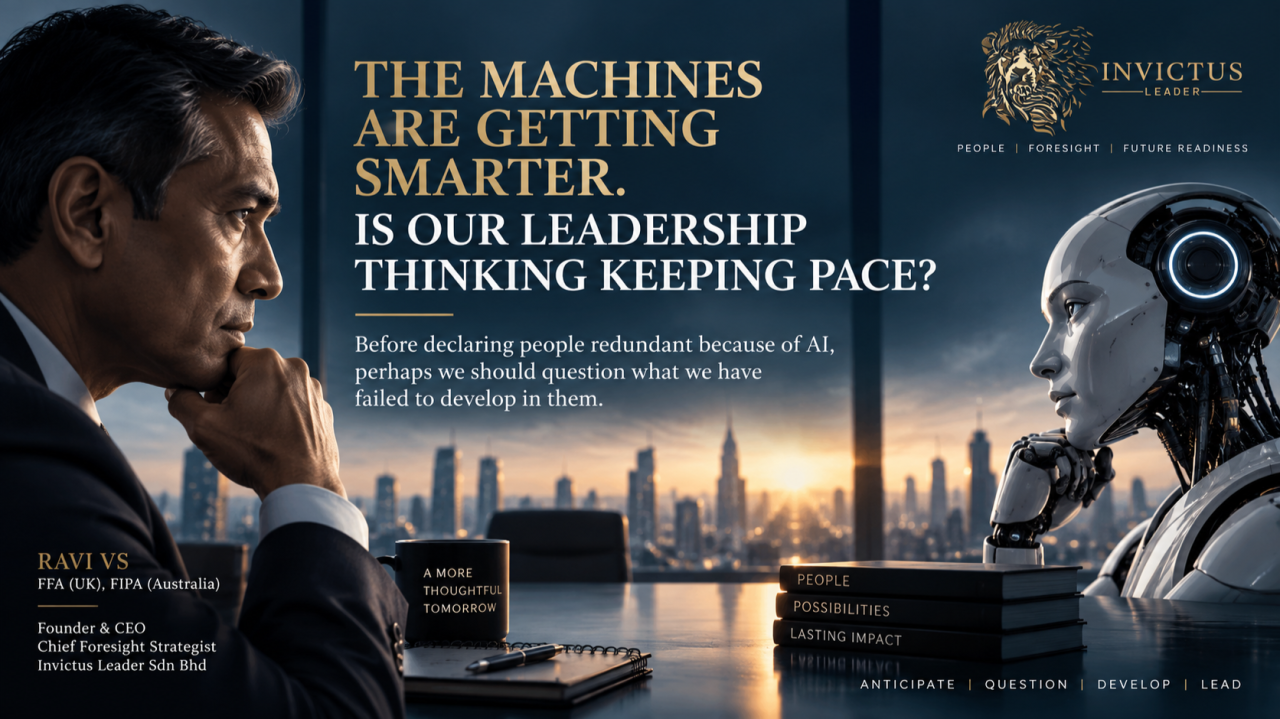
The Machines Are Getting Smarter. Is Our Leadership Thinking Keeping Pace?
A machine can now draft a contract clause, summarise a customer complaint, generate a financial forecast, or answer a support ticket faster than most people ever could. That part of the story is well told. The part that gets far less attention is what happens next, inside the organisation, to the people who used to do that work.
Do they simply become surplus to requirement? Or do they become available for something the organisation never had the capacity to do before?
This is not a rhetorical flourish. It is a genuine strategic fork, and most organisations are making the choice by default rather than by design. When a task is automated, the easiest decision is to remove the role attached to it and book the saving. The harder, more consequential decision is to ask what that person could now become capable of doing, and whether the organisation is prepared to invest in finding out.
Machines are getting measurably better at performing tasks. Leadership thinking has not necessarily kept pace with what that improvement makes possible. Boards approve AI budgets, executives commission automation programmes, and workforce plans get redrawn — often without a parallel conversation about capability. The result, in many organisations, is a workforce that is smaller and a leadership team that has not asked whether it is also more capable.
This article examines that gap. It does not argue against AI adoption. It argues that AI adoption, workforce strategy and leadership development are three conversations that are too often held separately — and that the organisations best placed for what comes next are the ones that start holding them together.
Table of Contents
- Introduction
- The Real Question Behind AI-Driven Automation
- When a Task Becomes Redundant, Does the Person Become Redundant?
- Efficiency Is Not the Same as Future Readiness
- Are Organisations Developing People Fast Enough?
- AI as a Tool for Human Capability
- Why More Training Alone Is Not the Answer
- The Role of Strategic Foresight
- Three Workforce Choices Leaders Should Examine
- What Should Boards Ask Before Reducing Workforce?
- Building Organisations That Can Adapt
- What This Means for Leadership
- Frequently Asked Questions
- Conclusion
Introduction
Every organisation now has an AI adoption story. Fewer have a workforce capability story that keeps pace with it. The two are usually written by different teams, on different timelines, reporting to different parts of the business — which is precisely why the gap between them tends to go unnoticed until it becomes expensive.
The common framing of AI adoption asks a narrow question: how many tasks, processes or roles can this technology take on? It is a legitimate question, and one that finance functions are right to ask. But it is not the only question that matters, and answering it well does not automatically answer the more important one: what could the people affected by this technology become capable of doing that they could not do before?
That second question rarely appears on a transformation roadmap. It is harder to quantify, harder to schedule, and harder to attach to a quarterly saving. It is also, increasingly, the question that separates organisations that emerge from AI adoption leaner from those that emerge more capable.
This distinction — leaner versus more capable — runs through the rest of this article. Both outcomes can follow from the same technology investment. Which one an organisation gets depends less on the sophistication of the AI system and more on the deliberateness of the leadership decisions made around it.
The Real Question Behind AI-Driven Automation
Most organisations evaluate AI investment through a familiar lens: productivity gained, cost removed, hours saved, headcount reduced. These are the metrics that appear in business cases, and for good reason — they are measurable, comparable across projects, and legible to a finance committee.
But there is a second dimension to AI adoption that this lens does not capture, because it was never designed to. That dimension is capability creation: the new problems an organisation becomes able to solve, the markets it becomes able to enter, the customer experiences it becomes able to offer, and the forms of judgement and problem-solving it becomes able to apply, once routine work is no longer consuming the time of skilled people.
These two dimensions are not in conflict, but they are answered by different questions, using different evidence, on different timelines. A cost-reduction question can be answered within a single budget cycle. A capability-creation question often cannot be answered at all unless someone in the organisation is explicitly responsible for asking it.
This is where many AI programmes quietly narrow. They are commissioned to answer the first question and are never asked the second. The result is a technology rollout that is judged a success on its own terms — the savings materialise — while the organisation’s broader capability is left unchanged, or even diminished, because the people who might have built that capability were released before anyone considered the possibility.
When a Task Becomes Redundant, Does the Person Become Redundant?
This is arguably the most consequential distinction leadership teams need to make, and it is one that gets collapsed far too often in practice.
A task becoming redundant is a statement about a process. It means a machine can now do that specific piece of work as well as, or better than, a person could. A person becoming redundant is a much larger claim — it says that the individual has nothing further of value to contribute to the organisation. The first claim can be demonstrated with data. The second is a judgement, and it is frequently made by default, simply because no one paused to ask it separately.
Consider an organisation that introduces an AI system and discovers it can competently handle a large share of administrative or repetitive tasks that previously occupied a team. The default response is to treat the affected roles as redundant and adjust headcount accordingly. That may, in some cases, be the right call. But before it becomes the only call considered, there is a broader set of questions worth asking about the people involved:
- What other capabilities do they already possess that this role never called upon?
- What problems, currently unaddressed because no one had the time, could they now help solve?
- What new roles might this technology shift make viable that did not exist before?
- Could they use the same AI tools to become significantly more productive in an adjacent function?
- Could they contribute to innovation, product development or process redesign?
- Could they move into more customer-facing or judgement-intensive work?
- What organisational problems have been chronically under-resourced simply for lack of people?
None of this implies that every employee affected by automation can or should be redeployed. Some tasks disappear because they should. Some organisations are genuinely over-resourced for the work that remains. The purpose of asking these questions is not to guarantee a particular outcome — it is to make sure the decision about people is actually made, deliberately, rather than inherited automatically from a decision about tasks.
Efficiency Is Not the Same as Future Readiness
An organisation can become smaller, cheaper, faster and more automated without becoming more adaptable, more innovative, more resilient, or better prepared for uncertainty. These are not the same achievement, even though they are frequently reported using the same language of “transformation.”
Efficiency gains are visible almost immediately and are easy to defend in a board pack. Future readiness is harder to observe in the short term and only becomes apparent when the organisation is tested by a shift it did not plan for — a new competitor, a changed customer expectation, a regulatory shock, or the next wave of the very technology it just used to cut costs.
The table below sets out the practical difference between the two orientations. Most organisations are not choosing one over the other consciously; they are defaulting to the efficiency column because it is the one their existing planning and reporting cycles are built to measure.
| Efficiency Focus | Future Readiness Focus |
|---|---|
| Cost reduction | Capability development |
| Automation | Human + technology collaboration |
| Headcount optimisation | Workforce redeployment |
| Existing processes | Emerging opportunities |
| Short-term savings | Long-term adaptability |
| Existing roles | Future capabilities |
Neither column is wrong. Every organisation needs a degree of efficiency discipline. The risk is treating the left-hand column as the entire strategy, simply because it is the part that is easiest to measure and report on.
Are Organisations Developing People Fast Enough?
Most organisations built their workforce development systems around a stable premise: define a role, describe its competencies, hire or train against that description, and evaluate performance against it periodically. That premise worked reasonably well when roles changed slowly.
AI is changing the premise itself. It is not simply making some roles obsolete — it is changing the content of roles that survive, often faster than the competency frameworks built to describe them. A job description written eighteen months ago may already understate what the role now requires, or overstate the value of skills the technology has absorbed.
This raises a question worth putting directly to any leadership team: are people being developed primarily for today’s job, or for tomorrow’s problems? The two are not the same investment. Training for today’s job optimises for the current description. Developing for tomorrow’s problems builds capacities that outlast any single role — among them:
- Adaptability under changing conditions
- Critical thinking and sound judgement
- The ability to frame a problem before attempting to solve it
- Systems thinking — seeing how a decision in one area affects another
- Strategic awareness of where the organisation and its market are heading
- Learning agility — the capacity to acquire new capability quickly
- Foresight — the habit of scanning for change before it becomes urgent
Very few competency frameworks are built to develop these capacities deliberately. Most were built to formalise the ones the organisation already valued. That is a reasonable starting point, but it is not, by itself, a future-ready one.
AI as a Tool for Human Capability
AI does not have to function only as a replacement mechanism. Used deliberately, the same systems that automate tasks can also act as augmentation tools — supporting learning, aiding decisions, accelerating research, and giving less experienced employees faster access to the judgement of more experienced ones.
This is not a hypothetical possibility. Economists Erik Brynjolfsson, Danielle Li and Lindsey Raymond studied the staggered rollout of a generative AI assistant among 5,172 customer support agents at a large software firm. They found that access to AI assistance increased worker productivity, measured as issues resolved per hour, by around 15% on average, with the improvement varying considerably from one worker to another. Notably, the gains were concentrated among less experienced and lower-skilled agents, who improved on both speed and quality, while the most experienced agents saw only marginal gains and, in some cases, small declines in output quality.
The researchers offered a plausible explanation: the AI tool appeared to capture patterns from the organisation’s most effective agents and make that expertise available to less experienced colleagues in real time — in effect, disseminating tacit knowledge that would otherwise take years of coaching to transfer.
This finding matters, but it should be read for what it is rather than extrapolated beyond it. It comes from one function — customer support — inside one organisation, using one specific AI tool designed to assist rather than replace agents. It does not establish that every AI deployment will produce a 15% productivity gain, nor that every workforce will benefit in the same pattern. What it does demonstrate is that the same technology capable of automating a task can, when designed and deployed with that intention, also raise the capability of the people using it. Which outcome an organisation gets is substantially a design choice, not an inevitability of the technology itself.
Why More Training Alone Is Not the Answer
A common leadership reflex, when a technology disrupts existing work, is to commission another round of training. It is an understandable instinct — training is visible, budgetable, and easy to report as evidence that “something is being done.” It is also, on its own, an insufficient response.
There is a meaningful difference between training people to perform today’s tasks more competently and developing people who can operate well when the tasks themselves keep changing. The first produces short-term proficiency. The second produces people who can recognise an emerging problem before it is named, question the assumptions behind a familiar process, interpret weak or ambiguous signals, make sound decisions without complete information, spot an opportunity that does not fit an existing category, use new tools effectively without waiting for a manual, construct a solution that has not been tried before, and help develop that same capacity in others.
This is not primarily an HR training question. It is a leadership capability question, because it concerns how an organisation thinks, decides and adapts — not simply what skills appear on an individual’s training record. A leadership team that treats workforce development as a compliance exercise, delegated entirely downward, will keep producing people who are well trained for a world that has already moved on.
The Role of Strategic Foresight
Strategic foresight is often misunderstood as an attempt to predict the future. It is not. No serious foresight practice claims to know precisely which jobs will disappear, which technologies will dominate, or when a particular disruption will arrive. Attempting that kind of prediction is a poor use of the discipline and tends to produce false confidence rather than useful insight.
What strategic foresight actually does is more modest and, in practice, more useful. It helps organisations identify early and weak signals of change before they become obvious to everyone at once. It encourages leaders to explore multiple plausible futures rather than planning around a single expected one. It challenges assumptions that have quietly hardened into “the way things are done.” It surfaces risks and opportunities that a purely operational view tends to miss. And, most importantly for the workforce questions raised in this article, it helps organisations create strategic options while they still have the freedom to choose between them.
Applied to AI and workforce planning, foresight does not tell a leadership team exactly which roles will be automated within eighteen months. It helps that team notice the shift early enough to have a genuine choice about how to respond — reduce, redeploy, reinvent, or some combination of the three — rather than discovering the choice has already been made for them by the pace of technology adoption elsewhere in the business. This is one of the areas where leadership and strategic foresight intersect directly with workforce strategy: foresight is what gives a leadership team the lead time to design a deliberate response instead of reacting to one.
Three Workforce Choices Leaders Should Examine
When a technology changes what a role requires, leadership teams generally have three broad paths available. They are not mutually exclusive — most large-scale AI transformations will involve some combination of all three, applied to different parts of the workforce.
Workforce Reduction
There are genuine circumstances in which automation reduces the organisation’s need for a given role, and reduction is the appropriate response. The financial case for reduction is usually straightforward to build. What is harder to quantify, and easy to overlook, is the organisational knowledge and informal capability that leaves with the people involved — institutional memory, customer relationships, and the tacit understanding of how work actually gets done that never made it into a process document.
Workforce Redeployment
Redeployment moves people into emerging roles, technology-enabled work, customer-facing functions, or areas of the business where problem-solving capacity is scarce. It is not a universal solution — not every role or every individual can be redeployed successfully, and doing it well requires genuine investment in reskilling, time, and management attention. Treated as a checkbox rather than a programme, redeployment tends to fail quietly and expensively.
Workforce Reinvention
Reinvention goes further than redeployment. It combines AI capability with human judgement to create something that did not previously exist in the organisation — a new product line, a new service model, a new market, a new operating model, or a materially different customer experience. This is the path with the highest potential upside and also the highest degree of uncertainty, since it requires the organisation to build something rather than simply reallocate something.
The strategic error most organisations make is not choosing the wrong path — it is failing to examine all three before defaulting to the first one because it is the most familiar.
What Should Boards Ask Before Reducing Workforce?
Workforce reduction decisions tied to AI adoption often move quickly once a business case is approved. Before that approval is given, boards and executive teams are well placed to test the decision against a small set of direct questions.
- Which tasks are genuinely being automated, as distinct from tasks that are merely assumed to be automatable?
- What capabilities will this organisation need in three to five years, and does this decision help build them or erode them?
- What capabilities already exist within the affected workforce that this decision would discard?
- Which employees could realistically transition into emerging or adjacent roles, given appropriate support?
- What would redeployment actually cost, compared honestly against the cost of replacement and rehiring later?
- What organisational knowledge, relationships or institutional memory would be lost, and how would that gap be filled?
- Could AI be used to increase the productivity of the existing workforce rather than substitute for it?
- What new products, services or markets could this technology make economically viable that were not viable before?
- What assumptions is this workforce reduction decision resting on, and how confident is the organisation in them?
- At the end of this transformation, will the organisation simply be leaner, or will it genuinely be more capable?
These questions will not always change the eventual decision. Their value lies in making sure the decision reflects a deliberate strategic choice rather than the path of least resistance.
Building Organisations That Can Adapt
Future readiness is not primarily an individual attribute that shows up in a performance review. It is an organisational capability, built deliberately through the systems, habits and incentives a leadership team puts in place. Organisations that adapt well to technological change tend to share a number of practices:
- Continuous capability development, rather than periodic training tied to a single role
- Cross-functional learning that exposes people to problems outside their immediate remit
- Genuine AI literacy across the leadership team, not confined to a technology function
- Strategic thinking built into decision-making at more levels than the top table
- Scenario planning that is revisited regularly rather than produced once and filed away
- Internal mobility that makes redeployment a realistic option rather than a slogan
- A tolerance for structured experimentation, including experiments that do not succeed
- Deliberate knowledge sharing, so expertise is not concentrated in a small number of people
- Leadership development that builds judgement and foresight, not only management technique
- Problem-solving capability treated as a resource to be cultivated, not assumed to exist
None of these practices are exotic. Most organisations already do some of them, in pockets. The difference in future-ready organisations is that these practices are connected to each other and sustained deliberately, rather than existing as isolated initiatives that compete for attention with the next quarter’s priorities.
Developing Leadership for an Uncertain Future
The questions raised throughout this article — how to weigh automation against capability, how to read early signals before they become urgent, how to choose between reduction, redeployment and reinvention — are ultimately leadership questions before they are technology questions. They require leaders who are comfortable questioning their own assumptions, alert to signals that a familiar process has quietly stopped being fit for purpose, and willing to think beyond the immediate problem in front of them.
This is the space that Invictus Leader‘s work sits within: helping leaders build the foresight and judgement to make better decisions under uncertainty, and helping organisations build the capability to act on those decisions rather than simply observe the change happening around them.
What This Means for Leadership
The pace of technological capability is not, in itself, the constraint most organisations face. Machines are already capable of a great deal, and they will become capable of more. The tighter constraint is the pace at which leadership decides what to do with that capability — whether to treat it purely as a cost lever, or to treat it as an opportunity to expand what the organisation and its people can do.
That decision cannot be delegated entirely to a technology function or an automation programme. It sits with leadership, because it requires weighing trade-offs that no algorithm can weigh on an organisation’s behalf: which capabilities matter for the future, which people can grow into them, and how much the organisation is willing to invest in finding out.
Frequently Asked Questions
How is AI changing leadership?
AI is changing leadership by shifting decisions that were once purely operational — which tasks to automate, which roles to redesign — into strategic decisions with long-term consequences for organisational capability. Leaders now need to weigh short-term efficiency against long-term adaptability, ask questions technology teams are not positioned to ask, and take responsibility for how automation gains are reinvested in people rather than simply booked as savings.
Does AI automation always mean job losses?
Not necessarily. AI automation reliably changes which tasks require a human, but what happens to the people who performed those tasks depends on organisational choices, not on the technology itself. Some roles will genuinely reduce in number. Others can be redeployed or reinvented into higher-value work. The outcome is shaped far more by leadership decisions than by the capability of the AI system involved.
What is the difference between task redundancy and human redundancy?
Task redundancy means a specific piece of work can now be done by a machine as well as, or better than, a person. Human redundancy is a much larger claim — that the individual has no further capacity to add value to the organisation. The first can be demonstrated with data; the second is a judgement that should be made deliberately, rather than assumed automatically whenever a task is automated.
How can organisations use AI to develop employees?
AI can act as a learning support system by giving less experienced employees real-time access to the patterns and judgement of more experienced colleagues, effectively accelerating the transfer of tacit knowledge. Research on customer support agents found meaningful productivity gains from this kind of AI assistance, concentrated particularly among less experienced workers, suggesting AI can shorten the learning curve when it is designed to augment rather than simply replace.
What is human capability in the context of AI?
Human capability, in this context, refers to the judgement, adaptability, problem-framing, critical thinking and relationship-based skills that remain valuable even as specific tasks are automated. It is distinct from task-specific proficiency, which technology can increasingly replicate. Organisations that invest in human capability are building capacity that outlasts any single tool or process.
Why is future readiness different from efficiency?
Efficiency measures how well an organisation performs its current work at lower cost or higher speed. Future readiness measures how well the organisation can adapt when the work itself changes. An organisation can become highly efficient at yesterday’s processes while remaining poorly prepared for tomorrow’s disruptions — the two require different investments and different measures of success.
What is strategic foresight?
Strategic foresight is a discipline for identifying early signals of change, exploring multiple plausible futures, and challenging assumptions that have become outdated — it is not an attempt to predict a single, specific future. Its purpose is to help organisations create and preserve strategic options before circumstances force a narrower set of choices on them.
How can strategic foresight help organisations prepare for AI disruption?
Foresight helps leadership teams notice shifts in technology, customer expectations or competitive behaviour early enough to respond deliberately, rather than reactively. Applied to workforce planning, it gives leaders lead time to weigh reduction, redeployment and reinvention as genuine choices, instead of discovering after the fact that the decision has effectively already been made.
Should organisations retrain employees affected by automation?
Retraining can help, but only when it goes beyond teaching people to perform existing tasks slightly differently. It is more valuable when it builds transferable capabilities — critical thinking, problem framing, adaptability — that hold up as roles continue to evolve. Retraining without this broader intent tends to prepare people for a version of the job that is already changing.