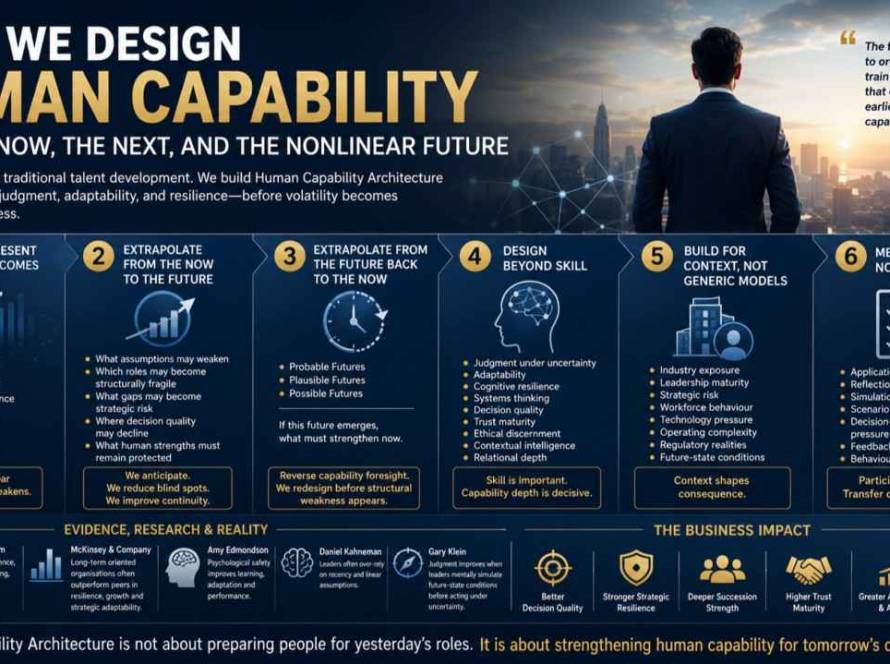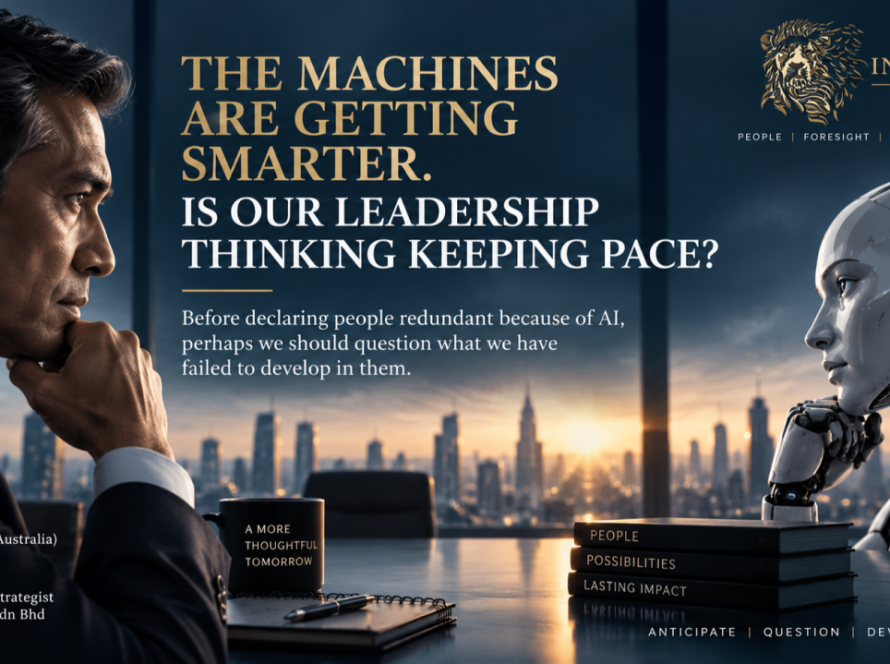
Most leaders are trained to solve the problem in front of them. Yet the problems that shape a business over the next five years rarely arrive with a warning label. Foresight executive coaching helps leaders spot weak signals early, test their assumptions, and make confident decisions before the pressure peaks. This guide explains what it is, how it works, and how to bring it into your leadership practice.
Why Foresight Matters for Leaders Today
Short-term reporting rewards speed. Leaders respond to the latest numbers, the latest market move, the latest headline. Over time this creates a reactive habit: the calendar fills with urgent items while the important shifts go unexamined.
Foresight changes the question. Instead of asking “what do we do about this quarter?”, leaders ask “what could change our business, and are we ready?” That shift is the starting point of strategic leadership.
If you would like to explore this with a coach, you can read more about our foresight executive coaching approach.
What Foresight Executive Coaching Is, and What It Is Not
Foresight executive coaching is a one-to-one or small-group partnership that develops a leader’s ability to think about the future in a structured way. It combines coaching conversations with practical foresight tools, such as scanning for signals, building scenarios, and testing decisions against several possible futures.
It is often confused with related ideas, so the differences are worth stating clearly.
| Approach | Core question | What it focuses on | Where it can fall short |
|---|---|---|---|
| Traditional coaching | How do I perform better in my role? | Behaviour, communication, presence | May stay focused on the present role |
| Strategic planning | What is our plan for the next few years? | Targets, budgets, priorities | Assumes one expected future |
| Forecasting | What will probably happen? | Trends and projections | Struggles with surprises and discontinuities |
| Foresight executive coaching | What could happen, and how should I lead given that? | Signals, scenarios, judgement, decisions | Needs regular practice to become a habit |
The key difference is that foresight coaching does not try to predict a single outcome. It prepares leaders to act well across several.
Foresight Is a Skill, Not a Prediction
Nobody can forecast the future reliably. What leaders can do is improve how they notice change, interpret it, and respond. Foresight is built from habits that can be trained.
| Capability | What it covers | Question leaders should ask |
|---|---|---|
| Noticing | Spotting early signals in markets, technology, policy, and customer behaviour | What small change are we ignoring? |
| Interpreting | Separating noise from patterns that matter | What would this mean if it grew? |
| Imagining | Building several plausible futures rather than one | What else could be true in three years? |
| Deciding | Choosing actions that hold up across scenarios | Which move works in most futures? |
Look at assumptions, not just data
Most strategies rest on unspoken beliefs about customers, competitors, and technology. Foresight coaching brings those beliefs into the open so they can be challenged before reality does it for you.
Core Principles of Foresight Coaching
- Think in possibilities, because the future is plural and planning for one version leaves you exposed.
- Stay curious about weak signals, since early indicators are easy to dismiss and costly to miss.
- Challenge your own assumptions, because the most dangerous blind spots are the ones leaders cannot see.
- Link insight to action, so that foresight changes real decisions rather than producing reports.
- Build the habit, as foresight works best when practised regularly, not once a year.
- Care for the human side, because uncertainty creates stress and good leaders help others stay clear-headed.
Applied Methods: From Insight to Everyday Practice
Foresight becomes useful when it shows up in calendars, meetings, and decisions. These are the methods coaches commonly use.
1. Horizon scanning
Leaders learn to collect signals from outside their usual sources, then sort them by relevance and time horizon. The aim is a manageable view of what is emerging, not an overload of information.
2. Scenario thinking
Together, the coach and leader build a small set of plausible futures. Each is examined for what it would mean for customers, talent, risk, and growth.
3. Decision stress-testing
Current plans are tested against each scenario. This shows which choices are robust, which are fragile, and where flexibility is worth paying for.
4. Reflective coaching conversations
Between sessions, leaders reflect on how they respond to uncertainty: where they rush, avoid, or over-control. This links strategic thinking to personal leadership style.
How to Build Foresight Capability Step by Step
- Clarify the horizon: decide how far ahead matters for your role, such as three, five, or ten years.
- Surface assumptions: list what you currently believe about your market, customers, and competitors.
- Scan for signals: track a small set of sources and note what is changing.
- Build scenarios: create three or four distinct futures and describe each in plain language.
- Test your plans: check which decisions hold up and which need contingency.
- Act on early moves: choose low-cost experiments that keep options open.
- Review and refresh: revisit signals and scenarios on a regular rhythm.
How to Tell Whether Foresight Is Working
Foresight is hard to measure with one number, but several signals show whether it is taking hold.
| What to look for | Example signals |
|---|---|
| Earlier awareness | Issues are raised months sooner, with fewer surprises in board discussions |
| Better decisions | Choices reference more than one possible future |
| Calmer leadership | Teams respond to disruption with less panic and more structure |
| Wider thinking | Leaders consult people and sources outside their usual circle |
| Strategic agility | Plans are adjusted quickly when signals change |
Treat these as prompts for conversation rather than a scorecard.
Common Foresight Coaching Mistakes
- Treating it as prediction: the goal is readiness, not being right about one outcome.
- Running it as a one-off workshop: without follow-up, insight fades within weeks.
- Collecting signals without deciding: information only matters when it shapes action.
- Keeping it with the CEO alone: senior teams need a shared view of the future.
- Ignoring the personal side: leaders who feel threatened by uncertainty often avoid it.
- Expecting instant results: foresight is a practice that grows with repetition.
Building Foresight Capability in Your Organisation
Individual coaching creates strong leaders, but organisations gain most when foresight becomes a shared language. Leadership teams can set a regular rhythm for reviewing signals, discuss scenarios in strategy sessions, and build contingency into planning.
Pairing coaching with team workshops helps the whole leadership group see the same horizon. To see how this works in practice, explore our foresight executive coaching programme.
Ready to lead with foresight?
Talk with Invictus Leader about how foresight executive coaching can sharpen your decisions and prepare your team for what’s next.
Explore Foresight CoachingFrequently Asked Questions
Understanding Foresight Coaching
What is foresight executive coaching in simple terms?
It is coaching that helps leaders anticipate change, explore several possible futures, and make better decisions today.
How is it different from strategic planning?
Strategic planning usually follows one expected future. Foresight coaching tests plans against several, so leaders are better prepared for surprises.
Is foresight coaching only for senior executives?
No. It benefits anyone making decisions with long-term impact, including emerging leaders, directors, and leadership teams.
Method and Practice
What tools are used in foresight coaching?
Common tools include horizon scanning, scenario building, assumption mapping, and decision stress-testing, combined with reflective coaching conversations.
Can foresight really be learned?
Yes. It is a set of habits for noticing, interpreting, and responding to change, and these improve with practice.
Does foresight mean predicting the future?
No. It prepares you to act well across several possible futures rather than betting on one.
Getting Started
Where should a leader start?
Begin by listing your key assumptions and choosing a time horizon. Then work with a coach to test them.
How long does it take to see results?
Many leaders notice sharper thinking within a few sessions. Lasting habits take several months of regular practice.
Who should take part in the work?
Start with the leader and their immediate team, then widen the circle as shared habits form.