In this article
- Is AI Becoming Another Form of Colonisation?
- From Data Colonialism to Mediated Intelligence
- The Familiar Architecture of Dependency
- Adoption Is Not Sovereignty
- A Signal Is Not a Decision
- Why Thinking Capability Matters More Than AI Skills
- Where Do Countries and Organisations Sit in the Intelligence Value Chain?
- What Is Intelligence Sovereignty?
- So, Is AI the New Colonisation?
- Frequently Asked Questions
1. Is AI Becoming Another Form of Colonisation?
Short answer: Not in the historical sense, but some patterns of concentration and dependency in the AI economy look strangely familiar.
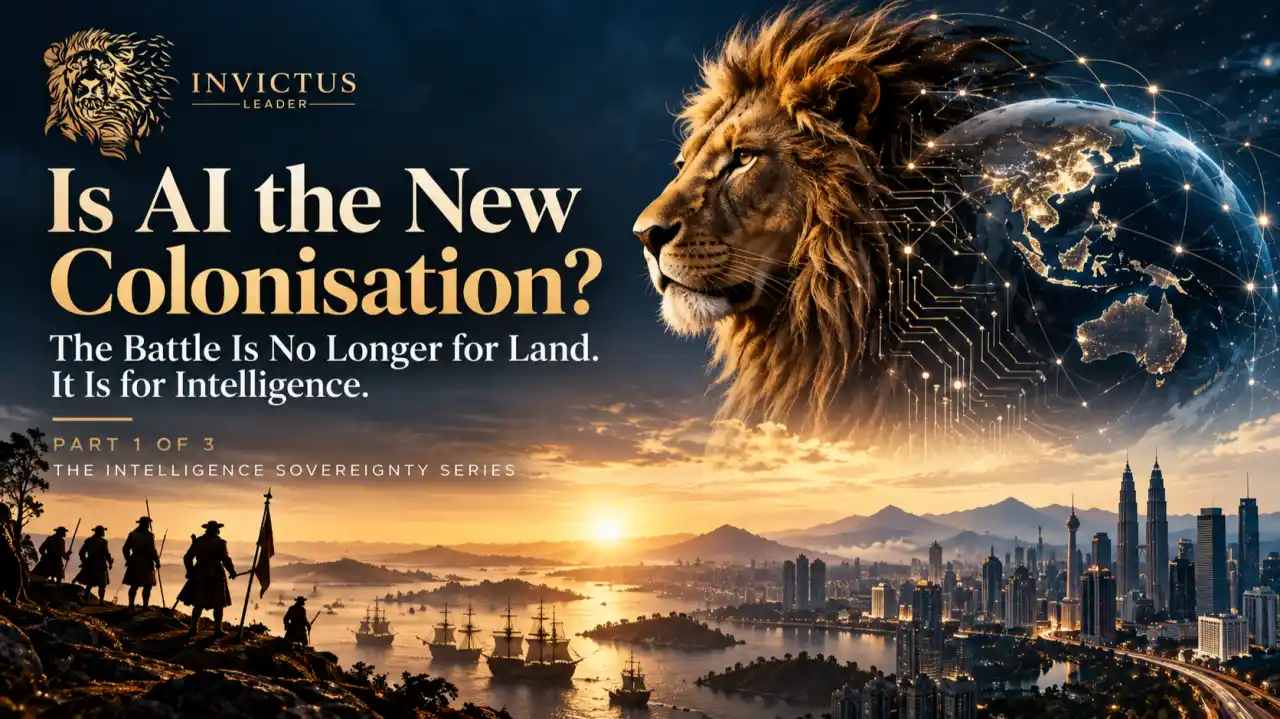
For centuries, colonisation followed a recognisable architecture: find what is valuable, control access to it, build the infrastructure around it, extract value from it, and eventually create dependency on the system. The resources were land, spices, rubber, tin, oil and labour.
Today there are no ships arriving in our ports and there may be no flags to lower. In fact, we may be voluntarily subscribing to the infrastructure ourselves. This time, the strategic resource may be intelligence.
This is not a claim that AI companies are colonial powers, nor does it equate technological development with the exploitation and brutality of historical colonialism. The question is narrower: are some of the underlying patterns of dependency beginning to look familiar?
2. From Data Colonialism to Mediated Intelligence
The idea did not begin with generative AI. Researchers Nick Couldry and Ulises Mejias wrote about data colonialism, arguing that human life was increasingly being converted into data from which economic value could be extracted.
The frontier has since moved. The first question was who is extracting our data? The question increasingly confronting us is who is mediating our intelligence?
There is a considerable difference between a technology knowing what you buy and a technology participating in:
- What you know
- Which evidence you consider
- How you define a problem
- Which alternatives you see
- What you eventually decide
3. The Familiar Architecture of Dependency
Countries with colonial histories will recognise part of this pattern. Many developing economies occupied the lower end of global value chains. They supplied rubber while someone else manufactured the tyre. They supplied minerals while someone else manufactured the machine. The raw material came from one part of the world, but a disproportionate share of the higher-value return accumulated elsewhere.
Now consider the AI economy. Consumers, organisations, governments, universities and professionals generate enormous amounts of data, knowledge and expertise. Societies generate language, behaviour and culture. Yet advanced semiconductor capability, computing infrastructure, foundation-model development, intellectual property and capital remain concentrated in a relatively small number of countries and corporations.
Illustrative data points
- UN Trade and Development estimates the global AI market could reach US$4.8 trillion by 2033.
- Just 100 companies, predominantly from the United States and China, accounted for 40% of global corporate AI R&D spending in the data highlighted by UNCTAD.
- 118 countries, mostly from the Global South, remain absent from major AI governance discussions.
This raises an uncomfortable question: are we in danger of becoming exporters of data and importers of intelligence?
4. Adoption Is Not Sovereignty
Many national and corporate AI conversations are still too shallow. They celebrate adoption: how many organisations use AI, how many employees are trained, how many applications are deployed, how many data centres are being built. All of this matters, but none of it answers the strategic question: where do we actually sit in the intelligence value chain?
An organisation that announces AI across its operations should also ask:
- Who owns the underlying models?
- Who owns the computing infrastructure?
- Who owns the intellectual property?
- Whose information shaped those models?
- Who determines their boundaries?
- Where does the economic value accumulate?
- If access disappeared tomorrow, what capability would remain inside the organisation?
The same questions apply to a country. Having access to AI is not the same as possessing AI capability, and possessing AI capability is not necessarily the same as possessing intelligence sovereignty.
5. A Signal Is Not a Decision
At Invictus, strategic foresight assignments rarely begin by asking people to predict the future. They begin with the organisation: its decisions, assumptions, uncertainties and industry, and increasingly what is happening outside its immediate field of vision.
The guiding questions include:
- What are you not seeing?
- What signals beyond the organisation could challenge its present assumptions?
- What is management seeing but dismissing because it does not yet fit the current business model?
- What would have to happen for the current strategy to become wrong?
- What is emerging at the periphery that could become material faster than management expects?
AI now helps with parts of this work. AI-supported signals and horizon scanning can examine a breadth of information that would once have taken human teams an extraordinary amount of time to process. But AI finds more, and finding more does not automatically mean understanding more.
Strategic disruption rarely sends an invitation before crossing industry boundaries. A demographic change elsewhere can alter your workforce. A regulatory development in another market can change your operating environment. A technological breakthrough outside your industry can destroy an assumption inside it.
Once signals appear, questions remain that cannot simply be delegated:
- Which signal matters, and why does it matter to this organisation?
- What is merely noise?
- What assumption does the signal challenge?
- What happens if two or three unrelated signals converge?
- What might the second and third-order consequences be?
- At what point should management act?
Machines will become extraordinarily good at scanning. The strategic advantage moves to what happens after the signal is found.
6. Why Thinking Capability Matters More Than AI Skills
There is enormous excitement about giving people AI skills. But organisations may be concentrating too heavily on teaching people to use increasingly intelligent machines, and not enough on developing their capacity to think alongside, beyond and sometimes against them.
Can your organisation:
- Interrogate the intelligence it consumes?
- Challenge the assumptions behind a recommendation?
- Identify what is absent?
- Recognise when historical patterns have stopped being useful?
- Construct a plausible alternative?
- Decide when evidence remains incomplete?
- Disagree intelligently with the machine?
These are not AI skills. They are thinking capabilities. If a machine can generate ten scenarios in seconds, teaching a leader to produce another scenario is no longer the frontier. The frontier is knowing what to do with those ten: which assumptions to challenge, which possibility deserves attention, which evidence would disconfirm the preferred position, which consequences are acceptable, and when to move.
Ultimately, the question is “What is your position?” and that cannot be handed back to the machine.
7. Where Do Countries and Organisations Sit in the Intelligence Value Chain?
The IMF’s AI Preparedness Index now looks across 174 economies. Its analysis estimates the share of jobs AI could endanger as follows:
| Economy Group | Jobs AI Could Endanger |
|---|---|
| Advanced economies | Around 33% |
| Emerging economies | Around 24% |
| Low-income countries | Around 18% |
That might suggest developing economies face less risk. But many emerging and lower-income economies also have weaker infrastructure and skills, leaving them less able to capture AI’s benefits. Lower exposure does not necessarily mean greater advantage. You can be less disrupted and still capture less value.
For countries such as Malaysia, the question must go beyond how quickly are we adopting AI? to where do we intend to sit in the emerging intelligence value chain? The options are very different economic and strategic positions:
- Consumer
- Implementer
- Integrator
- Developer
- Owner
- Architect
8. What Is Intelligence Sovereignty?
We already talk about data sovereignty, digital sovereignty and technology sovereignty. Another idea now deserves serious consideration: Intelligence Sovereignty.
Short answer: Intelligence Sovereignty is the capacity of an individual, organisation or nation to benefit from increasingly intelligent systems without surrendering the capability to independently question, interpret, imagine and decide.
It does not mean building everything ourselves, rejecting global technology or slowing AI development. It means understanding which capabilities must remain ours regardless of how intelligent the technology becomes.
- For nations: infrastructure, intellectual property, talent, language, local knowledge and economic value.
- For organisations: what thinking should we automate, what thinking should we augment, and what thinking must we never allow ourselves to lose?
The more capable the technology becomes, the less interesting the tools themselves become. The frontier is the quality of thinking surrounding them.
9. So, Is AI the New Colonisation?
There is no simple yes, and there should not be. Colonialism is too consequential a historical experience to use merely as a provocative metaphor. But we should recognise patterns of concentration and dependency when we see them. The AI economy is already highly concentrated, the capabilities to benefit from it are unevenly distributed, and the technology is moving from processing information towards participating in how humans construct knowledge and make decisions.
For centuries, power belonged to those who controlled territory, then resources, industrial capacity, capital, information and data. Now power is moving towards intelligence.
The danger is not that we use AI. We should. The danger begins if our capacity to function without external intelligence declines faster than our capacity to interrogate the intelligence we rely upon. Dependency rarely looks like dependency at first. It looks like convenience, efficiency and progress.
The next great divide may not be between those who have AI and those who do not. It may be between those who use AI to become more intelligent themselves, and those who become dependent on intelligence produced somewhere else.
Next in the series: What happens when the human remains in the loop, but gradually disappears from the thinking? Part 2 of the Intelligence Sovereignty Series continues from there.
10. Frequently Asked Questions