For years, the world of strategy and foresight has relied on animals to help leaders make sense of uncertainty.
Not because leaders lack intelligence. But because uncertainty refuses to sit neatly inside spreadsheets, dashboards, or five-year plans.
The animals were never meant to be cute metaphors. They were warnings.
Over time, however, something subtle happened.
We became very good at naming risks. But far less capable at judging them.
That gap is where organisations fail.
The original purpose of the animals
Each of the classic animals emerged to solve a specific blindness.
The White Elephant was introduced to name what everyone could see but no one wanted to confront. Known problems. Known consequences. Political avoidance disguised as prudence.
The Grey Rhino warned leaders about obvious, high-impact threats charging straight at them – threats ignored not because they were invisible, but because addressing them was inconvenient.
The Black Swan challenged our arrogance. It reminded us that history is shaped not only by trends, but by shocks no model predicted.
The Black Jellyfish surfaced later, reflecting a new reality systems so complex and adaptive that even when impacts were visible, causes kept mutating.
And the Grey Swan quietly sat in between low probability, but knowable. Visible only to those who bothered to sense weak signals early, before certainty arrived.
Each animal did its job well.
But notice something important.
All of them describe the environment. None of them describe the leader.

Where most organisations stop
In boardrooms and strategy offsites across the world, I see the same pattern.
Leaders debate:
- Is this a Black Swan or a Grey Rhino?
- Are we facing a Jellyfish or a White Elephant?
- Is this signal real or noise?
The discussion sounds sophisticated. The outcomes rarely are.
Why?
Because categorising risk does not automatically produce judgment.
What I see repeatedly is not a failure of intelligence or intent. It is a failure of posture.
Leaders oscillate between two extremes: paralysis while waiting for certainty, or speed without direction once urgency arrives.
In both cases, judgment is surrendered either to data, to consensus, or to the calendar.
Most organisations assume: If we label uncertainty correctly, the right decisions will follow.
That assumption is wrong.
History is full of organisations that correctly identified the risk and still failed.
Kodak understood digital. Nokia understood smartphones. Banks understood leverage risk in 2007.
Awareness was never the constraint. Orientation was.
What Invictus sees differently
At Invictus, our work sits in uncomfortable territory.
Not trend spotting. Not prediction. Not risk registers.
We work with leaders when:
- Information is incomplete
- Signals are contradictory
- Time is compressed
- And the cost of delay is higher than the cost of being imperfect
In these conditions, more data does not help.
Judgment does.
And judgment requires something the classic animals never addressed: direction without certainty.
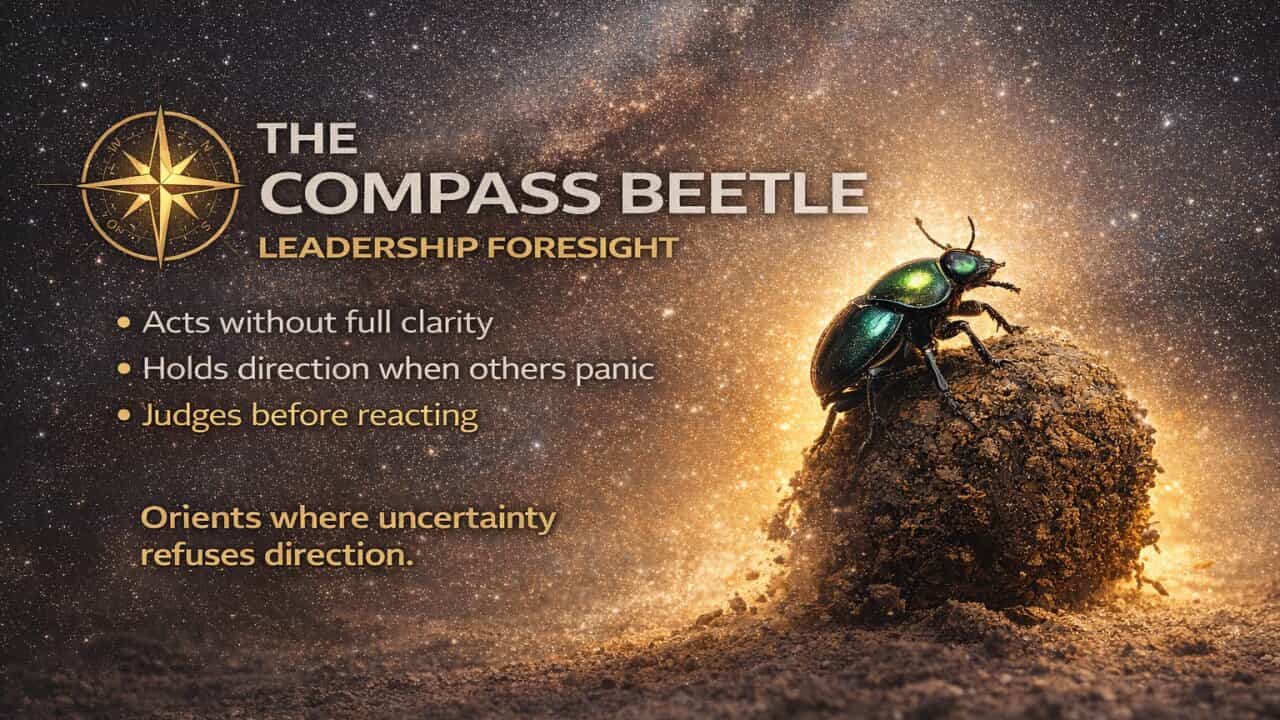
That is why we introduced the Compass Beetle.
Why the Compass Beetle
The Compass Beetle is not symbolic by accident.
It is one of the few creatures known to navigate using the Milky Way. Not landmarks. Not crowds. Not inherited paths.
Cosmic signals. Orientation in darkness.
That matters.
Because leadership today does not fail due to lack of intelligence. It fails due to loss of orientation.
Leaders freeze. Or they move fast in the wrong direction. Or they wait for consensus while the terrain shifts underneath them.
The Compass Beetle represents a different capability:
- Acting without full clarity
- Moving early, not urgently
- Distinguishing signal from noise
- Holding direction while others react
It is not another risk animal.
It is the capability required to survive all of them.
The missing dimension: time
In foresight work, timing matters more than correctness.
Being right too early looks like being wrong. Being right too late looks like incompetence.
Most leadership systems reward certainty and speed. Very few reward directional advantage.
The Compass Beetle does not optimise for accuracy. It optimises for when to move, not how fast to move.
That distinction separates foresight from hindsight.
This is the elevation
The classic animals ask: What kind of uncertainty are we facing?
The Compass Beetle asks: Who in this organisation is capable of navigating it?
That is the elevation.
From risk taxonomy to leadership capability
From naming uncertainty to judging under pressure
From reaction to orientation
Where Invictus draws the line
Invictus does not sell certainty. We do not promise prediction. We do not optimise leaders for comfort.
We build judgment under pressure.
We work upstream of crisis, before urgency removes choice. Because once urgency arrives, foresight has already failed.
Why this matters now
We are entering an era where:
- Grey Swans are accelerating
- Jellyfish dynamics are the norm
- Black Swans propagate faster due to interconnected systems
In such an environment, frameworks that stop at classification become dangerous.
They create the illusion of control without the substance of judgment.
Invictus does not reject the animals. We respect them.
But we refuse to stop there.
Because the future does not reward those who label risk well. It rewards those who move in the right direction before certainty arrives.
The uncomfortable truth
Elephants will always exist. Rhinos will keep charging. Swans will still surprise us.
The differentiator is not the animal.
It is whether the organisation has Compass Beetles in leadership positions — individuals capable of orienting, judging, and acting when clarity is absent.
Foresight is not a tool leaders use. It is a responsibility they either carry or quietly outsource until it is too late.
And that is the work we do.