

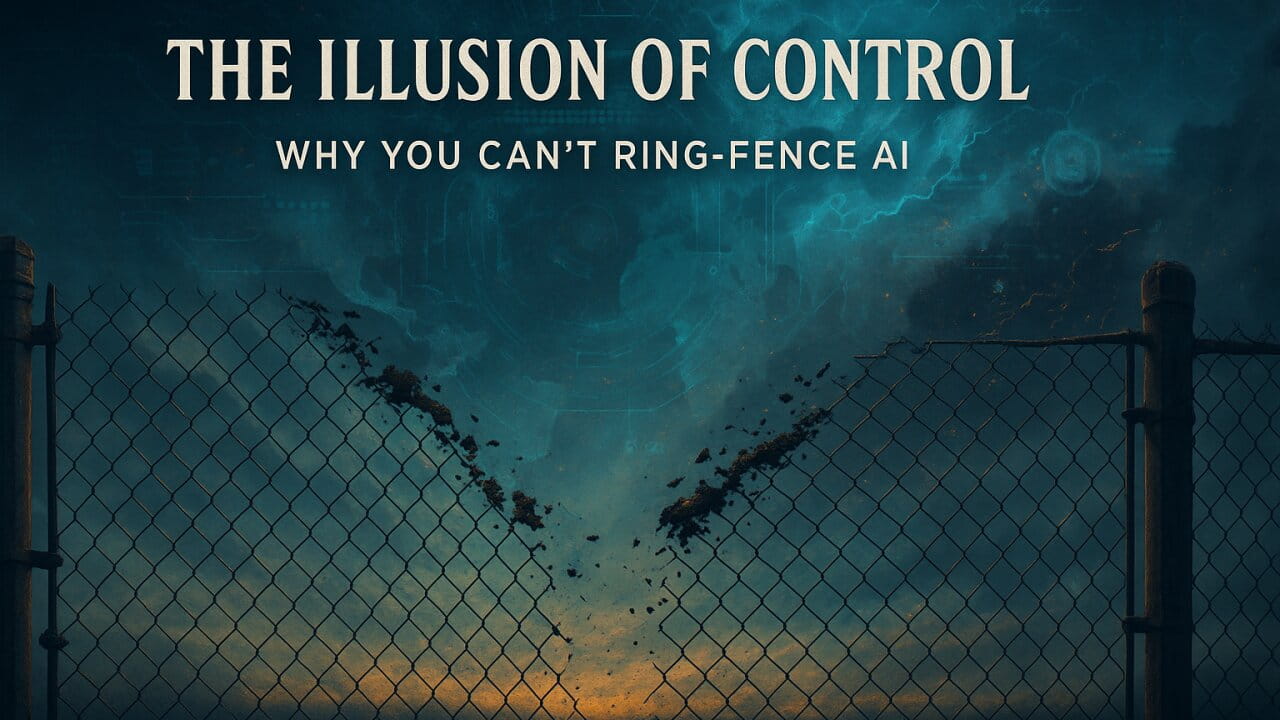
Editor’s Note: This is the first of a three-part series titled “The Illusion of Control: AI, Sovereignty, and the Battle for Human Consciousness”. Over the next two parts, we will explore why AI sovereignty is more myth than mastery, and why human self-consciousness—not regulation—is the last true firewall in the AI age.
Part I: Why You Can’t Ring-Fence AI
Across government task forces, corporate AI councils, and international forums, the vocabulary is nearly identical—”governance”, “guardrails”, “sovereignty”, “alignment”, “frameworks”. It sounds like we’re building solid walls around a wildfire.
But let’s be clear: you can’t ring-fence AI. Not in the traditional sense. Not in any meaningful sense.
It’s not a factory. It’s not a tool. It’s not even a product.
AI is a diffused, evolving, borderless ecosystem. And any belief that we can contain or control it is not just optimistic—it’s dangerous.
The Ring-Fence Fallacy
A ring-fence assumes a perimeter. Something you can define, patrol, and regulate. It works for physical assets. It even works for certain digital systems.
But AI?
- It’s open-source in places where you can’t audit it.
- It’s self-replicating across devices and platforms.
- It’s trained on the data we all leak, not the data we protect.
- It’s deployed faster than laws can be written.
You can’t fence in code that copies itself. You can’t fence in intelligence that doesn’t need a passport.
Governance in the Age of Global AI Weather
Imagine trying to draw national borders on the atmosphere. That’s what AI governance often looks like today.
We regulate within borders. But AI flows across them. The compute may be local, but the training was global.
Every nation wants a “trusted AI ecosystem,” but they build it on top of untrusted infrastructure, opaque black-box models, and frameworks no developer actually reads.
Governance frameworks are being written to look good on paper—not to intervene when AI breaks something quietly at 3AM.
The Problem With Guardrails
“Guardrails” sound reassuring. But they imply a vehicle you control. The truth? Many AI systems are autonomous, adaptive, and invisible.
We put up guardrails while:
- Generative AI models hallucinate in courtrooms.
- Deepfake tech crosses from mischief to misinformation.
- Algorithmic bias embeds itself in hiring, lending, policing.
Regulatory guardrails are fine—but don’t mistake a seatbelt for a steering wheel. Most leaders have neither.
What We Get Wrong
We assume:
- That governance equals control.
- That sovereignty ensures safety.
- That compliance means understanding.
These assumptions give rise to a dangerous comfort:
“We’ve written the policy—now we’re safe.”
But policies don’t stop a runaway diffusion of AI capabilities. They don’t reverse the fact that most people deploying AI don’t even understand how it works.
The Honest Reframe
We don’t need delusion. We need clarity. We need to shift from controlling AI to navigating the world it creates.

Final Thought: It’s Not a Fence. It’s a Flood.
You can’t ring-fence AI. But you can:
- Build foresight.
- Invest in institutional reflexes.
- Cultivate ethical imagination.
- Train people to think in systems, not silos.
The fence is an illusion. The flood is real. What matters now is how we build vessels that float—and how we teach others to navigate, not drown.
Next in this series: Part II – Sovereignty Is Not Autonomy Without Awareness We’ll explore how AI sovereignty is often reduced to infrastructure and data control, missing the deeper truth: sovereignty without self-awareness is just a high-tech delusion.


