

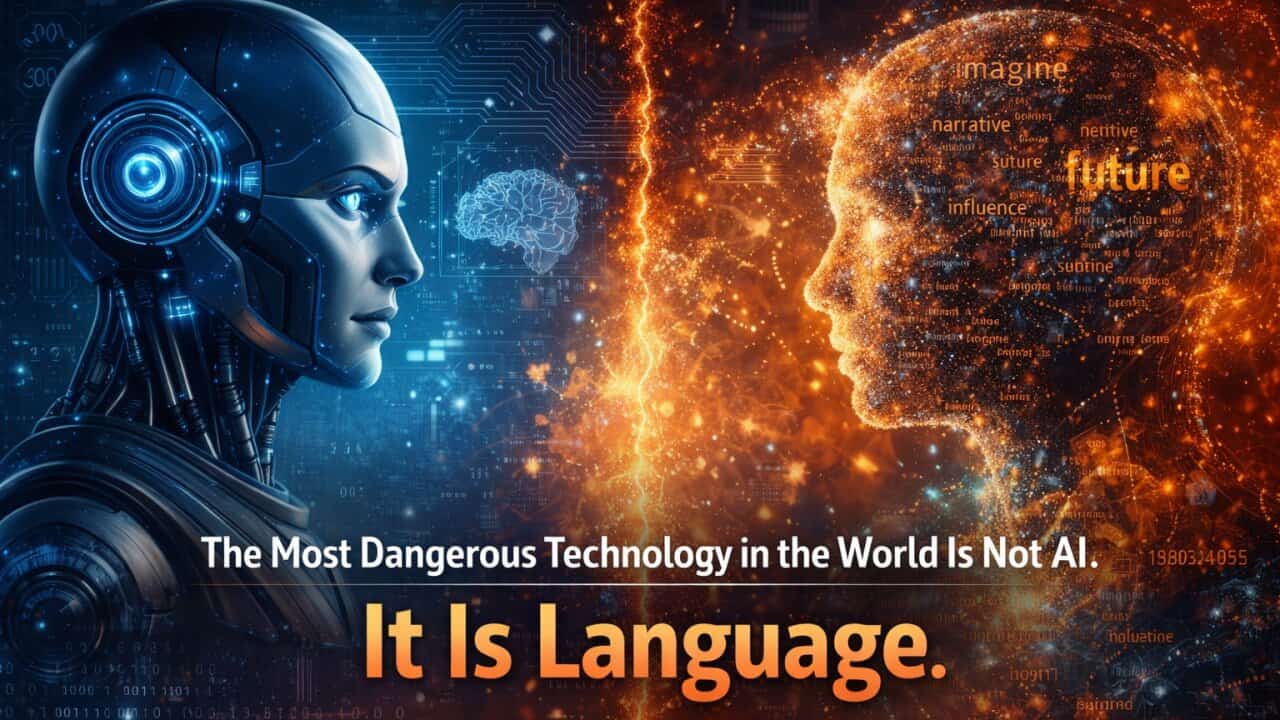
It Is Language.
Much of the global conversation today is dominated by artificial intelligence.
Governments are drafting AI regulations. Corporations are redesigning work. Universities are questioning the future of education.
The debate often centres around technology.
But there is a far older technology that quietly shapes how societies interpret all of this.
That technology is language.
Before algorithms program machines, language programs human thinking.
And in strategic foresight, this matters far more than most people realise.
The Invisible Constraint in Strategic Thinking
Most organisations believe their biggest challenge is uncertainty.
But in practice the deeper constraint is often something far simpler.
It is the language used to describe the problem.
If leaders describe something as a risk, the response becomes defensive.
If they describe it as a signal, curiosity emerges.
If they call it a disruption, panic spreads.
If they call it a transition, preparation begins.
The reality may be identical.
But the words used to describe it determine the strategy that follows.
This is why language becomes the first layer of strategic foresight.
Because the future is rarely limited by information.
It is limited by the frames through which information is interpreted.
Narratives Quietly Shape the Futures We Prepare For
Across geopolitics, economics and technology, the future is increasingly shaped by narratives rather than facts alone.
Consider artificial intelligence.
Some governments describe AI as a national security race.
Some corporations describe it as a productivity revolution.
Some educators describe it as a learning crisis.
The technology is the same.
Yet each description leads to completely different strategic responses.
A national security narrative drives geopolitical competition.
A productivity narrative drives automation and labour restructuring.
A learning crisis narrative drives educational reform.
The future begins to diverge depending on which narrative becomes dominant.

The Language Trap Inside Organisations
Corporate vocabulary often traps organisations inside outdated thinking.
Take the word efficiency.
Efficiency was the defining logic of the industrial era.
Factories, supply chains and management systems were designed around optimising efficiency.
But when efficiency becomes the dominant lens, exploration disappears.
Experimentation becomes uncomfortable.
Innovation slows down.
The organisation becomes optimised for stability rather than adaptability.
Or consider the popular terms upskilling and reskilling.
Both assume the future can be predicted well enough to identify the next set of required skills.
But the world we are entering is shaped by uncertainty, complexity and technological acceleration.
In such environments the real requirement is not simply new skills.
It is capability, judgement and adaptability.
A shift in language can quietly redefine an entire strategy.
Strategic Foresight Begins by Challenging Language
One of the first disciplines in foresight work is examining the language used to describe reality.
Because language often hides assumptions.
When someone says:
“We know our industry.”
It sounds like confidence.
But through a foresight lens it often signals overconfidence in known knowns.
When tested against technological disruption, geopolitical instability or systemic shifts, many of those “knowns” quickly become known unknowns.
Language can create the illusion of certainty.
Foresight begins by questioning that illusion.
The Nonlinear Nature of the Future
Another reason language becomes dangerous is that most language assumes linear cause and effect.
But the future rarely behaves that way.
We now operate in nonlinear systems.
Small signals can trigger disproportionate consequences.
A technological breakthrough can collapse an industry.
A geopolitical event can redirect global supply chains.
A scientific discovery can redefine entire sectors.
These interactions create cascading effects across systems.
Yet the language used in strategy often assumes stability and gradual change.
That mismatch can become dangerous.
When Language Changes, Systems Move
History shows that changing the language often changes the speed of response.
For decades the world spoke about climate change.
The phrase sounded gradual and distant.
But when the language shifted toward climate emergency, the global response accelerated.
Governments introduced new policies.
Financial markets redirected investment flows.
Corporations redesigned strategies.
The science did not suddenly change.
The narrative changed.
And narratives move systems.
The Battle for the Language of the Future
What we are witnessing today is not only a technological revolution.
It is also a battle for the language that will define the future.
Technology companies describe artificial intelligence as innovation and opportunity.
Governments increasingly describe it as strategic infrastructure and national power.
Labour organisations describe it as economic displacement.
Educators describe it as a transformation of knowledge itself.
Each narrative attempts to shape how societies interpret the same phenomenon.
And whoever defines the language often shapes the strategic response.
This is why geopolitical competition is no longer confined to military strength or economic influence.
It increasingly involves narrative power.
The ability to frame reality.
The ability to define opportunity.
The ability to influence how societies imagine the future.
Because language shapes perception.
Perception shapes strategy.
And strategy shapes the future.
Narrative Foresight: The Hidden Layer of Strategic Intelligence
Strategic foresight traditionally focuses on signals, trends and scenarios.
But there is another layer that is often overlooked.
Narratives.
Narratives influence how signals are interpreted.
They influence which trends are prioritised.
They influence which futures appear plausible.
This layer can be described as Narrative Foresight.
The discipline of understanding how language and narratives shape strategic interpretation.
Because in many cases the future does not change first.
The story about the future changes first.
And once the story changes, systems begin to move.

Why We Look at Foresight Differently at Invictus Leader
This is precisely why at Invictus Leader we examine foresight through a nonlinear lens.
Many traditional foresight models extend trends and assume the future unfolds gradually.
But the world we are entering behaves very differently.
Technological acceleration, geopolitical tensions, energy transitions, demographic shifts and artificial intelligence are interacting simultaneously.
Small signals can cascade into large disruptions.
Weak signals can amplify rapidly when multiple systems collide.
Through the Invictus approach to foresight, we examine signals not only through trend analysis but through system interaction, narrative interpretation and nonlinear consequence.
This requires asking different kinds of questions.
What happens when multiple weak signals collide?
Which assumptions collapse when systems accelerate?
Which narratives quietly shape strategic decisions today but may limit the futures organisations are able to imagine tomorrow?
Because sometimes the greatest strategic risk is not uncertainty.
It is the language that convinces us we already understand the future.
The First Skill of Foresight
Recently during a session with teenagers in the Thinking Under Pressure programme, I asked a simple question.
Can humans create a thought?
The discussion revealed something interesting.
Most thoughts are not entirely original.
They are inherited through language.
We repeat phrases, assumptions and interpretations absorbed from the systems around us.
True thinking begins when we question those assumptions.
And that is often where foresight begins.
The Future May Depend on the Words We Choose
Words do more than communicate.
They shape the boundaries of imagination.
And imagination shapes the future.
Before organisations redesign strategy…
Before governments redesign policy…
Before educators redesign learning systems…
They may first need to ask a far more fundamental question.
Are we using the right language to describe the future we are entering?
Because if the language is outdated, the strategies built upon it will also be outdated.
And in a nonlinear world, that gap can widen very quickly.

