Introduction
Picture this: A senior leadership team returns from a prestigious three-day residential retreat. Notebooks full. Energy high. LinkedIn posts glowing. Six weeks later — same meetings, same dynamics, same unspoken tensions. Same behaviours. Nothing has changed.
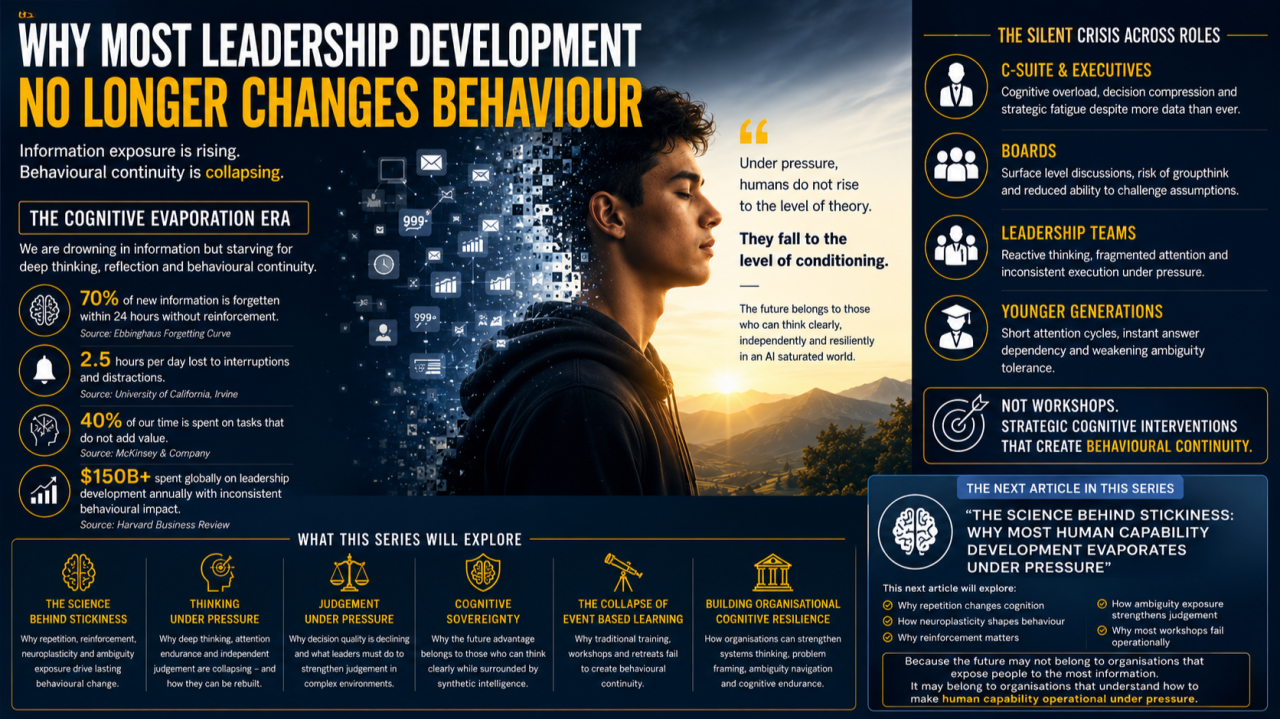
This is not an isolated anecdote. It is the dominant pattern in organisational leadership development today. Despite unprecedented investment in coaching, seminars, assessments, eLearning platforms and leadership academies, the fundamental needle on human behaviour rarely moves.
The question is not whether organisations care about developing their leaders — most do, sincerely and expensively. The question is whether the methods they rely upon are actually capable of producing what they promise.
Industry Reality Check
Why Traditional Programmes Fail
Most leadership development is built on a flawed architecture. It is designed to inform, not to transform. It treats leaders as empty vessels to be filled with frameworks, models and best practices — rather than as complex human beings whose behaviours are governed by deeply rooted beliefs, emotional patterns and identity structures.
There are five structural failure points that consistently undermine even the best-intentioned programmes:
Event-Based Learning Without Continuity
One-off workshops, annual retreats and quarterly seminars create moments of inspiration — but not habits of leadership. Without structured reinforcement, new awareness decays within days. The brain defaults to its established neural pathways. Old behaviours return.
Generic Content Divorced from Real Context
Off-the-shelf programmes present leadership as universal and abstract. But behaviour always occurs in specific relational, cultural and organisational contexts. What works in one boardroom is irrelevant in another. Generic content cannot address the particular triggers, tensions and blind spots of individual leaders.
Measuring Activity Rather Than Outcomes
Organisations track attendance, satisfaction scores and completion rates — none of which measure whether a leader’s behaviour has actually shifted. When the metric of success is participation rather than transformation, there is no incentive to design for real change.
Ignoring the Emotional and Psychological Dimension
Most programmes treat leadership as a cognitive exercise — as if better thinking alone produces better behaviour. But leadership is profoundly emotional. Fear, ego protection, unresolved identity conflicts and unconscious patterns drive behaviour far more powerfully than frameworks and competency models.
Polished Facilitators Without Transformational Authority
Compelling speakers can inspire and energise a room. They cannot produce sustained behavioural change without the methodology, depth of experience and ongoing presence required to guide a leader through genuine transformation. Inspiration and transformation are not the same thing.
The Knowledge–Behaviour Gap
There is an uncomfortable truth at the heart of leadership development: knowing is not doing. Leaders who can articulate servant leadership, psychological safety and systems thinking with sophistication still micromanage, dismiss dissent and operate from narrow transactional logic when the pressure is on.
This is the knowledge–behaviour gap, and it is not a failure of intelligence or motivation. It is a structural feature of how human beings are wired. The part of the brain that processes new information and the part that governs habitual behaviour are not the same. Learning does not automatically reach behaviour. It must be deliberately and patiently bridged.
“You cannot think your way into a new way of acting. You must act your way into a new way of thinking.”
— The foundational principle of behavioural leadership development
The programmes that address only knowledge accumulation — competency frameworks, leadership models, conceptual tools — are filling a vessel that has no pipe leading to the engine room. The information sits in the head. The behaviour stays anchored in habit, identity and environment.
Research in neuroscience and adult learning confirms that sustainable behaviour change requires repeated practice in real-world conditions, emotional engagement, and regular structured reflection — not one-time cognitive exposure. The leadership classroom and the leadership challenge are two entirely different development environments.
Identity, Beliefs & the Neural Architecture of Leadership
At the deepest level, a leader’s behaviour is an expression of their identity — how they see themselves, what they believe about authority and relationships, and what they have come to understand as safe and effective in organisational life.
These are not simply thought patterns. They are embedded in the neurological circuitry forged by decades of lived experience. A leader who grew up rewarded for having all the answers will not become genuinely curious and collaborative because they attended a workshop on psychological safety. Their identity will pull them back to what feels familiar and self-defining.
This is why Invictus Leader’s approach to executive development begins not with competencies, but with the interior architecture of the leader — the beliefs, assumptions and self-concepts that govern how they actually show up under pressure.
- Adding new frameworks without addressing identity
- Cognitive skill-building without emotional work
- Teaching leadership to people who fear vulnerability
- Developing skills in a vacuum, separated from real challenges
- Working at the level of belief and self-concept
- Integrating cognitive and emotional intelligence
- Creating psychological safety for honest self-examination
- Grounding development in real organisational situations
When the Environment Eats Development for Breakfast
Even when a leader leaves a programme genuinely altered — more self-aware, more intentional, more committed to change — the organisational environment they return to often dismantles that progress rapidly.
Cultures reward what they have always rewarded. Peers relate to each other through established patterns. Unspoken norms govern what is acceptable to say, feel and do. A leader who tries to lead differently encounters friction — from their team, their peers and sometimes their own superiors — and without support, they revert.
“Individual transformation without systemic support is like planting new seeds in unturned soil. The environment determines whether growth is possible at all.”
— Ravi VS, Invictus Leader
This is why sustainable leadership transformation requires attention to three simultaneous layers: the individual leader, their immediate team relationships, and the broader organisational culture that either supports or suppresses new behaviours.
At Invictus Leader, we have witnessed across three decades and 2,500+ client organisations that leaders who change without organisational alignment rarely sustain that change beyond ninety days. The system corrects them.
The Three Layers of Lasting Leadership Change
A New Model: What Actually Changes Behaviour
The good news is that genuine behavioural transformation in leadership is possible. But it requires a fundamentally different set of design principles — grounded in how human beings actually change, rather than how institutions prefer to teach.
Based on decades of practitioner-led executive development, the conditions for lasting behavioural change in leaders require all of the following to be present simultaneously:
Deep Self-Awareness Before Skill Acquisition
Lasting change begins with honest, often uncomfortable insight into one’s own behavioural patterns, triggers and blind spots. Without this foundation, new skills are layered over old habits without displacing them. Structured 360° feedback, psychometric depth work and rigorous self-reflection are not optional add-ons — they are the entry point.
Sustained Engagement Over Time — Not Events
Behaviour is shaped by repetition. Development journeys that span six to eighteen months with consistent coaching contact, structured reflection and real-world practice produce fundamentally different outcomes than intensive short programmes. The nervous system needs time and repetition to form new defaults.
Accountability Structures That Are Honest and Specific
Vague commitments produce vague change. Effective development establishes clear, observable behavioural targets with regular review cycles and honest feedback from those who experience the leader’s behaviour daily — not just self-report. Accountability is the engine that converts intention into action.
Real-World Application as the Primary Learning Environment
The leader’s actual workplace — with its messy politics, competing priorities and human complexity — is the most powerful development environment available. Effective programmes use the leader’s live challenges as the curriculum, with coaching providing interpretation, perspective and support in real time.
Measuring Behavioural Outcomes — Not Activity Metrics
The only metric that matters in leadership development is whether the leader’s behaviour — as observed by those around them — has measurably shifted in the intended direction. Satisfaction scores and completion certificates measure nothing of consequence. Behavioural observation, pre and post 360° assessments and business outcome tracking are the genuine indicators of programme effectiveness.
These principles form the foundation of the Future Leadership Foresight™ methodology developed over three decades by Invictus Leader. It is an approach that treats behavioural leadership development not as a programme to be delivered, but as a transformation to be engineered — systemically, personally and sustainably.
Explore the Invictus Leader approach →Conclusion: From Information to Transformation
The leadership development industry has a quality crisis masked by a volume illusion. Organisations continue to invest at scale in programmes they cannot demonstrate are working, measuring participation rather than transformation, and confusing content delivery with behaviour change.
The leaders most organisations need — adaptive, emotionally intelligent, psychologically secure, capable of building high-trust cultures and navigating genuine complexity — cannot be produced by programmes designed for knowledge transfer alone.
What they require is transformation. And transformation — genuine, lasting, behavioural — is painstaking, relational, contextual and longitudinal. It demands that we change not just what leaders know, but who they are and how they see themselves in relation to the people and organisations they lead.
The organisations that understand this — and invest accordingly — will be the ones building the leadership capacity that the next decade demands. The rest will continue spending billions to change nothing.
The question every leader and every organisation must honestly confront is this: are we investing in development — or in the appearance of development? One produces comfort. The other produces change. Only one of them is worth the investment.
Ready to Lead Differently?
Transform How Your Leaders Lead — Not Just What They Know
If your organisation’s leadership development is not producing visible, measurable behavioural change — it is time for a different conversation. Invictus Leader works with executives, boards and leadership teams who are serious about genuine transformation.