The escalation around Iran did not begin with missiles. It began with signals.
Weeks before headlines spoke of rising tensions, subtle movements were already visible across the global system. Oil prices began shifting in small but persistent increments. Shipping insurers quietly recalibrated their war-risk calculations. Logistics operators reviewed routes across sensitive maritime corridors. Energy traders increased hedging positions in anticipation of volatility.
None of these signals alone meant conflict.
But when multiple signals move in the same direction across different systems at the same time, something deeper is unfolding.
Strategic foresight begins precisely at this point. Not when the crisis explodes, but when patterns begin forming before the shock arrives.
The Timeline of Signals Many Overlooked
The global system had already begun reacting long before the escalation became headline news.
Maritime disruptions across important shipping corridors had increased risk calculations among insurers. Proxy conflicts across multiple parts of the region had intensified quietly but steadily. Strategic naval deployments across key maritime zones became more visible.
Meanwhile, the energy markets were already responding.
Nearly 20 percent of global oil supply passes through the Strait of Hormuz, representing approximately 17 to 21 million barrels per day.
When a corridor of that magnitude becomes strategically vulnerable, even the possibility of disruption alters behaviour across global markets.
Energy markets often move before governments publicly acknowledge risk. Traders, insurers, and logistics operators constantly read signals that rarely reach public discussion until much later.
Oil is not merely a commodity. It is the bloodstream of the global economy.
History Has Already Shown This Pattern
The relationship between geopolitical tension and energy shock is not new.
The 1973 oil crisis demonstrated how geopolitical events can instantly reshape global economic stability. The 1990 Gulf War triggered immediate oil volatility that rippled across markets. More recently, the 2019 attacks on Saudi Arabia’s Aramco facilities temporarily disrupted nearly five percent of global oil supply in a single day.
These events reveal a consistent pattern.
Energy infrastructure does not need to be destroyed permanently to create global disruption. The mere perception of vulnerability is often enough to move markets.
This is why foresight thinking studies patterns across time rather than focusing only on present events.
The Grey Rhino Many Chose Not to See
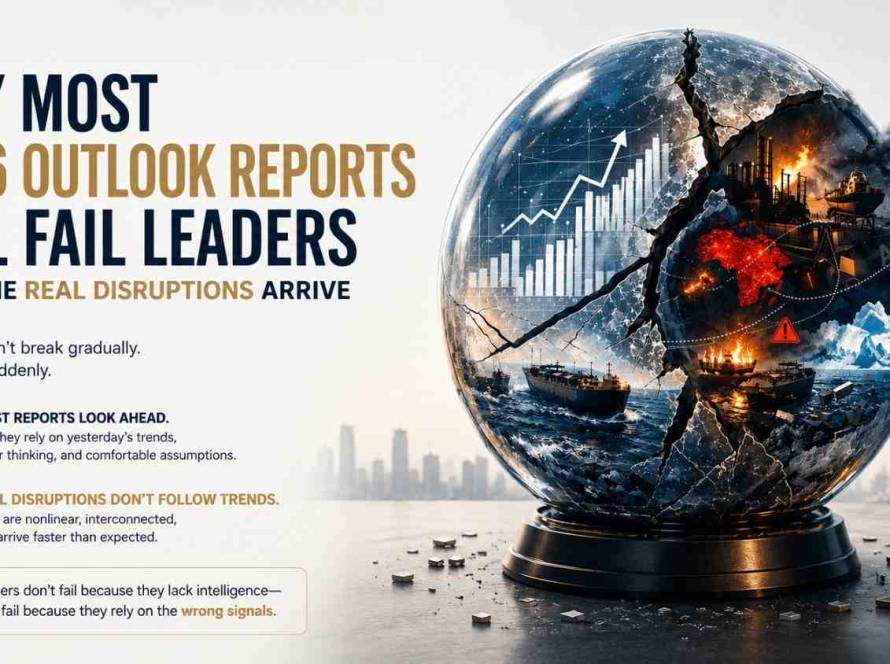
Many geopolitical crises are described as Black Swan events.
But the current situation resembles something very different.
It is closer to what strategists call a Grey Rhino.
A Grey Rhino represents a high-probability threat that is visible and approaching slowly, yet frequently ignored until its impact becomes unavoidable.
The signals were visible.
Rising regional tensions. Increasing proxy activity. Maritime security concerns. Energy market nervousness.
None of these developments were hidden.
Yet systems often prefer the illusion of stability until disruption forces a reassessment.
This is precisely where foresight thinking becomes essential.
The Oil Shock That Could Reshape the Equation
Even limited escalation in the region carries consequences that extend far beyond the battlefield.
Energy markets react quickly to uncertainty.
Disruption around the Strait of Hormuz does not need to halt shipments entirely to generate pressure. Even partial disruption introduces three immediate effects.
First, uncertainty in supply expectations begins pushing oil prices upward.
Second, maritime insurance premiums can rise dramatically, increasing the cost of global shipping.
Third, supply chains across manufacturing economies begin adjusting inventories and hedging positions.
In practical terms, a ten-dollar increase in oil prices can ripple across transportation, manufacturing, fertiliser production, and food supply chains globally.
Energy volatility rarely stays within the energy sector. It spreads rapidly across the entire economic system.
The Rogue Escalation Scenario
Another plausible pathway that foresight analysis must consider is the rogue escalation scenario.
When a nation faces overwhelming strategic pressure, escalation does not always occur through direct confrontation with the strongest opponent.
Instead, pressure may manifest through regional disruption.
Strategic infrastructure, maritime routes, and proxy actors may become part of the escalation dynamic.
The region has already witnessed such patterns.
The 2019 tanker incidents in the Gulf and the strike on Saudi Arabia’s Aramco facilities demonstrated how asymmetric escalation can produce substantial economic disruption without conventional warfare.
From a foresight perspective, these are not predictions.
They are plausible futures that responsible leaders must consider.
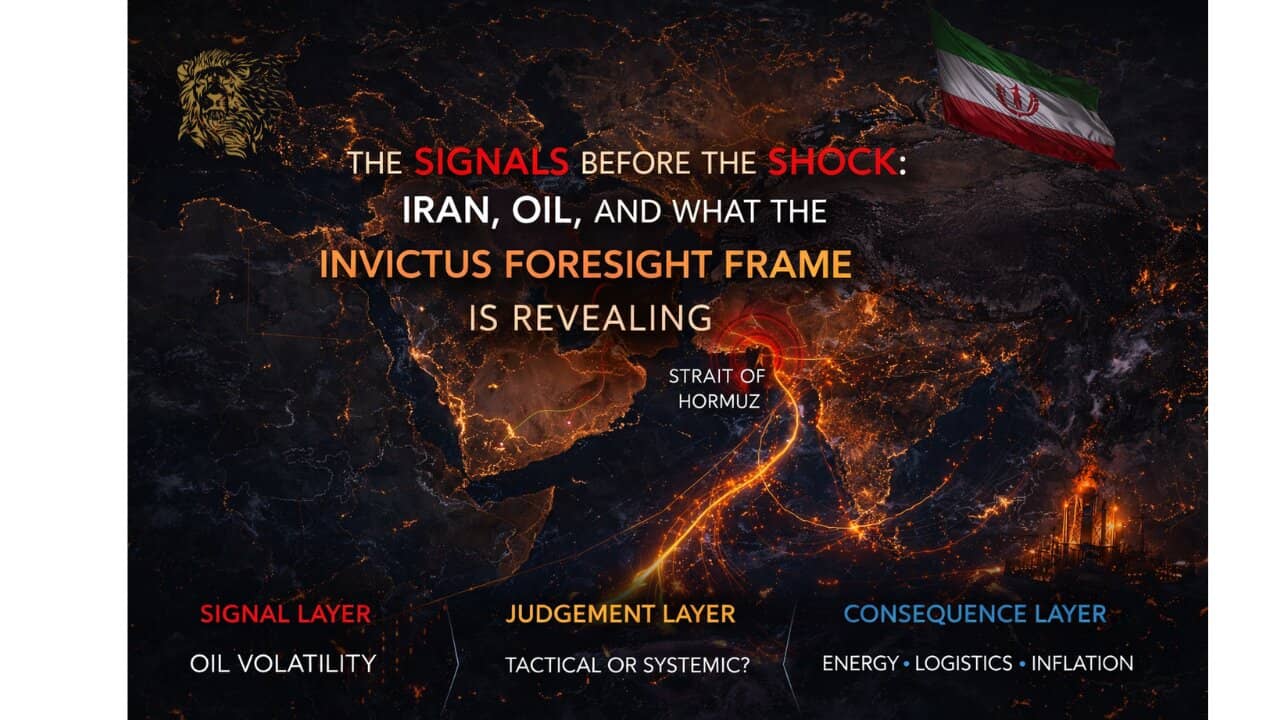
Understanding the Situation Through the Invictus Foresight Frame
The Invictus Foresight Frame does not attempt to predict a single outcome.
Instead, it examines unfolding events across three interconnected layers.
Signal Layer
Oil volatility Rising maritime insurance premiums Increased proxy conflict activity Strategic naval deployments
Judgement Layer
Are these signals temporary tactical tensions, or indicators of deeper systemic instability around global energy corridors?
Consequence Layer
Energy price volatility Shipping and logistics disruption Supply chain instability Inflationary pressure across global markets
When viewed through this framework, the current situation reveals a broader systemic pattern.
The escalation is not confined to geopolitics alone. It interacts with energy systems, financial markets, supply chains, and economic stability.
The Economic Domino Effect
Geopolitical tensions rarely remain isolated within their original domain.
Energy price increases influence shipping costs and airline fuel expenses. Fertiliser production, which is heavily dependent on energy inputs, becomes more expensive. Food supply chains begin feeling pressure as transportation costs increase.
This chain reaction becomes visible:
Oil volatility Shipping cost increases Fertiliser price pressures Food inflation Economic strain in energy-importing countries
Beyond economics, rising inflation can also generate political instability across nations heavily dependent on imported energy.
This is why foresight thinking focuses on systems and consequences rather than isolated events.
Why Many Leaders Miss the Signals
A persistent leadership challenge in complex environments is the tendency to treat geopolitical developments as distant news rather than strategic signals.
By the time disruption becomes visible in oil prices or supply chains, the system has already begun adjusting.
Foresight capability exists precisely to bridge this gap.
It enables leaders to observe patterns while they are still forming, before those patterns translate into operational disruption.
Without that capability, organisations are left reacting to shocks rather than preparing for them.
What Strategic Leaders Should Be Asking Now
The most important leadership response is not speculation about how long escalation will last.
Instead, leaders should be asking more practical questions.
Are we monitoring geopolitical signals that affect our supply chains?
What happens to our cost structure if oil rises significantly?
Which parts of our operations depend on stability in energy corridors?
These are the questions that transform foresight into strategic preparation.
Final Reflection
The real danger is not simply the conflict we see.
The greater danger lies in the signals we ignore before crises unfold.
Energy routes, logistics corridors, financial markets, and supply chains are now deeply interconnected. When pressure builds in one part of the system, the ripple effects travel rapidly across the entire global network.
Those who ignore the signals will always react too late.
Those who recognise the signals early gain something far more valuable than prediction.
They gain preparation.
And in an era defined by geopolitical uncertainty, preparation is the true advantage that strategic foresight provides.