There is a particular kind of boardroom energy that has become familiar over the last two years. Executives lean forward. Slides flash. Someone mentions ChatGPT, and then someone else mentions their competitor’s AI initiative. The question that inevitably follows — typed into every strategic planning deck from London to Singapore — is: “How do we use AI?”
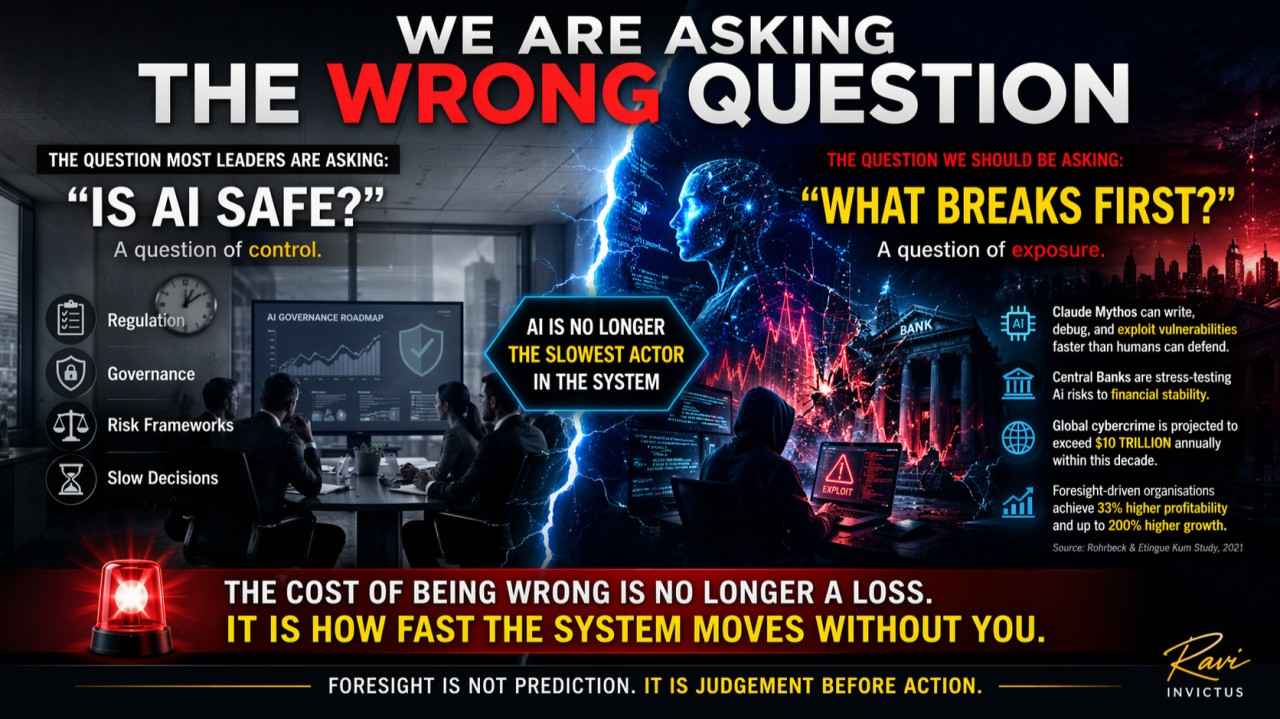
It feels like the right question. It is urgent, practical, and defensible. But it is also, in a very specific way, the wrong question — and the organisations discovering that first are the ones pulling ahead.
“The organisations that thrive won’t be the ones who adopted AI earliest. They’ll be the ones who redesigned their thinking before they deployed the technology.”
— Invictus Leader Research, 2025Why “How Do We Use AI?” Contains a Hidden Assumption
When we ask how to use a tool, we implicitly assume that our existing goals, structures, and workflows are the fixed points — and that the tool fits around them. It’s the same mental model that led early industrialists to add electric motors to horse-drawn carriage factories. They electrified the whip. They didn’t reimagine the journey.
AI, at its current trajectory, is not a feature upgrade. It is a compressive force — one that is collapsing the time it takes to process information, generate options, and execute decisions down to near-zero. When you can do something 100 times faster and 10 times cheaper, you don’t just do the same thing faster. The entire competitive geometry changes.
The Tool Trap
McKinsey’s 2024 State of AI report found that companies which treated AI as a tool — bolting it onto existing processes — saw productivity improvements of 15–25%. Impressive. But companies that redesigned their operating model around AI capabilities saw improvements of 200–400% in targeted functions. The difference was not the technology. It was the question asked before the technology was selected.
The Better Question: What Becomes Possible?
The leaders we work with at Invictus Leader who are navigating this most effectively share a different starting posture. Instead of “How do we use AI?”, they ask: “Given what AI makes possible — what should we now be doing that we couldn’t do before?”
The distinction is not semantic. It is architectural. One question is conservative; it preserves the current business model and looks for efficiency. The other is expansive; it interrogates assumptions about markets, margins, talent, and time.
A Concrete Illustration
Consider a mid-market professional services firm. The “how do we use AI?” version of their strategy produces an AI that drafts client emails faster and summarises meeting notes. Useful. Incremental.
The “what becomes possible?” version produces a different firm entirely — one that can serve 10× the clients with the same headcount, offer real-time strategic monitoring as a product feature, and shift revenue from hourly billing to outcome-based retainers. That is not an efficiency gain. That is a business model transformation. And it starts with a question, not a software license.
“Efficiency asks: how do we do this faster? Transformation asks: should we be doing this at all?”
Three Frames That Change the Conversation
Based on our work with executive teams across industries, we’ve identified three reframing questions that consistently unlock more useful strategic thinking about AI.
Frame 1: The Constraint Dissolve
Every business strategy is built around constraints: we can only serve X clients because we have Y people. We can’t offer Z because the analysis takes too long. AI collapses many of those constraints. The question becomes: If the constraint that has always shaped our strategy suddenly disappeared — what would we do differently? Most leadership teams have never answered this question, because it felt hypothetical. It no longer is.
Frame 2: The Value Migration Question
In every industry, AI is causing value to migrate — often from labour-intensive execution toward judgment, creativity, relationships, and accountability. Where, exactly, is value migrating in your sector? And does your current team architecture position you to capture it or lose it? This is a leadership question before it is a technology question. The teams answering it well are redesigning roles, incentives, and hiring criteria now — before the migration makes it an emergency.
Frame 3: The Speed Asymmetry
AI creates brutal speed asymmetries. A competitor who can run 50 strategic experiments per month versus your 3 will iterate their way to a better model — regardless of starting quality. The question is not whether your strategy is good. It is whether your decision velocity can compete. This is a systems and culture question. But it starts with leadership asking it.
What This Means for Leadership, Specifically
None of this is an argument against practical AI implementation. Productivity gains are real and worth capturing. But they are the floor, not the ceiling — and treating them as the destination is why so many AI transformation programmes quietly stall after early wins.
The leaders who will define their industries over the next decade are developing a new competency: the ability to hold strategic ambiguity at scale. To ask uncomfortable questions before reaching for comfortable answers. To distinguish between making existing work faster and making different work possible.
That competency is not technical. It is fundamentally human. It is — and always has been — what extraordinary leadership looks like.
Key Data Points
12%
of AI initiatives reach their stated strategic goals within 24 months
4×
greater returns when AI is built into the operating model, not layered on top
68%
of executives say their leadership team lacks AI strategic fluency
Sources: McKinsey State of AI 2024 · IBM Institute for Business Value · Gartner Executive Pulse
Key Takeaways
“How do we use AI?” is a conservative question. It produces efficiency, not transformation.
The right question is: “What becomes possible that wasn’t before?” — build strategy around the answer, not the software.
AI collapses the constraints that most strategies are built around. Leaders must audit which assumptions are now obsolete.
The scarcest resource in AI transformation is not data or compute — it is leaders who can tolerate strategic ambiguity long enough to ask better questions.
Organisations that redesign around AI capabilities see 4× greater returns than those that bolt it on top.
Conclusion
The race is not to deploy AI first — it is to ask the right question before you do. Stop asking “How do we use it?” and start asking “What does this make possible?” That single shift in framing is the difference between incremental efficiency and genuine transformation. The leaders who make it today will define the landscape everyone else competes in tomorrow.