Recently a friend asked me for my view on one of the elite assessment tools in the market.
A few days later two CEOs asked me almost the same question, but about another platform.
Three conversations within a short span of time.
All of them were essentially asking the same thing.
Can we rely on the results?
My answer surprised them.
Not because I rejected assessments.
Assessments have their place.
But I told them something that many organisations overlook.
The real problem is not the assessment tool.
The real problem is how we interpret the results.
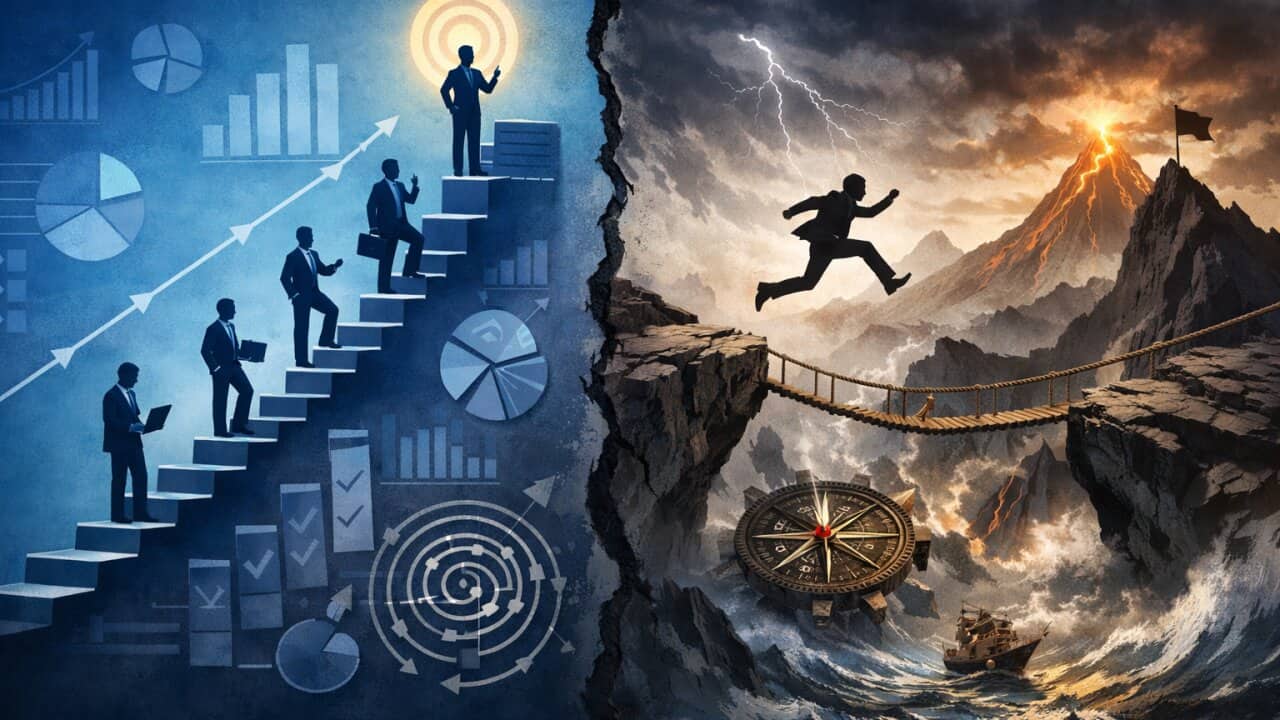
Most organisations read assessments through a present-day lens.
But leadership does not operate only in the present.
Leadership is about navigating future uncertainty.
And that requires a foresight lens.
Assessments Are Snapshots
Most assessments measure something very specific.
They capture a snapshot of behavioural preferences at a moment in time.
How someone sees themselves. How they prefer to work. How they respond to certain scenarios.
That information can be useful.
But it remains a static picture.
Leadership capability, however, is not static.
It evolves as environments shift, industries transform and pressures change.
Without a foresight perspective, organisations risk making decisions about the future using snapshots of the present.
The Linear Trap
Many assessment models operate on a linear assumption.
Measure enough traits and you can predict behaviour.
But the environments leaders operate in today are increasingly nonlinear.
Confidence can inspire a team in one situation and become arrogance in another.
Empathy can strengthen culture, yet the same empathy may delay difficult decisions when urgency is required.
Analytical thinking can improve strategy, but in moments of crisis too much analysis can paralyse action.
The effectiveness of any leadership trait depends on context.
And context is constantly shifting.
This is why assessments cannot be interpreted in isolation.
They need to be understood in relation to possible future environments.
That is where foresight becomes essential.
Why I Prefer Possibility Instead of Potential
This also explains why I rarely use the phrase leadership potential.
Potential assumes that the future capability of a person already exists and can be measured.
But the future rarely unfolds according to fixed traits.
People grow through exposure, challenges, failures and the environments they navigate.
Two individuals with identical assessment scores today may end up on completely different leadership journeys five years later.
One expands through challenge.
Another stagnates through comfort.
The difference was never in their potential.
The difference was in the possibilities they pursued and the environments they encountered.
Potential assumes the future is already contained within the individual.
Possibility recognises that the future emerges through interaction between the individual and the environment.
This is fundamentally a foresight perspective.
What Foresight Changes
When assessments are viewed through a foresight lens, the question changes.
Instead of asking:
“What type of leader is this person today?”
We begin to ask:
“How might this person respond across different possible futures?”
That shift is profound.
It moves the conversation from trait measurement to adaptive capability.
From personality profiles to thinking patterns under uncertainty.
From prediction to preparedness.
The Future of Leadership Assessment
Assessments will continue to exist.
In fact, with artificial intelligence entering recruitment systems, they may become even more sophisticated.
But sophistication does not automatically produce wisdom.
What organisations truly need is not better measurement.
They need better interpretation.
And interpretation requires understanding how human capability interacts with future uncertainty.
Final Reflection
Assessments can start a conversation.
But they should never end it.
Because leadership is not a fixed profile waiting to be measured.
It is a dynamic capability that reveals itself when circumstances change and certainty disappears.
Which is why assessments become far more meaningful when viewed through a foresight lens.
Not as predictions of who someone is.
But as signals of how someone might navigate the possibilities of the future.