Introduction
Imagine walking into your office carrying an invisible weight — a mounting pile of bills, an unexpected medical expense, or the creeping dread of not knowing how to meet next month’s mortgage payment. Now imagine being expected to collaborate, innovate, and perform at your highest level while that weight presses down on every decision you make.
For executives and organizational leaders, the data is no longer ambiguous. Employee financial wellbeing directly impacts productivity, retention, engagement, and your company’s bottom line. The question is not whether financial stress affects your teams — it unquestionably does. The critical question is: what will you do about it?
Progressive leaders who prioritize workplace transformation recognize that people-centric strategies are not soft initiatives — they are strategic imperatives. Understanding the full scope of how financial stress permeates organizational health is the first step toward building environments where people, and therefore companies, truly thrive.
The Research is Clear
The Cost of Financial Stress: By the Numbers
Financial Stress Doesn’t Stay Home When Employees Go to Work
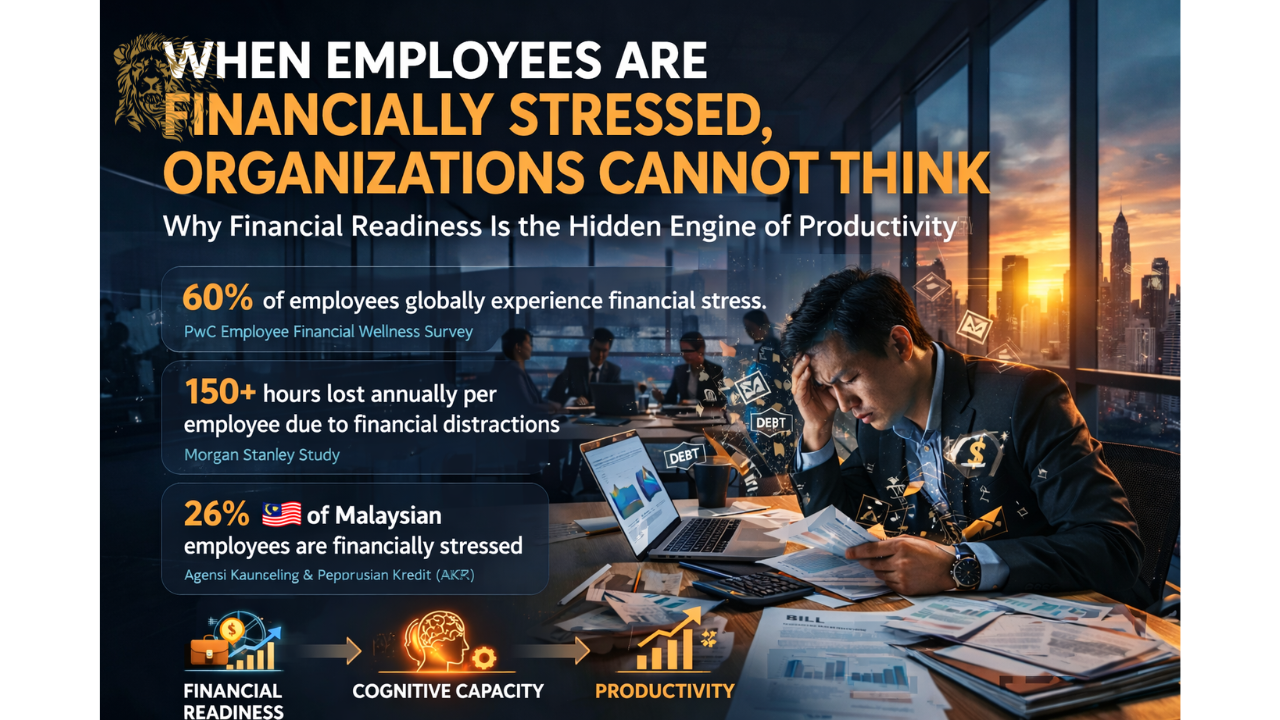
The human brain, when under financial duress, operates in a state of cognitive scarcity. Research from Princeton and Harvard has demonstrated that financial worry consumes mental bandwidth — the same bandwidth required for complex problem-solving, creative thinking, and sustained focus. When employees are preoccupied with financial hardship, they are neurologically less capable of performing at peak capacity.
This isn’t a matter of willpower or professionalism. It is neuroscience. The prefrontal cortex — responsible for executive function, decision-making, and impulse control — is demonstrably compromised when the mind is preoccupied with resource scarcity. Leaders who dismiss financial stress as “personal baggage” employees should “leave at home” are ignoring fundamental human biology.
The Ripple Effect Across Teams
Financial stress is contagious within teams. When one or more team members are visibly disengaged, overwhelmed, or absent due to financial hardship, the performance and morale of surrounding colleagues is measurably affected.
High-pressure moments — tight deadlines, client escalations, product launches — expose financially stressed employees most acutely. The organizations with the lowest resilience under pressure are consistently those with the highest rates of unaddressed employee financial anxiety.
Leading organizations that have implemented robust leadership development frameworks understand this dynamic and proactively address it as part of their organizational health strategy.
Wellbeing is Not a Benefit — It is a Business Strategy
The most forward-thinking organizations have stopped treating employee wellbeing as a line item in an HR budget and started treating it as a core business driver. They recognize that a workforce operating with holistic health — mentally, physically, and financially — is a workforce that delivers sustained competitive advantage.
Financial wellbeing is the often-overlooked pillar of the broader employee wellness conversation. Physical wellness programs, mental health days, and flexible work arrangements receive significant attention, but financial stress continues to operate quietly as the number one source of anxiety for employees globally.
The Leader’s Role in Financial Wellness
Leadership carries a profound responsibility that extends beyond quarterly targets and operational KPIs. The leaders who shape the most resilient, high-performing organizations are those who understand that their role is fundamentally human — built on trust, empathy, and a commitment to the flourishing of every individual under their influence.
This does not mean leaders must become financial advisors or therapists. It means they must become architects of environments where people feel safe, supported, and equipped to address the full range of challenges that affect their performance and wellbeing. Executive coaching has consistently shown that leaders who develop this depth of human awareness outperform their peers in every measurable business metric.
The call to action for leaders is clear: stop waiting for an HR initiative to solve what leadership culture creates or perpetuates. Own the organizational environment that either amplifies or alleviates employee financial stress.
The best leaders don’t manage problems — they build cultures where problems surface early, are met with compassion, and are solved together. Financial stress is not the exception to this principle. It is its most important test.
— Invictus Leader | Executive Leadership Principle
Practical Leadership
5 Strategies Leaders Can Implement Now
What Every Leader Must Remember
Take the Next Step
Strong Organizations Start with Strong People
Help your leaders create healthier, high-performing workplaces through intentional leadership development.
Explore Leadership Programs