Table of Contents
- The Giant That Saw the Disruption — and Blinked
- Tesla’s Future Strategy: Not a Car Company, Never Was
- Tesla vs General Motors: A Strategic Comparison
- Why Legacy Companies Are Structurally Wired to Fail Disruption
- Tesla’s Future Strategy: The Four Pillars That Built a Moat
- What Leaders Can Learn: The Foresight Gap
- Is GM’s Story Over? Or Is There Still a Path Forward?
- Key Takeaways: What the Tesla vs GM Story Teaches Every Leader
- Frequently Asked Questions
- The Future Doesn’t Arrive — It Is Built
Quick Answer: The Tesla vs General Motors story is not just a rivalry between two automakers — it is a masterclass in how strategic foresight separates legacy incumbents from future-defining disruptors. Tesla bet on software, energy, and autonomy when GM was still optimizing combustion. The gap between them reveals how leaders read — or miss — the signals of change.
In 2008, General Motors was the largest automaker on Earth. It had survived the Great Depression, two World Wars, and decades of fierce global competition. That same year, Tesla — a startup with fewer than 2,000 employees — delivered its first Roadster to a handful of customers. The idea that Tesla would one day surpass GM in market capitalization would have been laughed out of any boardroom.
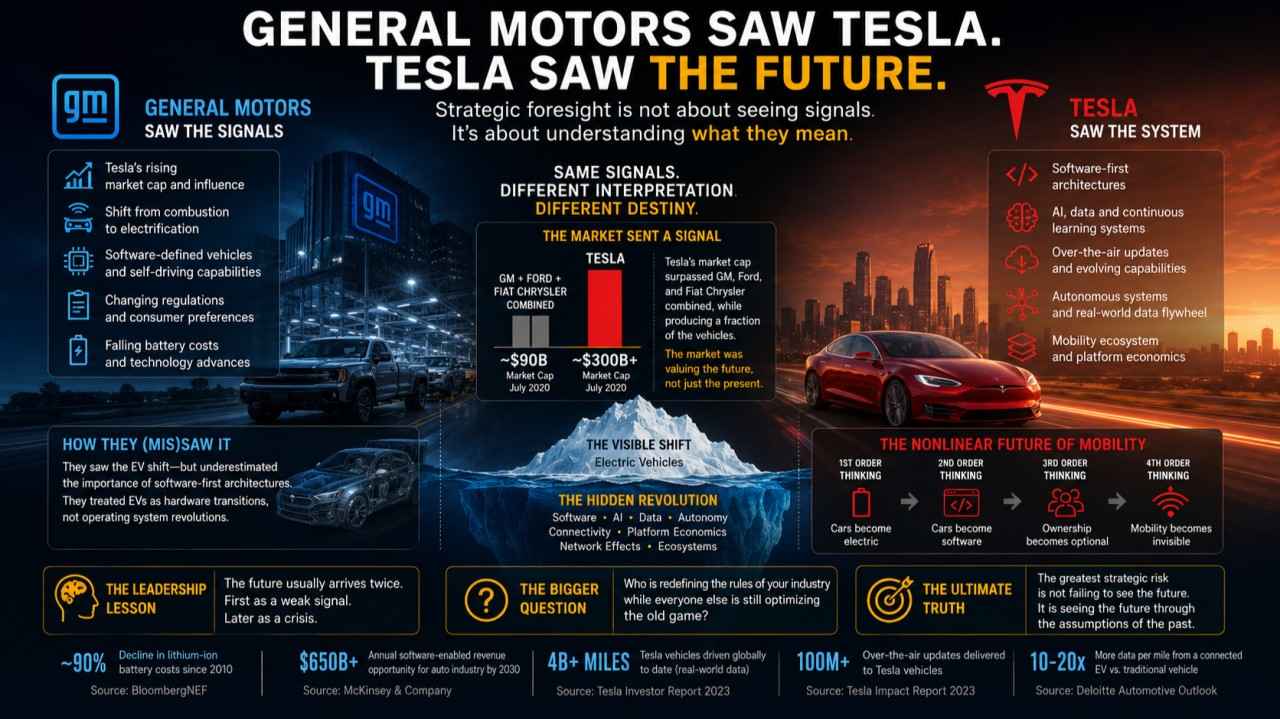
Yet by 2020, that is exactly what happened. And by 2023, Tesla’s market cap was more than five times that of General Motors.
This is not merely a business story. It is a profound case study in strategic foresight, organizational thinking, and what happens when leaders choose to defend the present instead of designing the future. The Tesla vs General Motors divergence holds lessons that go far beyond the auto industry — lessons every leader, executive, and organization can apply right now.
The Giant That Saw the Disruption — and Blinked
General Motors did not miss the electric vehicle revolution because they lacked intelligence. In fact, GM produced the EV1 in 1996 — one of the world’s first mass-produced electric vehicles. Engineers loved it. Early adopters praised it. The technology worked.
Then GM cancelled it. Crushed thousands of units. And returned to optimizing internal combustion.
Why? Because the future was visible, but the present was more profitable. GM’s entire system — its supplier networks, dealer franchises, profit models on parts and servicing, executive incentive structures — was built around combustion engines. Transitioning to EVs was not just a product challenge. It was an existential organizational redesign.
This is the trap that catches most incumbents. They see the signal. They may even run pilot projects. But their strategic architecture is designed to protect the current core, not to build the next one. As a result, the future arrives on someone else’s terms.
This is precisely the pattern that strategic foresight frameworks are designed to interrupt — helping leaders recognize not just what is changing, but what their own systems are incentivized to ignore.
Tesla’s Future Strategy: Not a Car Company, Never Was
Elon Musk’s most important strategic insight was deceptively simple: Tesla is not an automobile company. It is an energy and technology company that uses cars as the primary delivery mechanism for its platform.
This reframe changed everything. When you are building an energy platform, you invest in:
Battery Technology
Treating energy storage as the foundation of a multi-decade platform, not just a vehicle component.
Software & OTA Updates
Cars that improve over time like smartphones — creating a recurring relationship, not a one-time transaction.
Autonomous Driving Data
Every Tesla on the road feeds a global neural network, compounding the AI advantage with each mile driven.
Energy Ecosystem
Powerwall, Solar Roof, and Megapack position Tesla as the infrastructure layer of the clean energy transition.
Meanwhile, GM’s Tesla future strategy was reactive. They launched the Bolt. They announced electrification targets. They rebranded divisions. But the strategic architecture underneath — the mental models, incentive systems, and organizational design — remained combustion-era thinking in an electric-era wrapper.
This is the distinction between adaptation and transformation — between optimizing what exists and regenerating toward what is becoming. Organizations that master this distinction are exactly what the leadership systems and strategy work at Invictus Leader is built around.
Tesla vs General Motors: A Strategic Comparison
| Strategic Dimension | Tesla | General Motors |
|---|---|---|
| Core Identity | Energy & technology platform | Automotive manufacturer |
| Revenue Model | Software, energy, services, FSD licensing | Vehicle sales, parts, financing |
| Innovation Engine | Vertical integration, in-house chips, AI | Supplier networks, legacy R&D |
| Data Strategy | Fleet-scale real-world AI training | Limited, fragmented data assets |
| Leadership Orientation | Future-first, mission-driven | Present-optimized, shareholder returns |
| Market Cap (2024 est.) | ~$650–800 billion | ~$45–55 billion |
| Dealer Model | Direct-to-consumer | Franchise dealer network |
Why Legacy Companies Are Structurally Wired to Fail Disruption
The GM story is not unique. Kodak invented the digital camera — and buried it. Nokia dominated mobile — and dismissed the smartphone. Blockbuster had the chance to acquire Netflix — and passed. In each case, the incumbent had the intelligence, the capital, and even the technology. What they lacked was the organizational will — and the leadership architecture — to cannibalize themselves.
There are three structural reasons large organizations fail to respond to disruptive signals, even when they see them clearly:
Incentive Misalignment
Every executive bonus, every quarterly target, every analyst expectation is built around the existing business. Investing in a cannibalizing future is career risk, not career advancement.
Cognitive Anchoring
Leaders who rose within a paradigm are neurologically anchored to its assumptions. They filter new signals through the lens of what made them successful — which is precisely the lens that blinds them to structural shifts.
Organizational Immune Response
Large organizations have powerful immune systems. New ideas that threaten the core are rejected — not maliciously, but systemically. Procurement slows pilots. Legal stalls experiments. Culture kills urgency.
Breaking through these structural barriers requires more than a strategy offsite or a digital transformation program. It requires a fundamental rewiring of how the organization sees the future — and how it builds the capacity to act on what it sees. This is the work described in the Invictus Edge methodology, which combines futures intelligence with deep organizational change.
Tesla’s Future Strategy: The Four Pillars That Built a Moat
Tesla’s competitive advantage is frequently misunderstood. Most analysts focus on the vehicles. But the vehicles are just the access point to a much deeper strategic architecture. Tesla future strategy rests on four reinforcing pillars that compound over time.
Pillar 1: Vertical Integration as Strategic Control
Tesla designs its own chips, builds its own factories (Gigafactories), controls its own sales channel (no dealers), and operates its own charging network (Supercharger). This is not just cost efficiency — it is strategic control. Every touchpoint in the customer journey is owned, optimized, and data-generating. GM, by contrast, relies on a complex web of suppliers, franchise dealers, and third-party service networks — each introducing friction, data gaps, and margin leakage.
Pillar 2: The Software Flywheel
A Tesla purchased today will be meaningfully better in 12 months — without the owner ever visiting a dealership. Over-the-air software updates add features, improve performance, and fix issues. This creates a fundamentally different relationship between manufacturer and customer. It also creates a recurring revenue opportunity: Tesla’s Full Self-Driving (FSD) package is sold as a subscription, generating software margin on hardware already sold. GM has no equivalent capability at scale.
Pillar 3: Data as Compounding Competitive Advantage
With millions of vehicles on the road, Tesla collects billions of miles of real-world driving data every year. This data trains the neural networks that power Autopilot and Full Self-Driving. The more cars on the road, the better the AI. The better the AI, the more valuable the FSD product. The more valuable FSD, the more cars sold. This is a compounding flywheel that no competitor — not GM, not Ford, not Volkswagen — can replicate without years of catch-up at massive cost.
Pillar 4: Mission as Talent Magnet
Tesla’s stated mission — to accelerate the world’s transition to sustainable energy — is not marketing copy. It is a recruitment engine. The best engineers, AI researchers, and systems thinkers in the world choose Tesla because they want to work on something that matters. This gives Tesla access to talent pools that legacy automakers simply cannot attract. GM may offer higher salaries in some cases, but Tesla offers meaningful work at civilizational scale.
The numbers tell a stark story about the Tesla vs General Motors divergence
What Leaders Can Learn: The Foresight Gap
The Tesla vs General Motors story is ultimately about the foresight gap — the distance between what an organization can see and what it is willing to act on. This gap is not a failure of intelligence. It is a failure of organizational design, leadership courage, and futures capability.
Leaders who close the foresight gap share three characteristics:
They distinguish signals from noise systematically.
They have structured processes — not just intuition — for scanning the horizon and separating weak signals from irrelevant noise. They build futures intelligence into routine decision-making, not just annual planning.
They invest in the future before it becomes obvious.
The moment disruption becomes undeniable, the window for strategic positioning has largely closed. Tesla’s advantage was built during the years when the EV thesis was still dismissed by mainstream analysts. The leaders who act early, when the cost of being wrong is still manageable, are the ones who define the next era.
They build organizations capable of transformation, not just adaptation.
Adaptation optimizes for the existing context. Transformation redesigns the organization for a context that does not yet fully exist. This requires a different kind of leadership — one that can hold ambiguity, build trust through uncertainty, and create conviction without complete information.
These capabilities are not innate. They are developed through deliberate practice, rigorous frameworks, and the kind of immersive leadership development that Invictus Leader has refined across four decades and 54 countries.
Is GM’s Story Over? Or Is There Still a Path Forward?
It would be unfair — and strategically inaccurate — to write GM off entirely. Under CEO Mary Barra, General Motors has made genuine moves toward electrification and autonomy. The Ultium battery platform represents a serious engineering investment. The Cruise autonomous vehicle division, before its setbacks, showed genuine ambition. GM’s scale, manufacturing expertise, and global distribution remain formidable assets.
But the central challenge for GM is not technological. It is architectural. The question is whether GM can simultaneously optimize its existing combustion business (which still generates the majority of its profits) while building a genuinely new architecture for the electric, software-driven era. That is a brutal strategic tension that very few organizations in history have successfully navigated.
The companies that navigate it successfully tend to share one quality: they treat the incumbent business as the fuel for the future, not the definition of it. They use the cash flows and capabilities of today to fund experiments that may cannibalize tomorrow. That requires a level of organizational maturity and leadership sophistication that is extraordinarily rare.
It is the kind of capability that non-linear leadership and strategic foresight thinking is designed to build — not as a one-time intervention, but as an organizational capability that renews itself continuously.
Key Takeaways: What the Tesla vs GM Story Teaches Every Leader
Seeing the future is not enough. GM saw EVs coming. The gap between insight and action is an organizational design problem, not an intelligence problem.
Platform thinking beats product thinking. Tesla won not because it built a better car, but because it built a better platform. The car was the entry point to an ecosystem.
Incentive structures determine strategic behavior. If your organization rewards short-term performance, it will sacrifice long-term positioning. Every time.
Mission attracts the talent that builds moats. Organizational purpose is not a soft concept. It is a talent acquisition strategy that determines the quality of your innovation pipeline.
Foresight is a practice, not an event. Tesla future strategy was not defined in a single planning cycle. It was shaped by a consistent, relentless orientation toward the future that permeated every decision — from factory design to customer experience to capital allocation.
Regeneration outlasts transformation. One-time transformation programs create temporary advantage. Organizations that build the capacity to continuously regenerate — to renew their own architecture — sustain advantage across multiple disruption cycles.
Is Your Organization Building for the Future — or Defending the Present?
The gap between GM and Tesla is not about technology. It is about how leaders are developed, how organizations are designed, and whether you have the futures intelligence to act before disruption forces your hand.
Explore Our Solutions Talk to Our TeamFrequently Asked Questions: Tesla vs General Motors
Markets price future expectations, not current revenue. Tesla is valued as a technology and energy platform with software margins and compounding data advantages. GM is valued as a mature automotive manufacturer with commoditized margins.
GM’s biggest mistake was not the cancellation of the EV1. It was the failure to build the organizational architecture to act on what it already knew about electric vehicles and future market shifts.
Tesla’s deepest moat is its data flywheel, software ecosystem, vertical integration, direct sales model, and AI-driven autonomous driving capabilities.
GM can compete in specific EV segments, but closing the software, AI, and data gap requires years of transformation and significant organizational change.
The story highlights the importance of strategic foresight, platform thinking, innovation culture, mission-driven leadership, and long-term investment in future opportunities.
Tesla controls the customer experience end-to-end, reduces costs, gathers direct customer data, and avoids dealer-related friction.
Strategic foresight helps organizations identify future opportunities and threats before they become obvious, enabling proactive rather than reactive decisions.
FSD creates recurring software revenue, improves through real-world data collection, and strengthens Tesla’s competitive advantage over time.
Examples include Microsoft under Satya Nadella and Adobe’s transition to Creative Cloud, both of which successfully reinvented their business models.
Organizations can build foresight through future-focused leadership development, scenario planning, innovation systems, and structured horizon scanning.
The Future Doesn’t Arrive — It Is Built
The Tesla vs General Motors story will be studied in business schools for generations. But its most important lesson has nothing to do with electric vehicles, stock prices, or Silicon Valley culture.
Its most important lesson is this: the future does not happen to organizations. It is built by leaders who develop the foresight to see it coming, the courage to act before it arrives, and the organizational architecture to sustain advantage through the disruption that inevitably follows.
GM saw Tesla. Tesla saw the future. The difference was not intelligence. It was design — the design of leadership, strategy, and organizational systems for a world that had not yet arrived.
The question every leader must ask is: when the next Tesla looks at your industry, what will they see? And will your organization be positioned to build alongside them — or to defend against them?
If you are ready to close your organization’s foresight gap, connect with the Invictus Leader team and explore how three decades of futures intelligence and regenerative leadership work can help you build an organization designed for what is becoming — not just what is.