Introduction: A Sacred Day Meets a Digital Age
Every year, on the full moon of the lunar month of Vesakha, millions of Buddhists across the world pause. They light candles, offer flowers, and sit quietly with a question that has echoed for over two-and-a-half millennia: What does it truly mean to see clearly?
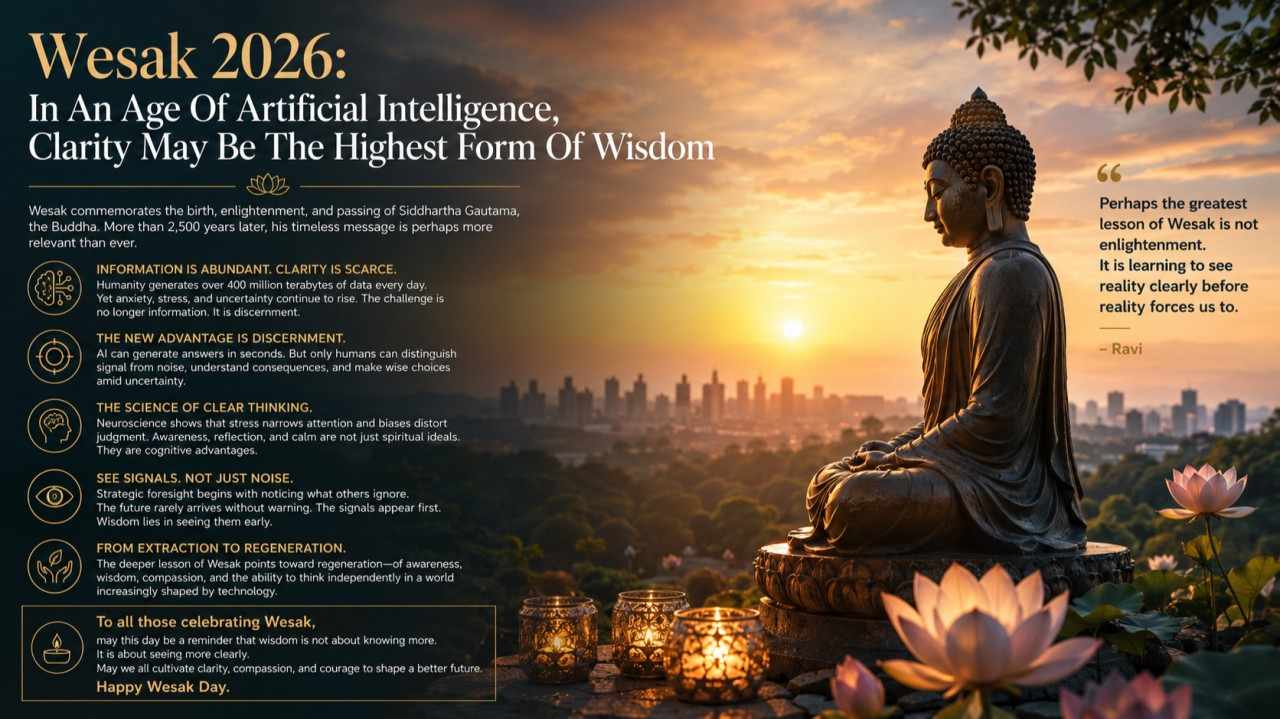
In 2026, Wesak Day falls on 31 May — and it arrives at a moment of extraordinary historical irony. The world is in the grip of an intelligence revolution. Artificial intelligence now writes, reasons, diagnoses, creates, and advises. Data is infinite. Information is instant. And yet, by most measures, human clarity — the kind the Buddha spent his life cultivating and teaching — has never been rarer or more urgently needed.
This Wesak 2026, we explore a profound intersection: the ancient Buddhist pursuit of clarity, wisdom, and mindful awareness, and what that pursuit means for leaders, organisations, and individuals navigating an age powered by artificial intelligence. As the Buddha’s teachings remind us, intelligence without wisdom is noise. And in 2026, the world has more noise than it has ever known.
At Invictus Leader, we believe that in an age of artificial intelligence, clarity may indeed be the highest form of wisdom — for leaders, for teams, and for the organisations they serve.
What Is Wesak and Why Does It Matter in 2026?
Wesak — also known as Vesak, Buddha Day, or Buddha Purnima — is the most important festival in the Buddhist calendar. It commemorates three momentous events in the life of Siddhartha Gautama on the same day of the lunar calendar: his birth, enlightenment, and passing (Parinirvana).
Birth
The arrival of the one who would become the Awakened One — a reminder that transformation begins with a single moment of becoming.
Enlightenment
Beneath the Bodhi tree, Siddhartha saw through the illusions of the conditioned mind — and found the clarity that would become Buddhism’s greatest gift.
Parinirvana
The final passing into liberation — a teaching that all things are impermanent, and that what endures is the wisdom we leave behind.
In 2026, Wesak is observed globally. In the United Kingdom, Buddhist communities from Theravāda to Mahāyāna traditions gather to celebrate. Across Malaysia, Singapore, Sri Lanka, Thailand, and India, public processions, temple ceremonies, acts of charity, and the release of animals mark the day. The symbolic acts are rich with meaning: flowers represent life’s impermanence; candles and incense, the light of wisdom overcoming ignorance; white garments, the simplicity of an uncluttered mind.
At its core, Wesak is not merely a commemoration. It is an invitation — to reflect, to recommit, and above all, to cultivate the kind of seeing clearly that the Buddha called the foundation of all liberation.
The Challenge of Clarity in an Age of AI
We live in what may be history’s most information-rich moment. In 2026, AI systems generate more text, analysis, and creative output in a single day than any human library has ever contained. Executives receive AI-generated briefings. Algorithms write reports. Predictive models advise on strategy. And yet, paradoxically, many leaders report feeling less clear — not more — about what is true, what matters, and what to do.
“Intelligence and wisdom are not the same thing. Intelligence processes. Wisdom discerns. AI gives us more of the former. The question for 2026 is whether we are cultivating enough of the latter.”
Research published in Nature Mental Health in 2026 notes that while AI is advancing rapidly, it lacks the core attributes of human wisdom — including compassion, self-reflection, emotional regulation, and the acceptance of diverse perspectives. The study calls for a new kind of “artificial wisdom” system, but the deeper implication is clear: human wisdom cannot be automated. It must be developed, practised, and protected.
The Buddhist concept of Prajñā — often translated as wisdom or insight — describes a quality of mind that sees things as they actually are, free from distortion, bias, and craving. In the AI age, this has a startling practical relevance. Leaders who cannot distinguish between data and truth, between AI-generated insight and genuine understanding, between processed information and lived wisdom, are navigating by a map that may not reflect the territory.
The Three Modern Obstacles to Clarity
The Buddha identified mental hindrances — kilesas — that cloud perception and lead to suffering. In the AI era, three contemporary equivalents threaten executive clarity:
- Information overload: When every decision is preceded by dozens of AI-generated reports, the signal is buried in noise. Volume masquerades as insight.
- Algorithmic bias: AI models reflect the assumptions built into their training data. Leaders who accept AI output uncritically inherit those assumptions without knowing it.
- Speed pressure: The expectation of instant AI-powered responses compresses the reflective time that genuine wisdom requires. Decisions are made faster — but not always better.
These are not technological problems. They are human problems — and they call for human solutions rooted in the kind of mindful, deliberate awareness that Wesak celebrates.
What Buddhist Wisdom Teaches Us About AI
The Buddha’s teachings — particularly the Noble Eightfold Path — offer a framework of extraordinary relevance for leaders grappling with AI. At the heart of this path is a commitment not to intelligence for its own sake, but to right understanding and right intention. These are the first two steps — and they are deeply about clarity.
The Buddhist concept of Anicca — impermanence — is particularly instructive. Today’s leading AI model will be obsolete within months. The tool your team relies on today will be superseded, deprecated, or replaced. Leaders who build their organisations around the permanence of any AI system are building on sand. What endures is not the tool, but the wisdom with which it is used.
The leadership development frameworks we work with at Invictus Leader are designed precisely around this principle: cultivating the human capacities — clarity, discernment, ethical grounding — that no algorithm can replace.
Clarity as the Highest Form of Leadership Wisdom
What do we mean when we say that clarity may be the highest form of wisdom in the AI age? We mean something specific — and something that leaders at every level need to hear.
Clarity is not simplicity. It is not the reduction of complexity to a soundbite or a dashboard metric. Clarity is the capacity to hold complexity, to sit with uncertainty, and to see through confusion to what is actually true and actually important. It is, in Buddhist terms, the mind that has been trained not to be swept away by the torrents of data, opinion, fear, and desire that constitute modern organisational life.
Three Dimensions of Leadership Clarity
1. Perceptual Clarity
The ability to see what is actually happening — in the data, in the team, in the market — without the distortions of ego, assumption, or wishful thinking. In an AI-rich environment, this means asking: What is the AI not seeing?
2. Intentional Clarity
Knowing why you are doing what you are doing, and being able to articulate it to your team and stakeholders. As AI takes over the how of many tasks, the why becomes the leader’s most distinctive — and most human — contribution.
3. Communicative Clarity
The capacity to translate complex, AI-informed realities into language that people can act on. Leaders who speak clearly — who can synthesise, simplify without distorting, and inspire without misleading — become invaluable in the AI age.
Research consistently shows that clarity of purpose is one of the most significant predictors of team performance and organisational resilience. A 2024 McKinsey Global Survey found that organisations with clear strategic intent performed significantly better in periods of disruption — and disruption, in 2026, is the baseline condition rather than the exception.
This is why we at Invictus Leader focus on developing what we call executive foresight — the cultivated capacity to see further, more clearly, and more wisely than the volume of information and the pace of change would otherwise allow.
Five Practices for Cultivating Clarity in the AI Era
Drawing on both Buddhist philosophy and contemporary leadership science, here are five practices that leaders can begin this Wesak 2026 — not as spiritual exercises, but as rigorous professional disciplines.
Practice Intentional Stillness
The Buddha’s enlightenment came through sustained, disciplined stillness — not through processing more information, but through the radical act of stopping. Build deliberate pauses into your decision-making processes. Before acting on any significant AI-generated recommendation, take time to reflect: Is this true? Is this useful? Is this aligned with our values?
Cultivate Beginner’s Mind
The Zen concept of shoshin — beginner’s mind — describes the ability to approach even familiar situations with openness and without assumption. In the AI age, this means staying genuinely curious about what the technology cannot do, where its models break down, and what human judgment must supply. Experts are most dangerous when they stop questioning.
Separate Signal from Noise
In the Buddhist tradition, the practice of discernment — viveka — is the disciplined capacity to distinguish what is essential from what is incidental. Leaders must develop explicit practices for filtering AI-generated information: not all data is equally meaningful, and not all recommendations are equally wise. Invest in your organisation’s signal-to-noise capabilities.
Anchor in Values, Not Metrics
AI is extraordinarily good at optimising for what can be measured. It has no capacity to protect what cannot be quantified — culture, trust, integrity, human dignity. Leaders must consciously anchor their decisions in stated organisational values, especially when AI-generated analysis points in a different direction. Clarity of values is the compass when data becomes noise.
Invest in Human Connection
The Buddha’s teaching on Sangha — community — recognised that wisdom is not a solo achievement. It emerges in relationship, in dialogue, in the friction and support of genuine human connection. As AI mediates more and more professional interactions, the leaders who deliberately invest in face-to-face connection, honest conversation, and authentic relationship will build the trusting environments where wisdom can actually grow.
Develop the Clarity Your Leadership Requires
In an age of artificial intelligence, your most valuable leadership asset is the wisdom to act with clarity, conviction, and compassion. Invictus Leader works with senior executives to build exactly that capacity — through foresight advisory, executive engagement, and transformational programmes designed for the AI era.
Conclusion: The Light That Does Not Flicker
On Wesak 2026, as lanterns are lit and temples are filled with the scent of incense and the sound of chanting, the central symbol of the day speaks as powerfully as it ever has: the candle’s flame, representing the light of wisdom overcoming the darkness of ignorance.
In 2026, the darkness is not ignorance in the traditional sense. We have more information than we can process. The darkness is the confusion that information overload produces — the inability to see clearly amid the noise, the speed, and the sheer volume of an AI-powered world. And the light, as the Buddha taught, is not more data. It is clarity. It is wisdom. It is the trained, cultivated, practised capacity to see what is actually true.
For leaders, for organisations, and for the individuals who make up both, this Wesak offers more than a moment of spiritual reflection. It offers a practical provocation: In an age of artificial intelligence, are you investing as seriously in your human wisdom as you are in your technology?
Because if you are not, no algorithm will compensate for the gap. AI can process. AI can predict. AI can optimise. But only you — as a leader, as a human being with values and vision and the capacity for genuine wisdom — can provide the clarity that your organisation most deeply needs.
The leadership advisory work we do at Invictus Leader is grounded in exactly this conviction. Happy Wesak 2026. May your thinking be clear, your intentions be noble, and your leadership illuminate the path for those who follow you.
Frequently Asked Questions