


Introduction: The Question That Has Defined Half a Century
Featured Insight
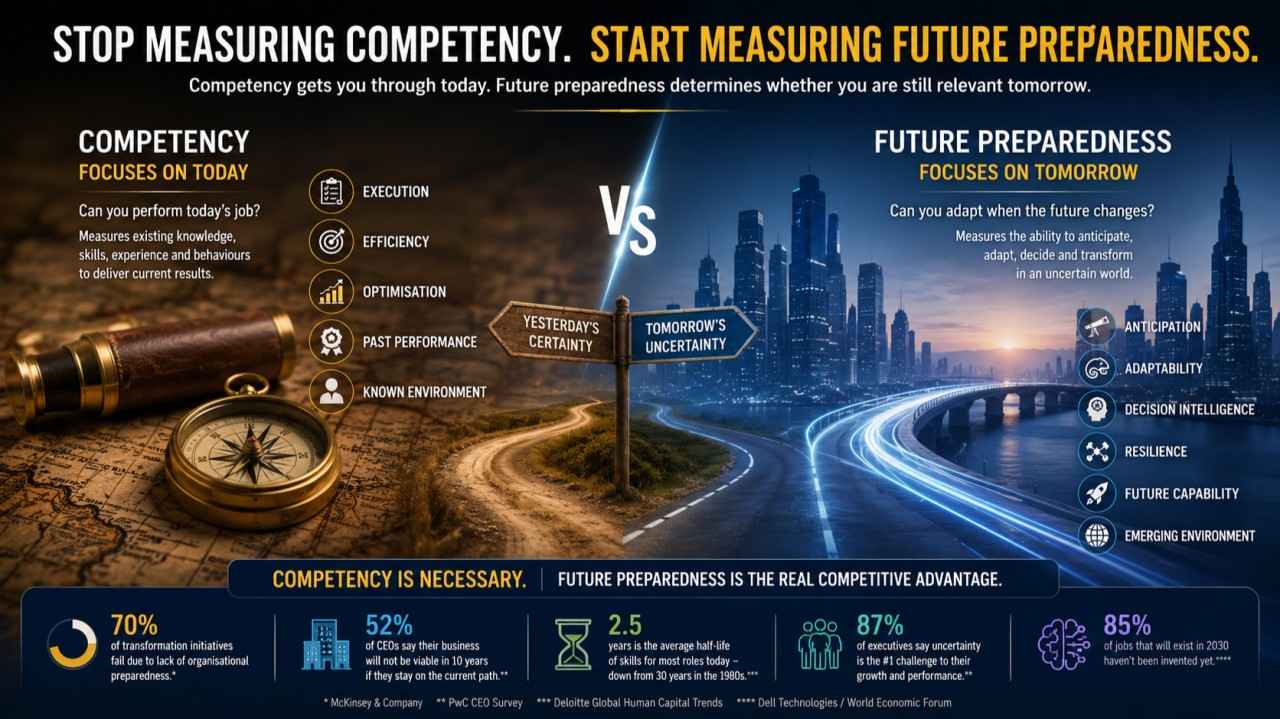
What is the difference between competency and future preparedness? Competency tells us whether someone can perform today’s role. Future preparedness tells us whether individuals, teams and organisations can adapt when that role changes. One measures today’s ability. The other measures tomorrow’s resilience. Both are necessary — but only one determines whether an organisation is still relevant in a decade.
For almost half a century, organisations have been obsessed with one question: “Are our people competent?”
Entire industries have been built around answering it. Competency frameworks. Competency-based interviews. Competency assessments. Competency dictionaries. Competency development programmes. Billions of dollars have been invested globally to define, measure and develop competencies.
There is nothing inherently wrong with competency. In fact, competency remains essential.
But there is one problem.
Competency was never designed to measure preparedness.
And that distinction has become one of the biggest strategic blind spots facing organisations today.
70%
of transformation initiatives fail due to lack of organisational preparedness
52%
of CEOs say their business will not be viable in 10 years on the current path
2.5
years — the average half-life of skills today, down from 30 years in the 1980s
85%
of jobs that will exist in 2030 have not been invented yet
Three Ages of Organisational Measurement
Every era measures what it values. And what an era values reveals exactly what it believes success requires. The journey from industrial productivity to competency to preparedness is not simply a story about measurement tools — it is a story about how the nature of competitive advantage itself has transformed.
The Industrial Age — Measuring Productivity
Success was measured by output. How much could you produce? How efficiently could you operate? How consistently could you repeat the process? The best organisations became masters of efficiency — and they measured every step of it.
The Knowledge Economy — Measuring Competency
Success shifted towards capability. Organisations wanted people with the right knowledge, the right skills, the right behaviours, the right experience. Competency became the language of recruitment, learning, leadership development and succession planning. It was the right response for its time.
The Age of Uncertainty — Measuring Preparedness
Today’s environment is fundamentally different. AI is changing work faster than organisations can redesign jobs. Business models are disrupted. Supply chains carry geopolitical risk. Customer expectations evolve continuously. In this environment, the question is no longer “Are we competent?” — it is “Are we prepared?” That is a fundamentally different question.
Competency Is Necessary. It Is No Longer Sufficient.
Quick Answer
Why is competency no longer enough? Competency measures the ability to perform today’s role in today’s environment. Future preparedness measures whether an individual, team or organisation can anticipate, adapt and make effective decisions when that environment changes. As change accelerates, the gap between these two questions widens — and that gap is where organisations either survive or fail.
One is not better than the other. Both are important. But they answer completely different questions — and most organisations only measure one of them.
| Competency — Focuses on Today | Future Preparedness — Focuses on Tomorrow |
|---|---|
| Can you perform today’s job? | Can you adapt when the future changes? |
| Measures existing knowledge, skills and behaviours | Measures ability to anticipate, adapt, decide and transform |
| Execution | Anticipation |
| Efficiency | Adaptability |
| Optimisation | Decision Intelligence |
| Past performance | Resilience |
| Known environment | Emerging environment |
Competency measures today’s ability. Preparedness measures tomorrow’s resilience. Competency explains current performance. Preparedness determines future relevance.
History Has Already Given Us the Answer
Think about the organisations that dominated their industries. Their failure was not caused by a lack of competency. It was their inability to read the signals of change.
These were not organisations staffed by incompetent people. They employed some of the world’s most competent engineers, marketers, strategists and executives. Their failure was something else entirely.
Kodak
Invented digital photography. Could not adapt to it. Competency remained high. Preparedness collapsed.
Nokia
40% of the mobile market. Missed the smartphone era. Not for lack of talent — for lack of foresight.
BlackBerry
Owned enterprise mobile. Refused to challenge its core assumptions. Competence without adaptability.
Yahoo
Once synonymous with the internet. Could not sense the shift or respond decisively in time.
What they had
Competency remained high. World-class engineers, strategists and executives.
What they lost
Preparedness declined. The inability to sense signals, challenge assumptions and adapt proved fatal.
Science Has Been Pointing in This Direction for Years
Management research has increasingly shifted beyond competency toward broader organisational capabilities. The evidence has been accumulating for years.
Three bodies of research in particular converge on the same conclusion — and every serious CEO and board member should be familiar with them.
Dynamic Capabilities Research
Long-term success depends on an organisation’s ability to sense change in the environment, seize emerging opportunities, and continuously transform itself. These capabilities go far beyond the execution of existing competencies.
Absorptive Capacity Research
Organisations create competitive advantage by recognising valuable external knowledge, integrating it into their systems, and applying it faster than competitors. This is a preparedness capability — not a competency one.
Strategic Foresight Research
Organisations that systematically scan for change, interpret weak signals, and explore alternative futures are generally better positioned to navigate uncertainty. Foresight is a discipline — not an instinct — and it must be deliberately developed.
The common thread across all three is clear. Future success depends on more than competency. It depends on preparedness. And preparedness, unlike competency, cannot be measured by asking whether someone completed a training programme or scored well on an assessment.
The Questions Every Board Should Be Asking
Quick Answer
What questions should boards be asking about future preparedness? Boards should be asking whether the organisation can detect weak signals before competitors; how vulnerable its strategy is to multiple future scenarios; where its strategic blind spots lie; how quickly it can adapt when disruption occurs; and what future capabilities are missing today. These questions cannot be answered through competency frameworks alone.
Most Organisations Ask
- “Are our leaders competent?”
- “Do we have the right skills?”
- “Have employees completed training?”
These remain useful questions — but they are no longer enough.
Future-Ready Boards Also Ask
- “Can we detect weak signals before competitors?”
- “Where are our strategic blind spots?”
- “How quickly can we adapt to disruption?”
- “What future capabilities are missing today?”
- “How prepared are we to decide under uncertainty?”
The organisations that will thrive in the coming decade are not necessarily those with the highest competency scores. They are those whose boards have the courage and the vocabulary to ask the second set of questions — and the measurement systems to answer them honestly.
Measuring the Wrong Thing Creates a False Sense of Confidence
This is perhaps the most dangerous dimension of the competency trap. An organisation can have exceptional competency scores, outstanding performance ratings, excellent leadership programmes, and strong employee engagement — and still be strategically unprepared.
History repeatedly shows that organisations rarely collapse because people suddenly become incompetent. They struggle because they continue measuring yesterday’s success while tomorrow’s environment changes around them.
The false confidence created by strong competency measures is insidious precisely because it is built on real data. The data is accurate. The problem is that it answers a question the future is not asking.
The Measurement Gap
Preparedness cannot be assumed. It must be measured.
From Competency to Future Preparedness
Quick Answer
What is the Invictus Future Readiness Diagnostic™? The IFRD is a proprietary assessment framework developed by Invictus Leader that evaluates organisational preparedness across multiple strategic dimensions — including strategic readiness, leadership readiness, signal readiness, decision intelligence, AI readiness, governance, learning velocity, workforce readiness and strategic integrity. It answers the question: how prepared are we to succeed in an uncertain future?
This is precisely why Invictus Leader developed the Invictus Future Readiness Diagnostic™ (IFRD).
The IFRD is not another competency assessment. Nor is it intended to replace competency frameworks. It answers an entirely different question: How prepared are individuals, teams and organisations to succeed in an uncertain future?
IFRD — What It Measures
Because in the coming decade, the greatest competitive advantage will not belong to organisations with the best competency frameworks. It will belong to those that recognise change earlier, make better decisions under uncertainty, and prepare before disruption forces them to react.
A Final Thought
Competency may have built yesterday’s successful organisations. Preparedness will build tomorrow’s.
The distinction is not abstract. It is not a theoretical exercise for academics or a talking point for consultants. It is the most practical leadership question of our time.
Every CEO who sits in a boardroom reviewing competency data while the competitive landscape shifts around them is experiencing this distinction in real time — whether they have named it or not.
Quick Answer
What is the most important leadership question for the decade ahead? The most important question every CEO, board member and HR leader should now ask is not “How competent are we?” but “How prepared are we for a future that has not yet arrived?” Competency gets you through today’s challenges. Future preparedness determines whether you are still relevant tomorrow.
Competency gets you through today’s challenges. Future preparedness determines whether you are still relevant tomorrow.
— Ravi VS, Invictus Leader
About Invictus Leader
How Invictus Leader Helps Organisations Measure What Matters
Invictus Leader is a boutique global advisory firm helping leaders and organisations thrive through clarity, foresight, and purposeful growth. Its belief is foundational: the future isn’t managed — it’s co-created.
The work of Invictus Leader is built on the conviction at the heart of this article: that the most consequential question an organisation can ask has shifted. No longer “Are we competent?” but “Are we prepared?” And that preparedness — unlike competency — must be deliberately designed, systematically measured, and continuously developed.
What Invictus Leader Offers
- The Invictus Future Readiness Diagnostic™ (IFRD) — A proprietary multi-dimensional framework that evaluates organisational preparedness across strategic, leadership, workforce, AI and governance dimensions. Not a competency assessment. A preparedness measurement.
- CEO & Executive Foresight Coaching — Structured coaching that helps leaders develop the capacity to read signals, challenge prevailing assumptions and make better decisions in uncertain environments.
- Leadership Foresight Programs — Development programmes that build the strategic vocabulary and cognitive tools of future-ready leadership across executive and senior leadership teams.
- Culture Architecture & Transformation — Advisory work that designs the environments, systems and norms that enable organisations to adapt, learn and continuously improve — at pace.
- Organisational leadership consulting — End-to-end advisory engagements that move organisations from reactive competency management to proactive preparedness by design.
The leaders who work with Invictus Leader do not simply close skill gaps. They develop the organisational intelligence to see around corners — and the readiness to act on what they see, before their competitors do.
Is your organisation measuring the right thing?
If your current measurement systems tell you how competent your organisation is — but cannot tell you how prepared it is — Invictus Leader’s future readiness advisory services provide the framework, expertise and foresight to change that.
Explore Invictus Leader →Frequently Asked Questions
What is the difference between competency and future preparedness?
Competency measures whether someone can perform today’s role in today’s environment — their existing knowledge, skills, behaviours and experience. Future preparedness measures whether individuals, teams and organisations can anticipate, adapt and make effective decisions when that environment changes. Competency answers the question of current execution. Future preparedness answers the question of tomorrow’s relevance.
Why is competency no longer sufficient for organisational success?
Competency was designed for relatively stable environments where the skills that produced past success would continue to produce future success. Today’s environment — characterised by AI disruption, geopolitical volatility, shortening technology cycles and rapidly evolving customer expectations — is not stable. Skills now have an average half-life of 2.5 years. In this context, the ability to adapt, anticipate and learn fast is more strategically valuable than any fixed set of competencies.
What organisations failed due to competency without preparedness?
Kodak, Nokia, BlackBerry and Yahoo are among the most cited examples. Each employed highly competent professionals — engineers, strategists and executives of the highest calibre. Their failure was not a competency failure. It was a preparedness failure: the inability to recognise emerging signals, challenge prevailing assumptions, adapt quickly enough and respond decisively to structural change. Their competency remained high. Their preparedness declined. The difference proved fatal.
What questions should a board be asking about future preparedness?
Future-ready boards should be asking: Can we detect weak signals before competitors? How vulnerable is our strategy to multiple future scenarios? Where are our strategic blind spots? How quickly can we adapt when disruption occurs? What future capabilities are missing today? How prepared are we to make decisions under uncertainty? These questions cannot be answered through competency frameworks or performance management systems alone — they require a dedicated preparedness measurement approach.
What is the Invictus Future Readiness Diagnostic™ (IFRD)?
The IFRD is a proprietary assessment framework developed by Invictus Leader that evaluates organisational preparedness across multiple strategic dimensions — including strategic readiness, leadership readiness, signal readiness, decision intelligence, AI readiness, governance, learning velocity, workforce readiness and strategic integrity. Unlike competency assessments, which measure current capability, the IFRD measures the capacity to navigate an uncertain future. It is designed for CEOs, boards and senior leadership teams who need to know not just how competent their organisations are — but how prepared.
How does strategic foresight relate to future preparedness?
Strategic foresight is one of the core capabilities of a future-ready organisation. It is the capacity to systematically scan the environment for weak signals, interpret emerging patterns before they become obvious, and explore multiple alternative futures to make better decisions today. Research consistently shows that organisations with developed foresight practices are better positioned to navigate uncertainty than those relying on historical data and existing competency. Foresight is a discipline — it must be deliberately built into leadership practice and organisational culture.
How is future preparedness different from risk management?
Risk management identifies and mitigates known or anticipated threats — it operates within existing frameworks. Future preparedness goes further: it develops the cognitive and organisational capacity to navigate uncertainty that cannot yet be fully defined. Risk management asks “what could go wrong?” Future preparedness asks “are we capable of adapting to whatever does go wrong — including scenarios we have not yet imagined?” The difference is significant, particularly in environments of non-linear change.
Why does measuring the wrong thing create a false sense of confidence?
Because strong measurements create real conviction. An organisation with high competency scores, excellent performance ratings and strong engagement data genuinely believes it is performing well — because in terms of what it is measuring, it is. The danger is that these measurements capture yesterday’s success indicators, not tomorrow’s readiness. Organisations rarely collapse because people suddenly become incompetent. They struggle because their measurement systems continued to validate the present while the future changed around them.
What is the half-life of skills and why does it matter?
The half-life of skills refers to the rate at which a set of skills becomes outdated or insufficient. Research suggests the average half-life of skills today is approximately 2.5 years — down from 30 years in the 1980s. This means that competencies which are relevant today may be partially or fully obsolete within three years. For organisations that measure only current competency and invest in skills development based on today’s job descriptions, this pace of change creates an ever-widening gap between what their people know and what the future demands.
How can organisations begin developing future preparedness today?
Developing future preparedness begins with four shifts: first, expanding measurement beyond competency to include preparedness dimensions such as signal readiness, decision intelligence and learning velocity; second, building foresight practices into leadership routines — scanning for weak signals, challenging assumptions, and exploring alternative futures; third, designing organisational environments that reward adaptability and continuous learning, not just execution; and fourth, engaging expert advisory support to assess current preparedness honestly and build targeted development pathways. Invictus Leader’s Future Readiness Diagnostic™ provides a structured starting point for all four.
The Question That Changes Everything
Stop Asking “Are We Competent?” Start Asking “Are We Prepared?”
Explore how Invictus Leader helps CEOs, boards and leadership teams measure preparedness, build foresight capability, and design organisations that are ready for a future that has not yet arrived.
Explore Invictus Leader →

