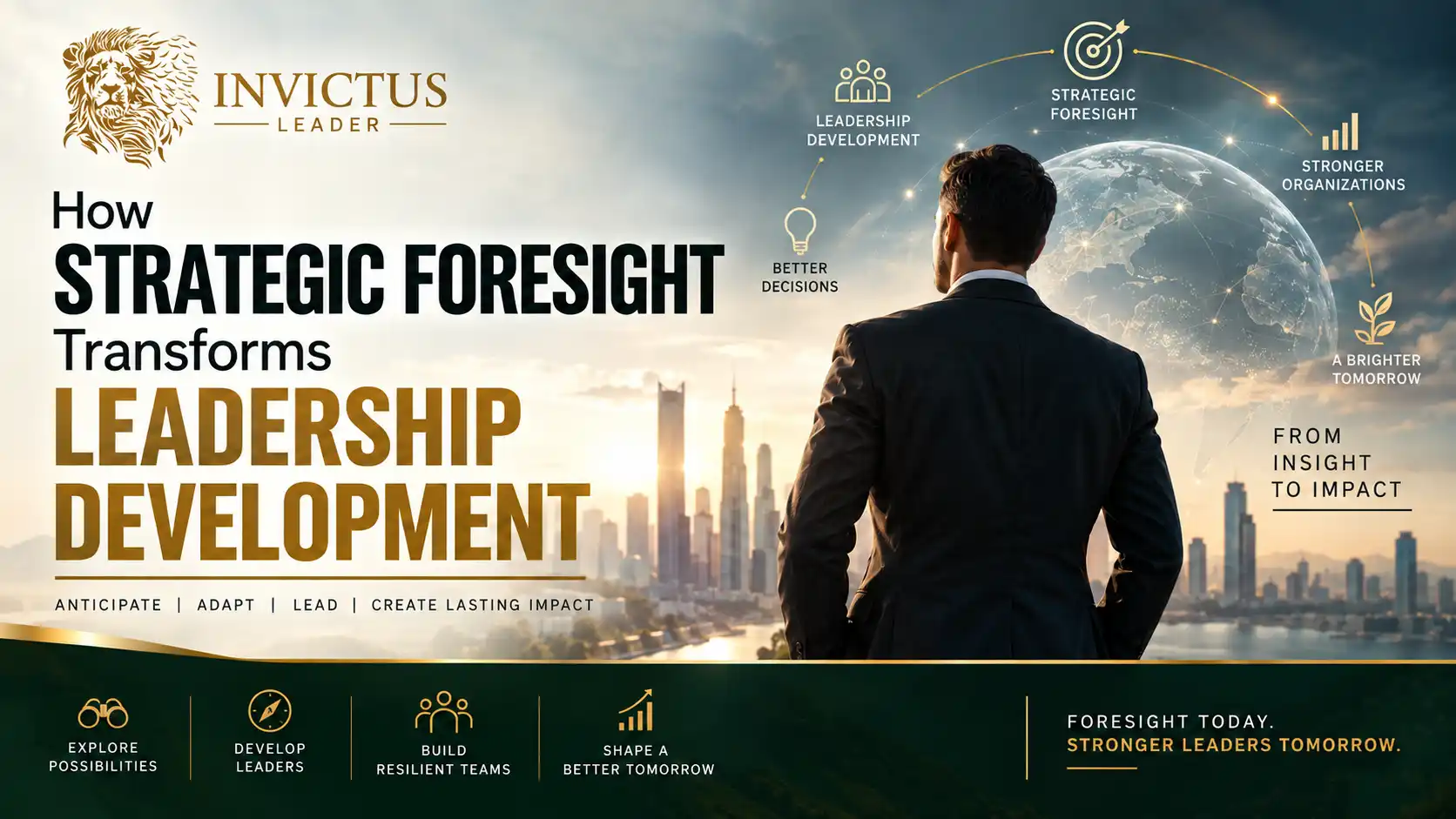
Strategic foresight is no longer a boardroom buzzword. In fact, it is fast becoming the defining capability of leaders who want their organizations to last. This guide unpacks how strategic foresight and leadership development intersect. It also shows how executives can build the habits, structures, and mindsets needed to lead through uncertainty, rather than be blindsided by it.
Every generation of leaders believes it is navigating unprecedented change. Today, however, disruption compounds faster than ever. Technological, geopolitical, economic, and cultural shifts now arrive together, not one at a time. As a result, the leaders who thrive are not the ones with the best five-year plan. Instead, they are the ones who can see change coming, interpret it correctly, and adapt before the market forces them to.
That capacity has a name: strategic foresight. When it is deliberately woven into how leaders are developed, coached, and evaluated, it becomes the foundation of future-ready leadership.
1. What Is Strategic Foresight?
Foresight Is Not Prediction
Strategic foresight is a structured discipline for exploring plausible futures. It helps leaders spot early signals of change and use those insights to inform decisions today. However, it is not fortune-telling. Foresight practitioners do not claim to predict one certain outcome. Instead, they build a range of scenarios — best case, worst case, and several in between. This way, leadership teams can pressure-test strategy against multiple versions of tomorrow.
The Three Pillars of Strategic Foresight
At its core, strategic foresight rests on three activities:
- Scanning — systematically monitoring weak signals, trends, and emerging risks across technology, regulation, demographics, and markets.
- Sense-making — interpreting what those signals mean for the organization’s specific context, rather than reacting to headlines.
- Scenario planning — translating insight into a small set of coherent, plausible futures that leadership can plan against.
Making Foresight an Ongoing Capability
Organizations that treat foresight as a one-off workshop rarely see lasting benefit. Instead, the firms that gain a genuine edge treat it as an ongoing capability. They embed it into strategy cycles, board reporting, and leadership development — much like the Foresight & Regenerative Frameworks approach used by advisory practices working across global markets.
Consider the scale of the challenge:
of organizations report they are not prepared for the pace of change occurring in and around their industry.
Source: World Economic Forumof senior leaders in a McKinsey survey felt genuinely ready to meet the challenges ahead of them.
Source: McKinsey & Company2. What Is Leadership Development?
Leadership development is the deliberate process of building the mindsets, skills, and behaviors that allow individuals to lead teams, functions, or entire organizations effectively. Traditionally, this has focused on competencies such as communication, delegation, performance management, and emotional intelligence.
Those fundamentals remain essential. However, competency-based models were designed for a more stable era. Back then, the skills that made a leader successful this year would likely still apply five years later. That assumption no longer holds. As a result, leadership development programs that stop at competency-building leave a critical gap. They prepare leaders to manage the present, not to navigate what comes next.
This is why many organizations are now redesigning their leadership and culture development programs. They are adding foresight, systems thinking, and adaptive decision-making alongside the traditional core skills.
3. Why Strategic Foresight Matters for Today’s Leaders
Together, three converging forces make foresight a leadership imperative, not just a nice-to-have:
Complexity is compounding, not linear
Today, a regulatory shift, a supply chain shock, and a generational change in workforce expectations rarely arrive one at a time. Consequently, leaders who only respond to the most visible crisis are perpetually reactive.
Strategic planning cycles are too slow
Annual strategy reviews were built for a world that changed annually. However, foresight-driven leaders build continuous scanning into how they operate. As a result, strategy can flex mid-cycle, rather than waiting for the next planning offsite.
Talent expects leaders who can articulate direction under uncertainty
Employees increasingly judge leadership credibility differently today. Rather than expecting leaders to have all the answers, they expect leaders to hold ambiguity honestly and still chart a confident path forward.
For this reason, leaders who build foresight into how they think — not just what they know — are better equipped to make this shift. In fact, this is why foresight has become a core thread running through leadership development programs that combine strategic foresight with executive coaching, rather than a separate discipline.
4. How Strategic Foresight Improves Decision-Making
In practice, foresight changes decision-making in three measurable ways.
| Traditional Decision-Making | Foresight-Informed Decision-Making |
|---|---|
| Relies on historical data and past performance | Weighs historical data alongside emerging signals and scenarios |
| Assumes a single “most likely” future | Plans against multiple plausible futures |
| Reacts once change becomes visible | Positions the organization before change fully materializes |
| Treats strategy as a fixed annual document | Treats strategy as a living hypothesis, revisited continuously |
This matters in practice. A foresight-trained executive team is less likely to be blindsided by a single external shock, because they have already stress-tested their assumptions against alternative futures. It also means decisions carry more nuance. Leaders can explain not just what they decided, but why that decision holds up across multiple scenarios.
5. Building Future-Ready Leadership
Future-ready leadership is not a personality trait. Rather, it is a set of habits that can be deliberately built. Based on patterns observed across executive coaching and leadership advisory engagements, four habits consistently distinguish future-ready leaders:
1. They scan deliberately, not incidentally
Future-ready leaders build a regular cadence — weekly or monthly — for reviewing trends outside their immediate industry, not just inside it.
2. They separate signal from noise
Not every headline is a strategic signal. Future-ready leaders develop frameworks for filtering what genuinely matters to their organization’s trajectory.
3. They communicate uncertainty with confidence
Rather than projecting false certainty, they frame decisions as “the best path given what we know today.” This builds durable trust with teams and boards alike.
4. They build optionality into strategy
Instead of committing fully to one path, they design decisions that preserve the ability to pivot as new information emerges.
6. Adaptive and Regenerative Leadership in Practice
Adaptive leadership asks leaders to adjust their approach as conditions change. Regenerative leadership goes a step further. It asks leaders to build organizations, teams, and cultures that don’t just survive disruption, but come out of it stronger — restoring capacity rather than merely conserving it.
This marks a meaningful departure from classic transformation thinking. Classic models often treat change as a one-time project, with a defined start and end date. Regenerative leadership, by contrast, treats change as a continuous condition. It asks leaders to build cultures where teams expect to keep evolving, rather than waiting for the next “transformation” to be announced from the top.
In practice, this shows up in how leaders design feedback loops and rotate talent through cross-functional exposure. It also shows up in how they structure decision rights, so teams closer to the signal can act without waiting for permission from several layers above. For this reason, approaches built around regenerative leadership and culture systems are increasingly replacing legacy change-management models.
7. Strategic Foresight and Organizational Resilience
From Reaction to Anticipation
Resilience is often mistaken for the ability to bounce back after a shock. However, foresight practitioners work toward a more useful definition: the ability to anticipate disruption early enough that the “shock” is smaller by the time it arrives.
Three Ways Foresight Builds Resilience
Foresight strengthens organizational resilience in three concrete ways:
- Earlier warning systems — structured scanning surfaces risks months or years before they hit the P&L.
- Distributed judgment — when foresight thinking is embedded across leadership levels, not just at the top, more of the organization can recognize and respond to early signals.
- Faster strategic recalibration — because scenarios were already mapped in advance, leadership teams can pivot from “Plan B” rather than starting from a blank page under pressure.
This is precisely why resilience-focused organizations increasingly invest in foresight capability at the leadership level. They no longer isolate it inside a single strategy or innovation team.
8. Building a Foresight-Driven Leadership Development Strategy
Embedding foresight into leadership development requires more than adding a single workshop to the calendar. A durable strategy typically includes:
Diagnose before you design
Before building a program, first assess how prepared your current leadership bench actually is to anticipate and respond to change. This diagnostic step prevents organizations from building generic training that doesn’t address their real gaps.
Integrate foresight into existing leadership tracks
Rather than running foresight as a stand-alone course, the strongest programs weave it directly into existing leadership and executive coaching pathways. This includes scenario planning, trend scanning, and decision-simulation exercises.
Make it a board-level conversation
Foresight-driven leadership development gains far more traction when boards ask about it directly. In other words, future-readiness becomes a governance topic, not just an HR initiative.
Measure preparedness, not just competency
Traditional 360-degree reviews measure current competency. However, foresight-driven programs add a second lens: how well does this leader anticipate, interpret, and act on change before it becomes urgent?
Organizations exploring this shift often start with a structured capability assessment. Only then do they redesign their broader leadership architecture — a step that mirrors how Invictus Leader approaches foresight and leadership advisory work with executive teams and boards globally.
9. Practical Implementation: A Roadmap for Leaders
For leaders and HR/L&D teams ready to act, a practical rollout typically follows four phases:
- Assess — Benchmark current leadership readiness for change, including how leaders currently gather and act on external signals.
- Design — Build a foresight-integrated leadership curriculum, combining scenario exercises, trend-scanning routines, and coaching on decision-making under uncertainty.
- Embed — Move foresight practices out of the classroom and into real operating rhythms: strategy reviews, board updates, and quarterly planning.
- Sustain — Revisit scenarios regularly, track which signals proved material, and refine the organization’s foresight muscle over time rather than treating it as a finished project.
Done well, this roadmap does more than build comfort with ambiguity. It produces organizations that consistently arrive at strategic inflection points earlier than their competitors — with more options on the table and less pressure to react under duress.
Build Future-Ready Leaders With Strategic Foresight
If your leadership bench is strong on execution but untested on anticipation, it may be time for a structured review. Invictus Leader works with boards, CEOs, and executive teams across 54 countries to build exactly this capability.
10. Frequently Asked Questions
Strategic planning typically produces a single, fixed roadmap based on the most likely future. Strategic foresight, however, explores multiple plausible futures. It then uses them to pressure-test that roadmap, so leaders are prepared even if conditions shift.
Leadership development that focuses only on current competencies prepares leaders for today’s challenges, not tomorrow’s. Adding foresight, however, helps leaders anticipate change and adapt decisions before disruption forces their hand.
No. While large enterprises often formalize foresight through dedicated teams, the underlying practices — scanning, scenario thinking, and decision-testing — scale down effectively for mid-sized organizations and growth-stage leadership teams as well.
Initial scenario-planning skills can be introduced within a few structured workshops. However, embedding foresight into ongoing decision-making, governance, and culture typically takes several quarters of consistent practice and reinforcement.
Regenerative leadership focuses on building organizations that grow stronger through disruption rather than merely surviving it. Strategic foresight supports this by helping leaders spot the early signals that inform when and how to regenerate systems, culture, and strategy.
Yes. Boards that incorporate foresight into governance discussions are better positioned to ask sharper questions about risk, strategy resilience, and long-term positioning, rather than relying solely on backward-looking performance reports.
Common methods include environmental scanning, trend analysis, scenario planning, wind-tunneling of strategic decisions against multiple futures, and structured diagnostics that benchmark an organization’s current future-readiness.
Rather than relying only on competency scores, future-readiness assessments evaluate how well leaders scan for change, interpret ambiguous signals, and adapt decisions in response — often through structured diagnostics rather than self-reported surveys alone.
Most organizations benefit from starting with a diagnostic to understand current leadership readiness for change, followed by integrating foresight practices into existing leadership development and executive coaching programs rather than launching a separate, siloed initiative.