1What Is Leadership Development, Really?
Leadership development is the deliberate process of building the mindsets, capabilities, and behaviors leaders need to make sound decisions under uncertainty — not just to run their current function well. It spans self-awareness, decision quality, influence, systems thinking, and the ability to translate ambiguity into direction for a team.
Traditional programs treat leadership as a fixed set of competencies delivered through workshops: communication, delegation, feedback, time management. These remain relevant, but they describe management, not leadership in a volatile operating environment. Genuine leadership development also builds the capacity to sense change early, reframe problems correctly, and lead people through transitions that don’t have a precedent.
Self-Awareness
Leaders who understand their own patterns, biases, and blind spots make faster, cleaner decisions under pressure.
Decision Architecture
Structured frameworks for making high-stakes calls when data is incomplete and timelines are compressed.
Influence & Culture
The ability to shape behavior and belief across a team or organization, not just issue instructions.
Boutique consulting firms working across 50+ countries consistently find the same gap: organizations rarely lack talent. What they lack is the connective tissue between capability and foresight — the ability to see what’s coming and lead through it with clarity.
2Strategic Foresight: The Missing Layer in Most Leadership Programs
Strategic foresight is the discipline of systematically exploring plausible futures to make better decisions today. It is not forecasting — foresight doesn’t predict a single outcome, it maps a range of futures so leaders can build resilience, optionality, and readiness into their strategy regardless of which scenario unfolds.
Where most leadership training stops at “how do I lead my team better,” foresight-integrated development asks a different question: how do I lead my team through change I haven’t seen yet? That distinction matters because the half-life of strategic plans keeps shrinking. A five-year roadmap built on linear assumptions can be obsolete within eighteen months when a single technological or geopolitical shift changes the operating landscape.
Core Elements of Strategic Foresight
- Weak signal detection — identifying early indicators of change before they become headline trends.
- Scenario planning — building multiple plausible futures rather than a single forecast.
- Upstream problem framing — solving root causes instead of reacting to symptoms.
- Imagination-led readiness — preparing leaders to act decisively even when the future is ambiguous.
This is the philosophy behind strategic foresight frameworks used by governments, sovereign institutions, and global C-suites: strategy shifts from long-range planning to imagination-led readiness. Leaders who are trained in foresight don’t just react faster — they anticipate better, and that changes the entire risk profile of an organization.
3Executive Coaching: From Performance Fixes to Identity Shifts
Executive coaching is often misunderstood as a remedial intervention — something assigned when a leader has a “gap” to close. In premium consulting practice, coaching is the opposite: it’s a growth accelerant for leaders who are already capable but need a thinking partner to navigate complexity, sharpen judgment, and shift identity as their role scales.
Effective executive coaching operates at three levels simultaneously:
The Three Levels of Executive Coaching
| Level | Focus | Typical Outcome |
|---|---|---|
| Behavioral | Communication, delegation, feedback, presence | Faster team performance gains |
| Strategic | Decision quality, prioritization, stakeholder navigation | Better outcomes under ambiguity |
| Identity | Self-concept, purpose, and how the leader shows up under pressure | Sustainable, durable leadership growth |
Most coaching engagements stop at the behavioral level. The deepest, most durable change happens at the identity level — where a leader stops managing the way they were taught and starts leading the way the moment actually requires. This is why one-off training rarely sticks, while sustained coaching engagements — paired with real decisions, in real time — consistently produce measurable behavioral change and stronger leadership bonds across an organization.
4How Leadership Development, Foresight, and Coaching Work Together
Treated separately, leadership development, strategic foresight, and executive coaching each deliver partial value. Combined, they form a closed loop: foresight tells leaders what is changing, leadership development builds the capability to respond, and executive coaching ensures the change is internalized and sustained under real pressure.
| Discipline | Primary Question | Time Horizon |
|---|---|---|
| Strategic Foresight | What futures are plausible, and what signals matter now? | Medium to long-term |
| Leadership Development | What capabilities do our leaders need to build? | Ongoing / structural |
| Executive Coaching | How does this leader apply it, personally, under pressure? | Individual / immediate |
Organizations that integrate all three consistently outperform those running siloed training calendars, because the loop keeps re-calibrating: foresight updates the map, development updates the toolkit, and coaching makes sure the leader actually uses it when it counts.
5Future-Ready Leadership: The New Baseline Competency
Future-ready leadership is no longer an advanced or optional skill set reserved for the C-suite. As AI adoption, workforce shifts, and market volatility accelerate, it is becoming the baseline expectation for leaders at every level of an organization.
What Sets Future-Ready Leaders Apart
- They treat uncertainty as a design constraint, not an excuse for inaction.
- They build optionality into strategy instead of betting on a single forecast.
- They lead through continuous sensing — watching for weak signals rather than waiting for disruption to arrive.
- They know how to translate ambiguity into a clear, communicable direction for their teams.
This is the essence of future-ready leadership: it isn’t about predicting the future correctly, it’s about building the organizational and personal readiness to act well regardless of which future arrives. Leaders trained this way tend to move from reactive firefighting to proactively shaping outcomes — a shift that changes not just performance, but the entire posture of the organization toward change.
6Adaptive and Regenerative Leadership Models
Adaptive leadership focuses on a leader’s ability to adjust strategy, structure, and behavior in response to shifting conditions — without losing coherence or direction. Regenerative leadership goes a step further: it asks leaders not just to sustain the organization, but to leave every system, team, and community they touch stronger than they found it.
Adaptive vs. Regenerative Leadership
| Dimension | Adaptive Leadership | Regenerative Leadership |
|---|---|---|
| Core Aim | Respond effectively to change | Restore and strengthen the system while growing it |
| Orientation | Reactive to proactive | Purpose-led, systemic, long-horizon |
| Success Metric | Resilience under disruption | Value created for people, purpose, and planet |
| Typical Practice | Agile decision cycles, scenario response | Systems thinking, culture regeneration, capability transfer |
Guided by a people–purpose–planet philosophy, regenerative leadership development pushes organizations beyond transformation for its own sake — toward growth that restores more than it consumes. This is increasingly central to leadership & culture development work with enterprises navigating both disruption and long-term sustainability commitments.
7Leadership Development as a Driver of Organizational Transformation
Organizational transformation efforts fail far more often from leadership assumptions than from technology gaps. Investment in AI, digital tools, and process redesign continues to rise across industries, yet many organizations struggle to convert that investment into sustained value — because the governance models, decision rights, and leadership behaviors underneath the transformation were built for a more predictable environment.
Where Transformation Efforts Typically Break Down
- Leadership assumptions that no longer match operating reality.
- Decision frameworks designed for stable, linear conditions.
- Culture and behavior that resist the new operating model despite process redesign.
- Governance structures that unintentionally amplify risk instead of managing it.
Real transformation requires working with leadership at every level — not only the top team. Combining group workshops with individual coaching to challenge management styles has repeatedly produced visible, measurable behavioral change across entire leadership populations, not just a handful of executives.
8Practical Strategies to Build a Leadership Development Program
Turning these principles into a working program requires a deliberate structure. Below is a practical framework organizations can adapt.
An Ideate → Adaptate → Incubate → Accelerate Approach
Ideate
Surface bold possibilities rooted in foresight — not just current-state problem solving.
Adaptate
Build the agility to adjust plans as conditions shift, without losing direction.
Incubate
Turn leadership insights into actionable prototypes and pilot behaviors.
Accelerate
Scale what works into repeatable practice across the organization.
Practical Checklist for Leadership Development Design
- Pair every workshop-based intervention with individual executive coaching for lasting behavior change.
- Build weak-signal scanning into quarterly leadership reviews, not just annual strategy offsites.
- Set a Return on Futures index alongside standard ROI metrics to track readiness, not just output.
- Extend development beyond the C-suite — mid-level leaders shape culture daily.
- Reassess leadership frameworks every 12–18 months as the operating environment shifts.
Programs built this way tend to move participants from theory into applied practice quickly — because the value only compounds when leaders act on what they learn, not simply attend a session and return to old habits.
9Build Future-Ready Leadership With Invictus Leader
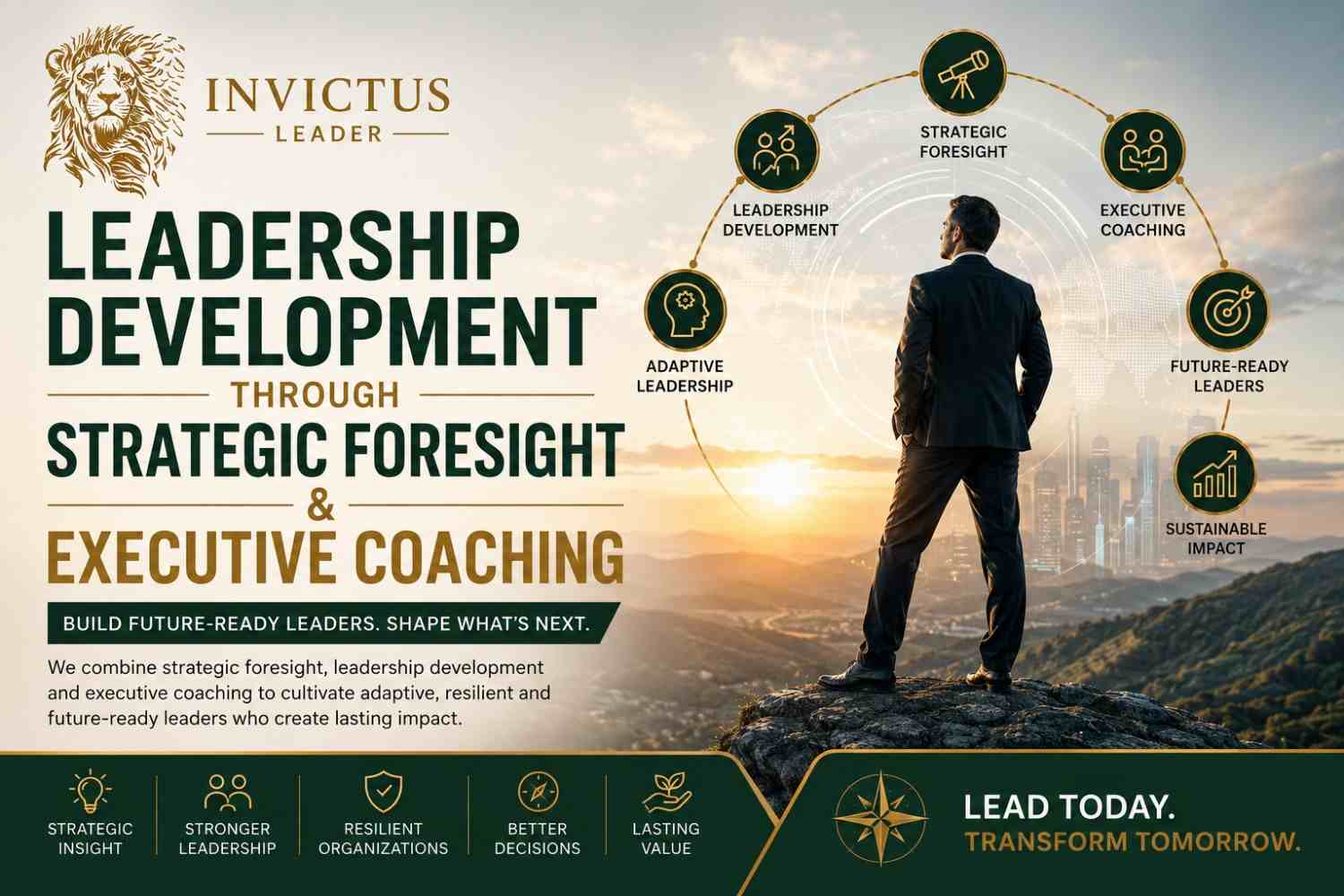
Invictus Leader has spent over three decades helping leaders and organizations across 54 countries convert foresight into capability, and capability into lasting impact. If your leadership development strategy still runs on last decade’s assumptions, it’s time to rebuild it around foresight, coaching, and regenerative growth.
10Frequently Asked Questions
Leadership development is a broader, often structural process of building capabilities across a group of leaders through frameworks, workshops, and applied practice. Executive coaching is a personalized, one-to-one engagement focused on how a specific leader applies those capabilities in their own context, decisions, and behavior under pressure.
Strategic foresight equips leaders to detect early signals of change and map multiple plausible futures instead of relying on a single forecast. This allows leaders to build resilience and optionality into strategy, so decisions hold up even as conditions shift — rather than becoming obsolete the moment assumptions change.
No. While the term originated with C-suite engagements, coaching is now applied across leadership tiers — from emerging managers to founders — anywhere a leader needs a structured thinking partner to sharpen judgment and accelerate growth.
Future-ready leadership refers to a leader’s ability to act decisively and effectively despite genuine uncertainty about what’s ahead. It combines foresight (sensing change early), adaptability (adjusting strategy without losing direction), and clarity (communicating direction to teams even when the full picture isn’t known).
Sustainability generally aims to minimize harm and maintain current systems. Regenerative leadership goes further — it asks leaders to actively restore and strengthen the people, culture, and systems they lead, so growth leaves the organization (and its wider ecosystem) stronger than before.
Behavioral shifts from combined workshop-and-coaching engagements are often visible within three to six months. Deeper, identity-level change — the kind that sustains under real pressure — typically takes six months to a year of consistent engagement, particularly when paired with individual executive coaching.
Transformation failures are rarely technological. They typically stem from leadership assumptions, decision frameworks, and governance models built for stable, predictable conditions — which break down under the volatility most organizations now face. Addressing leadership behavior and decision quality alongside technology investment closes this gap.
Strategic foresight is a learnable discipline, not an innate trait. Through structured frameworks — weak-signal detection, scenario planning, and upstream problem framing — leaders at any level can build stronger foresight capability with consistent practice.
Invictus Leader integrates proprietary foresight frameworks with individual and group executive coaching, combining workshops with one-to-one coaching to challenge management styles and build effective leadership at every level — an approach applied across 54 countries and thousands of engagements.