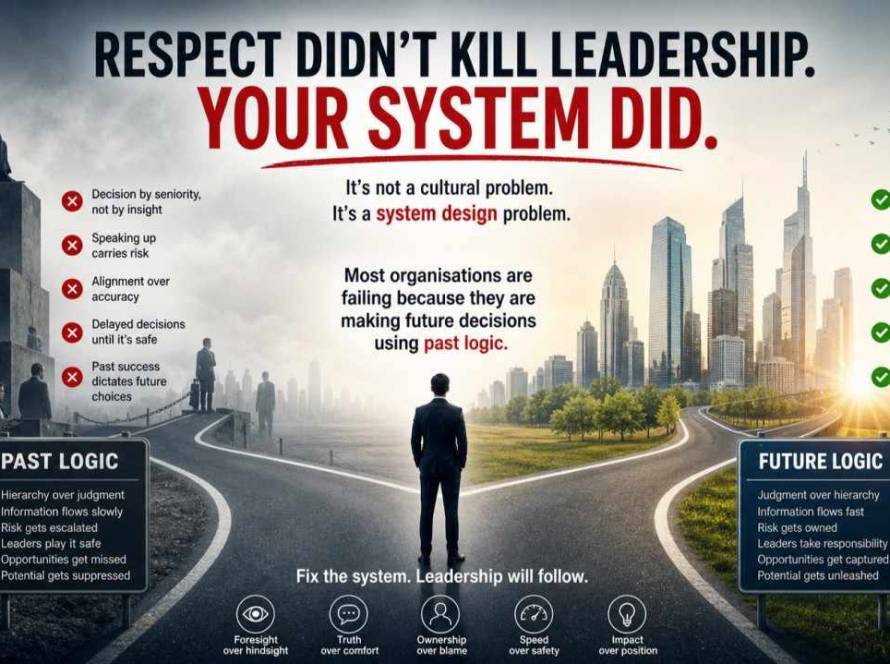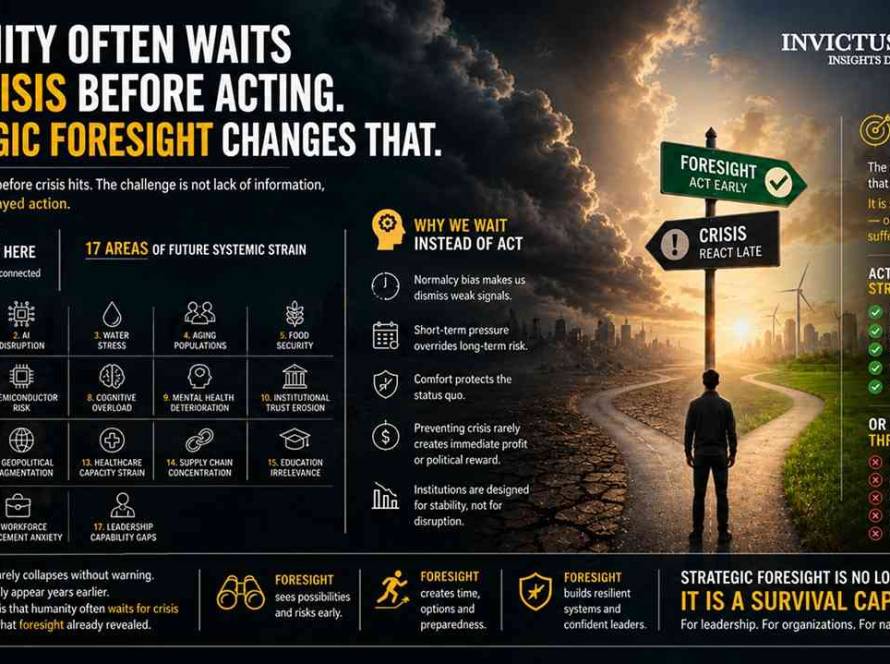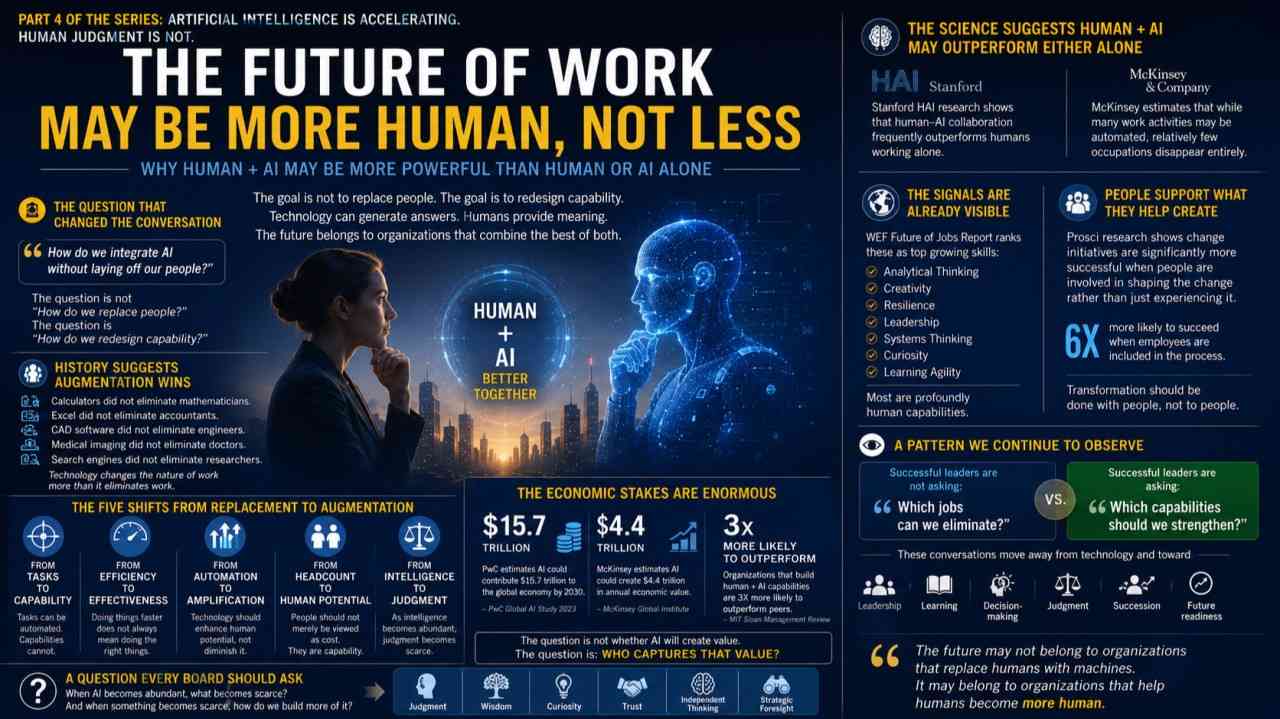
The Future of Work: Why It May Be More Human, Not Less
Artificial intelligence is rewriting how organizations operate — but the leaders who win the next decade won’t be the ones who automate the fastest. They’ll be the ones who understand that Future of Work success depends on human judgment, empathy, and trust as much as it depends on algorithms. Here’s why Human-Centric Leadership is becoming the real competitive edge.
Introduction
Artificial Intelligence is transforming industries at a pace unlike anything businesses have experienced before. From automating repetitive tasks to delivering predictive insights, AI has become an indispensable tool for organizations striving to remain competitive. Yet amid this technological revolution, one truth remains unchanged—businesses succeed because of people, not technology alone.
The future of work is no longer defined solely by digital transformation or automation. It is increasingly shaped by leaders who understand how to combine technological innovation with empathy, trust, collaboration, and strategic thinking. Organizations that recognize this balance are not merely adopting AI; they are creating workplaces where technology amplifies human capability rather than replacing it.
Today’s workforce expects more than efficient systems. Employees seek meaningful work, transparent communication, opportunities for growth, and leaders who can navigate uncertainty with confidence. While AI excels at processing data, recognizing patterns, and automating routine tasks, it cannot replace the uniquely human abilities that inspire teams, build trust, foster creativity, and guide ethical decision-making.
This shift demands a new leadership mindset. Modern leaders must become architects of change, ensuring technology supports organizational goals while strengthening employee engagement and organizational culture. Success depends on aligning AI initiatives with business strategy, workforce development, and long-term organizational values.
At Invictus Leader, we believe that organizations become truly future-ready when technology and people evolve together.
Businesses that prioritize human-centric leadership alongside digital innovation are better positioned to navigate disruption, inspire their workforce, and create sustainable competitive advantages.
This article explores how AI is reshaping leadership, why human-centered organizations consistently outperform technology-driven competitors, and the practical strategies leaders can implement today to prepare for the future of work.
The Future of Work: Why Leadership Matters More Than Ever
The workplace has undergone remarkable transformation over the past decade. Cloud computing, remote collaboration, automation, machine learning, and generative AI have fundamentally changed how organizations operate. These technologies have increased productivity, accelerated innovation, and enabled businesses to make data-driven decisions faster than ever before.
However, technology alone cannot create resilient organizations.
Research consistently shows that successful digital transformation depends more on leadership and organizational culture than on technology implementation. Companies that invest equally in people and technology experience higher employee engagement, stronger innovation, and greater long-term profitability.
Why Human-Centric Leadership Wins
Technology can automate tasks, but leadership inspires people.
Employees do not remain loyal because their organization has the latest AI platform. They stay because they trust leadership, feel valued, and believe their work contributes to a meaningful purpose. Human-centric leadership focuses on understanding employee needs while leveraging technology to remove barriers that prevent people from doing their best work.
Benefits of Human-Centric Leadership
Higher Engagement
Employees feel connected and motivated by a shared purpose.
Better Decisions
Diverse perspectives and open communication improve strategic choices.
Faster Innovation
Psychological safety encourages teams to test new ideas rapidly.
Greater Resilience
Organizations adapt to disruptions more effectively.
Talent Retention
A supportive culture attracts and keeps top industry talent.
Business Performance
Happy employees drive higher profitability and customer satisfaction.
Human Skills vs. Artificial Intelligence
Artificial Intelligence has dramatically improved business efficiency. It can analyze millions of data points in seconds, automate repetitive tasks, generate reports, and identify patterns that would take humans weeks to discover.
Yet despite these impressive capabilities, AI lacks the qualities that define exceptional leadership. The organizations of tomorrow will not be distinguished by who owns the most advanced AI systems. They will be distinguished by leaders who know when technology should lead—and when human judgment must take precedence.
| Artificial Intelligence Excels At | Human Leadership Excels At |
|---|---|
| Processing millions of data points rapidly | Understanding nuanced human emotions |
| Automating repetitive, rule-based workflows | Building deep, trusting relationships |
| Detecting complex patterns in historical data | Creating inspiring visions for the future |
| Predicting trends and optimizing efficiency | Solving highly ambiguous, novel problems |
| Executing precise, programmed instructions | Making difficult ethical and moral decisions |
Leadership Insight
The future is not about humans competing with AI. It is about leaders creating workplaces where people and technology work together to solve increasingly complex challenges. Businesses that understand this balance will build stronger cultures, make better decisions, and create lasting competitive advantages.
Leadership in the AI Era
Artificial Intelligence is changing the way leaders make decisions, manage teams, and drive innovation. However, becoming an effective leader in the AI era is not about understanding algorithms or learning to code—it is about knowing how to integrate technology into an organization without losing sight of the people behind every business outcome.
Modern leaders face a unique challenge. They must embrace rapid technological change while maintaining employee trust, preserving organizational culture, and ensuring ethical decision-making. The organizations that succeed are those whose leaders treat AI as a strategic partner rather than a replacement for human expertise.
Employees naturally have questions whenever new technologies are introduced. Will AI replace jobs? Will performance be measured differently? How will roles evolve? Strong leaders address these concerns openly. They create transparency around AI adoption, communicate the purpose behind technological changes, and demonstrate how automation can enhance—not diminish—human contribution.
Leadership Tip
Before implementing any AI initiative, answer three questions for your team: Why are we introducing this technology? How will it improve our work? Who will benefit? When people understand the purpose behind change, resistance decreases and adoption increases.
Continuous Learning: The New Leadership Imperative
One of the greatest misconceptions about AI is that learning ends once a new technology is implemented. In reality, AI evolves continuously, making ongoing learning one of the most valuable capabilities an organization can develop.
The future of work belongs to organizations that embrace a culture of continuous learning rather than occasional training sessions. Skills that are highly valuable today may become outdated within a few years, while entirely new roles continue to emerge across industries.
Organizations that encourage learning become more innovative because employees feel confident exploring new ideas, testing solutions, and sharing knowledge without fear of failure.
Building a Learning Culture
Effective organizations encourage employees to: Attend leadership development programs, participate in cross-functional projects, share knowledge across teams, experiment with AI tools responsibly, and stay informed about industry trends.
Building a Human-Centric Organizational Culture
Technology can be purchased overnight. Culture cannot.
Organizational culture is built gradually through leadership behaviors, shared values, communication, and everyday decisions. It influences how employees respond to change, collaborate with one another, and embrace innovation.
A human-centric culture places people at the center of every strategic decision. Rather than asking, “How can technology improve efficiency?” successful organizations also ask, “How will this technology improve the employee experience?”
Warning Signs of an Unhealthy Culture
Organizations should monitor for indicators that culture is weakening. These include poor communication, low employee engagement, high turnover, resistance to change, lack of collaboration, fear of making mistakes, siloed departments, and limited innovation. Addressing these issues early prevents larger organizational challenges.
Technology as an Enabler, Not a Replacement
One of the biggest mistakes organizations make is viewing AI purely as a replacement for human work. Technology delivers its greatest value when it removes friction, reduces repetitive tasks, and enables employees to focus on activities that require creativity, collaboration, and strategic thinking.
- Instead of spending hours preparing reports, managers receive automated insights.
- Instead of manually sorting customer inquiries, service teams receive intelligent recommendations.
- Instead of searching through thousands of documents, employees can retrieve information instantly.
These improvements increase productivity while allowing employees to dedicate more time to innovation, customer relationships, and problem-solving.
AI Governance and Ethical Leadership
As Artificial Intelligence becomes more deeply integrated into business operations, organizations face an increasingly important question: Just because AI can make a decision, should it?
This is where AI governance becomes essential. Effective governance ensures that AI systems operate responsibly, transparently, and in alignment with organizational values. Without clear oversight, even the most advanced technology can introduce unintended bias, privacy concerns, regulatory risks, and ethical dilemmas.
Technology can recommend. People must decide.
Principles of Responsible AI Leadership
Organizations should establish governance frameworks built on Transparency, Fairness, Accountability, Privacy, and Human Oversight. Critical decisions involving hiring, promotions, legal matters, or customer relationships should always include human review.
Key Takeaways for Future-Ready Organizations
- Artificial Intelligence is transforming work, but people remain the foundation of successful organizations.
- Human-centric leadership creates trust, engagement, and innovation.
- Continuous learning enables employees and leaders to adapt to changing technologies.
- Responsible AI governance protects trust, fairness, and accountability.
- Technology should enhance human capability—not replace it.
Conclusion
The future of work is not defined by technology alone. It is defined by the leaders who choose how technology is used to create value for people, organizations, and society.
Organizations that embrace a human-centric approach to digital transformation recognize that sustainable success comes from empowering people alongside technology. By investing in leadership development, continuous learning, responsible AI governance, and employee experience, businesses create environments where innovation flourishes and change becomes an opportunity rather than a disruption.
Whether your organization is beginning its AI journey or accelerating digital transformation, the greatest competitive advantage will always be the ability to lead people with purpose, confidence, and vision.
If you’re looking to develop future-ready leaders and build a high-performing organization, explore the leadership consulting and organizational transformation services available at Invictus Leader. Investing in people today is the strongest foundation for tomorrow’s success.
Frequently Asked Questions
The Future of Work refers to the evolving workplace shaped by artificial intelligence, automation, digital technologies, changing workforce expectations, and new leadership models. It focuses on creating flexible, technology-enabled organizations while keeping people at the center of business success.
Human-Centric Leadership prioritizes people alongside business performance. It emphasizes empathy, trust, communication, collaboration, and employee development while leveraging technology to improve productivity and innovation.
No. AI can analyze data and automate routine tasks, but leadership requires emotional intelligence, ethical decision-making, strategic vision, and relationship-building—qualities that remain uniquely human.
As technology evolves rapidly, employees and leaders must continuously update their technical and interpersonal skills. Organizations that invest in ongoing learning become more adaptable, innovative, and competitive.
AI automates repetitive tasks, provides faster insights, streamlines workflows, and supports better decision-making, allowing employees to focus on higher-value strategic and creative work.
Responsible AI governance involves establishing policies and oversight to ensure AI systems are transparent, fair, ethical, secure, and aligned with organizational values and regulatory requirements.
A strong organizational culture encourages collaboration, trust, innovation, and adaptability. These factors significantly improve the success of digital transformation initiatives and AI adoption.
Leaders should embrace continuous learning, strengthen communication, invest in employee development, implement responsible AI practices, and foster a culture that balances technology with human values.
Healthcare, finance, manufacturing, retail, education, logistics, professional services, and technology are among the industries experiencing significant benefits from AI-driven innovation and operational improvements.
A human-centric approach ensures technology enhances employee experience, strengthens customer relationships, builds trust, supports ethical decision-making, and creates sustainable long-term business success.