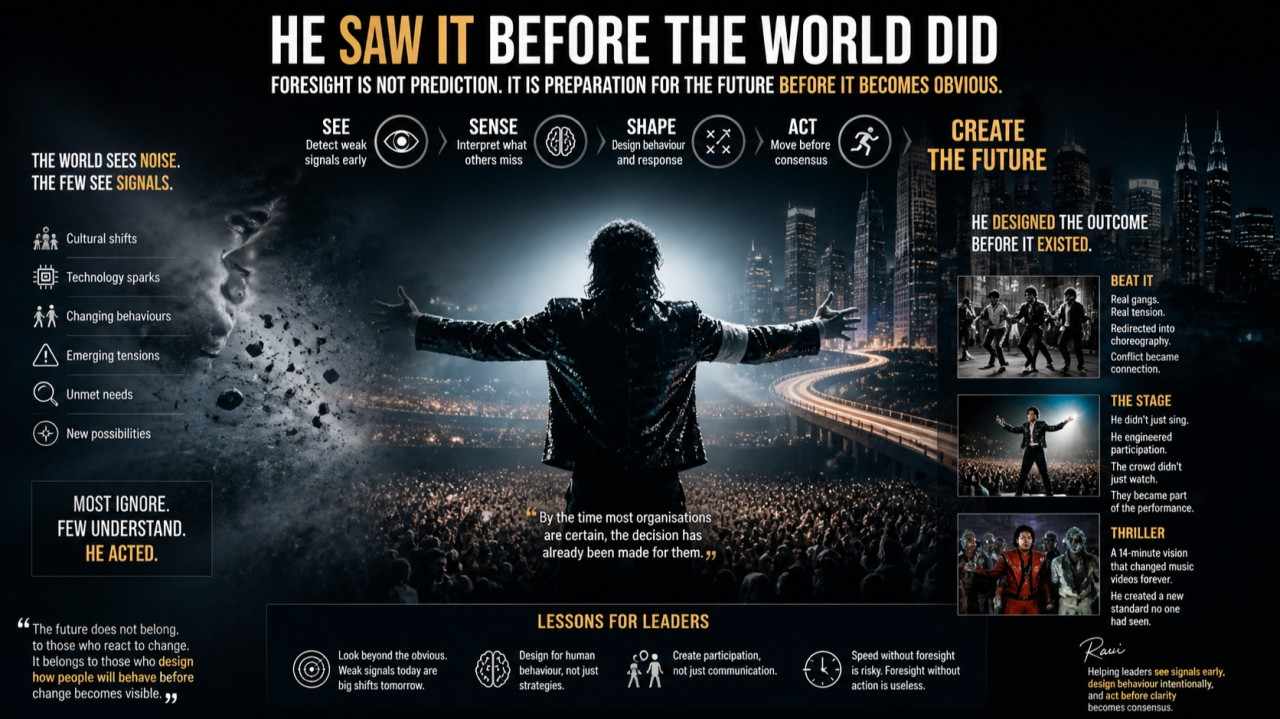
The organisations that will define the next decade are not the ones with the best data. They are the ones capable of acting before the data confirms what they already sense — and designing what happens next before it becomes visible to anyone else.
01 — The Misdiagnosis
Most Leaders Confuse Information with Intelligence
The persistent failure in leadership is not a shortage of information. Boardrooms today are dense with data, research, and analysis. The failure is a systematic inability to act on what is forming — before it becomes consensus.
When leaders ask “What should we do next?” without first asking “What are we not yet seeing?” — they have already ceded the initiative. They are responding to a world already shaped by others.
McKinsey research consistently shows that close to 70 percent of transformation efforts fail. Not because strategies are poorly designed. Because they are built on validated certainty — by which point the window for meaningful action has already closed.
02 — Signal vs. Reaction
Foresight Is Not Prediction. It Is Velocity Before Validation.
The critical distinction is not between those who see and those who do not. It is between those who act on weak signals and those who wait for confirmation. By the time a signal becomes obvious, its strategic value has been distributed to everyone — which means it holds no competitive advantage for anyone.
The organisations that consistently outperform operate on a different timeline. They move when conditions are still forming. When others are still evaluating, they are already executing. The World Economic Forum has noted repeatedly that technological acceleration is outpacing organisational response — not because organisations lack intelligence, but because their decision systems are calibrated for a world that no longer exists.
03 — The Gap No One Addresses
Seeing the Signal Is Not Enough. You Must Design the Response.
Even the organisations that develop genuine foresight capability stop at detection. They identify what is forming. They surface the signal. And then they wait — for alignment, for further evidence, for the board to reach consensus. This is where foresight fails to convert into performance.
The next frontier of strategic leadership is behavioural design — the deliberate architecture of how people will respond to what you create, before they experience it. This is not communications strategy. It is not change management. It is the construction of participation, adoption, and response at the system level.
Harvard Business Review has demonstrated consistently that organisations overestimate rational adoption and underestimate behavioural resistance. The human brain defaults to familiarity and pattern repetition. Introducing new strategic directions without designing for that resistance does not produce change — it produces delay dressed as process.
04 — A Case Study in Designed Behaviour
Netflix Did Not Win on Technology. It Won on Behavioural Architecture.
The conventional reading of Netflix versus Blockbuster frames it as a story of technological disruption. It was not. Both organisations had access to the same signals. The streaming infrastructure was not proprietary. The shift in consumer behaviour was visible to everyone operating in that market.
The divergence was not in what each organisation saw. It was in what each organisation built toward. Blockbuster analysed the signals and continued optimising for existing behaviour — ownership, physical distribution, scheduled consumption. Netflix designed for a behavioural shift that had not yet fully materialised.
One organisation waited for behaviour to confirm the strategy. The other built the infrastructure to produce the behaviour. That is the gap between foresight and behavioural design — and it is the gap that determines which organisations endure.
05 — The Imperative for Leadership Now
Speed Without Foresight Is Accelerated Failure.
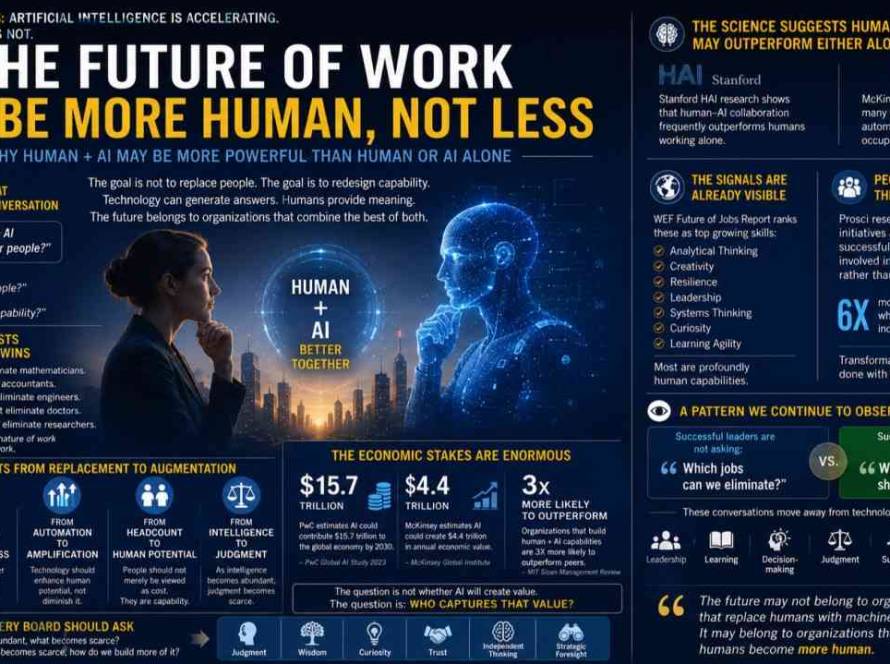
AI is compressing decision cycles. Markets are shifting in real time. Signals appear well before data confirms them. In this environment, the organisations that operate on consensus timelines are not cautious — they are structurally vulnerable.
Leadership today requires three distinct capabilities, in sequence:
- Signal detection at the periphery — the ability to identify what is forming before it reaches the centre of industry attention
- Decision architecture under uncertainty — the ability to frame action when data remains incomplete and the cost of waiting exceeds the cost of being wrong
- Behavioural design ahead of adoption — the ability to construct how people will respond, before the response is needed
Most leadership development addresses none of these. Most strategic planning tools are built for the third or fourth phase of a signal’s lifecycle — when it has already become a market trend, a competitive threat, or a confirmed disruption. At that point, strategy is not leadership. It is a response to a decision already made by others.
06 — Closing Thought
By the Time You Are Certain, Someone Else Has Already Moved.
The most dangerous position in a nonlinear world is not ignorance. It is the confidence that comes from validated data — because that confidence is always retrospective. It describes what was true when the signal was collected, not what is forming at the edge of what you can currently see.
The question for every leadership team is not whether you are informed. It is whether you are capable of acting before information becomes confirmation — and whether you are designing how people will behave before the future requires it.
Foresight without behavioural design is observation. Behavioural design without foresight is engineering in the wrong direction. The intersection of both is where durable organisations are built.