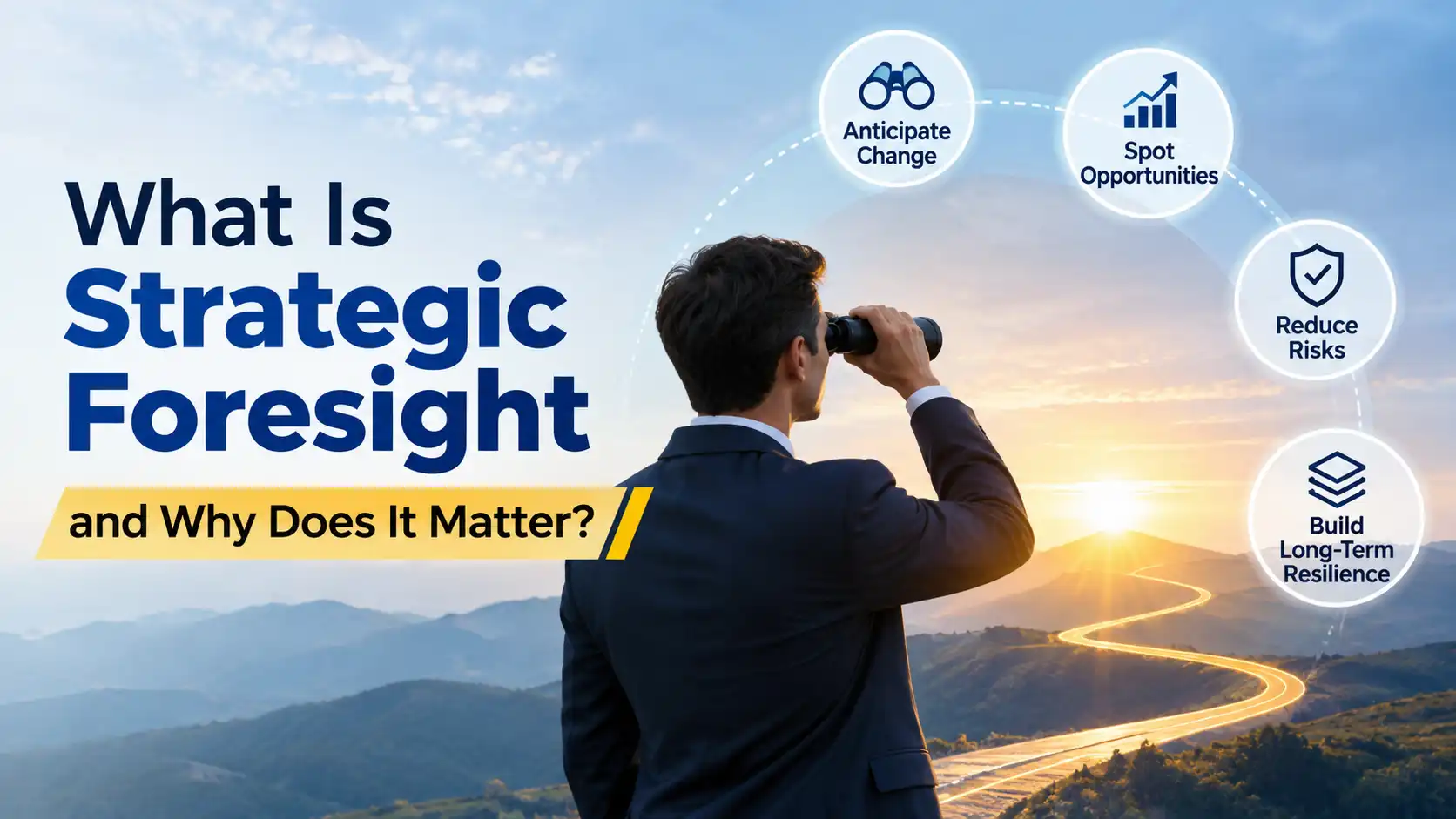
Most organisations plan by extending today’s trends into tomorrow. That works until conditions shift faster than the plan can. Strategic foresight is the discipline of systematically exploring possible futures so leaders can make better decisions today. This guide explains what strategic foresight is, why it matters, and how to start building it in your organisation.
- Why Strategic Foresight Matters Beyond Forecasting
- What Strategic Foresight Is, and What It Is Not
- Foresight Is a System: The Stages That Shape It
- Core Principles of Strategic Foresight
- Applied Methods: From Insight to Everyday Practice
- How to Build Strategic Foresight Step by Step
- How to Tell Whether Foresight Is Working
- Common Strategic Foresight Mistakes
- Building Foresight Capability in Your Organisation
- Frequently Asked Questions
Why Strategic Foresight Matters Beyond Forecasting
Forecasts answer the question “what will probably happen?” That is useful when the future resembles the past. It is far less useful when technology, regulation, climate and geopolitics change at once. In those conditions, a single prediction gives leaders confidence they have not earned.
Leaders often notice the symptoms late: a competitor appears from an adjacent industry, a customer need shifts, or a supply chain assumption breaks. Strategic foresight looks at the signals that come before these events. Instead of asking only how to hit this quarter’s targets, it asks whether the organisation is ready for several different futures.
If you want to explore this work with an advisory team, you can read more about our strategic foresight services.
What Strategic Foresight Is, and What It Is Not
Strategic foresight is a structured practice for scanning change, making sense of it, and turning it into better strategy. It does not claim to predict the future. It prepares leaders to act wisely whichever future arrives.
People often confuse it with related ideas, so the differences are worth stating clearly.
| Approach | Core question | What it focuses on | Where it can fall short |
|---|---|---|---|
| Forecasting | What is most likely to happen? | Extending data and trends into a single projection | Breaks down when change is non-linear |
| Strategic planning | What will we do over the next few years? | Goals, budgets and execution | Assumes the operating context stays stable |
| Risk management | What could go wrong? | Known threats and controls | Misses emerging opportunities and unknown unknowns |
| Strategic foresight | What could happen, and how should we prepare? | Weak signals, multiple futures and better decisions now | Needs discipline to connect insight to action |
The key difference is scope. Foresight does not replace planning or risk management. It strengthens both by testing their assumptions against a wider range of futures.
Foresight Is a System: The Stages That Shape It
Foresight is not a one-off workshop. It works best as a repeating cycle in which each stage feeds the next.
| Stage | What it involves | Question leaders should ask |
|---|---|---|
| Scanning | Collecting signals, trends and early indicators from inside and outside the industry | What is changing that we are not tracking? |
| Sensemaking | Finding patterns, drivers and uncertainties in what was collected | Which changes matter most to our business? |
| Scenarios | Building a small set of plausible, different futures | How would we perform in each of them? |
| Strategy and action | Choosing moves that hold up across scenarios, and monitoring signals | What should we decide or start now? |
Look at the whole cycle, not one stage
A team that scans widely but never builds scenarios ends up with a pile of interesting trends. A team that builds scenarios but never changes a decision has produced a report. Value appears only when the cycle is complete.
Core Principles of Strategic Foresight
- Think in possibilities, because the future is plural and no single forecast deserves full trust.
- Start with signals, because small, early changes often reveal large shifts.
- Challenge assumptions, since most strategic surprises come from beliefs nobody questioned.
- Connect to decisions, because foresight that does not influence choices has no value.
- Include diverse perspectives, since different people notice different signals.
- Repeat the practice, because the future keeps changing and so should your view of it.
Applied Methods: From Insight to Everyday Practice
Foresight becomes practical when it uses clear methods that teams can repeat.
1. Horizon scanning
Horizon scanning is a regular review of emerging signals across technology, society, economy, environment and politics. It works best when findings are shared and discussed rather than stored in a folder.
2. Scenario planning
Scenario planning builds a few contrasting futures based on the most important uncertainties. Leaders then stress-test strategy against each one, which exposes weak points early.
3. Backcasting and decision tests
Backcasting starts from a desired future and works backwards to the steps required. Decision tests ask whether a current choice still makes sense in each scenario.
How to Build Strategic Foresight Step by Step
- Clarify purpose: first, agree on the decisions foresight should inform.
- Set the horizon: choose a time frame that fits your industry, often five to ten years.
- Scan widely: gather signals from outside your usual sources.
- Find the drivers: identify the forces and uncertainties that matter most.
- Build scenarios: develop a small set of plausible and distinct futures.
- Test your strategy: check plans and investments against every scenario.
- Act and monitor: make no-regret moves, place small bets, and track key signals.
- Embed the rhythm: review regularly so foresight becomes part of how leadership works.
How to Tell Whether Foresight Is Working
Foresight is hard to measure in one number, but several signals show whether it is taking hold.
| Dimension | What to look for | Example signals |
|---|---|---|
| Awareness | Leaders notice change early | Emerging issues appear in board discussions before they become crises |
| Decision quality | Choices reflect more than one future | Major investments include scenario tests |
| Agility | The organisation adjusts quickly | Plans have clear triggers for change |
| Culture | Questioning assumptions is safe | Teams challenge “how we have always done it” |
| Long-term value | Decisions weigh future impact | Leaders accept short-term trade-offs for resilience |
Treat these signals as prompts for conversation, because a scorecard alone will not tell you the full story.
Common Strategic Foresight Mistakes
- Treating it as prediction: foresight explores options; it does not promise outcomes.
- Running a single workshop: one-off events fade quickly without a regular rhythm.
- Delegating it entirely: if executives are not involved, insights rarely reach decisions.
- Scanning only familiar sources: the most useful signals often come from outside your sector.
- Ignoring uncomfortable scenarios: the futures leaders avoid are often the ones that matter.
- Stopping at the report: insights need owners, actions and follow-up.
Building Foresight Capability in Your Organisation
Strategic foresight is a capability that grows with practice. Start with a clear decision to inform, a small cross-functional team, and a simple scanning routine. Then add scenario work and connect it to planning cycles. Over time, foresight stops being a project and becomes part of how leaders think.
Combining foresight tools with leadership development and regular follow-up helps teams turn insight into action, so better decisions become part of everyday leadership.
Ready to build future-ready leadership?
Talk with Invictus Leader about how strategic foresight can strengthen decisions, reduce blind spots and prepare your organisation for change.
Explore Strategic ForesightFrequently Asked Questions
Understanding Strategic Foresight
What is strategic foresight in simple terms?
It is a structured way of exploring possible futures so organisations can make better decisions today. It focuses on preparing for several outcomes rather than predicting one.
How is strategic foresight different from forecasting?
Forecasting projects a likely outcome from past data. Strategic foresight explores a range of plausible futures, including surprising ones, and tests strategy against them.
Is strategic foresight only for large organisations?
No. Smaller organisations can use the same ideas with lighter tools, such as a short scanning routine and a few scenarios.
Methods and Practice
What is horizon scanning?
It is the regular search for early signals of change across technology, society, economy, environment and politics.
What is a scenario?
A scenario is a plausible, internally consistent story about how the future could unfold. Teams use a small set to test strategy under different conditions.
Can foresight really improve decisions?
Yes, when it is connected to real choices. It reveals hidden assumptions, widens options and helps leaders act earlier.
Getting Started
Where should a leadership team start?
Pick one important decision, such as a major investment or market entry, and test it against two or three contrasting scenarios.
How long does it take to build foresight capability?
Early results can appear within weeks, while a lasting capability usually takes several planning cycles of regular practice.
Who should take part in the work?
Senior leaders, plus people from different functions, regions and generations, so that a wider range of signals is noticed.