

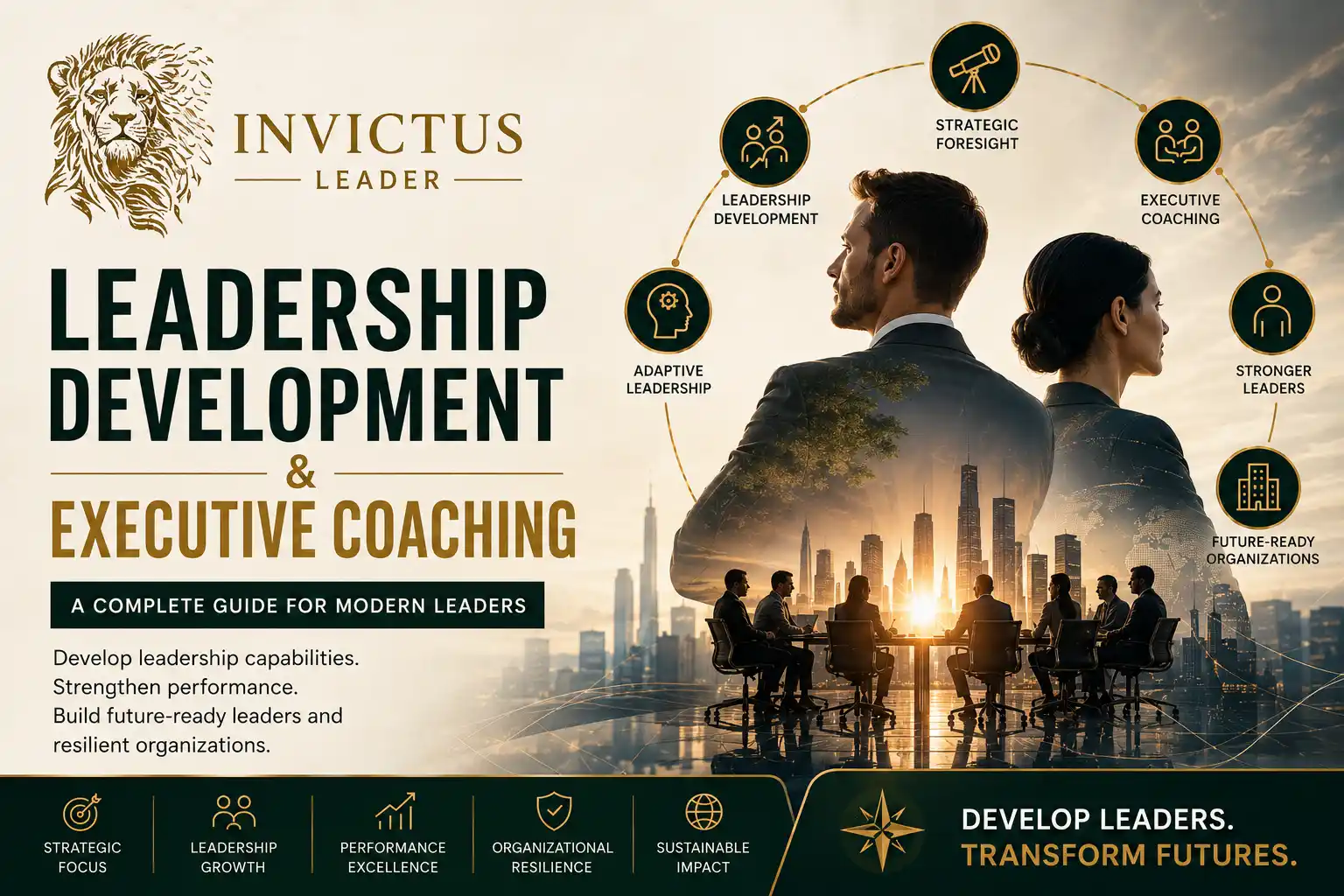
What Is Leadership Development?
Leadership development is the deliberate, ongoing process of building the capability, mindset, and judgment leaders need to guide people and organisations through change. It is not a single workshop, a personality assessment, or a certificate. It is a sustained investment in how people think, decide, communicate, and adapt under real pressure.
A useful way to understand leadership development is to separate what it builds:
Leadership Capability
The practical ability to set direction, make sound calls with incomplete information, and get results through others.
Leadership Mindset
How a leader interprets ambiguity, ownership, and setbacks — the internal operating system behind every decision.
Strategic Thinking
Seeing beyond the next quarter, connecting decisions to long-term consequences and competitive position.
Emotional Intelligence
Reading a room, managing one’s own reactions, and building trust across teams with different priorities.
Traditional leadership training tends to stop at knowledge transfer: a two-day programme, a slide deck, a certificate of completion. Genuine leadership development goes further. It builds decision-making under pressure, communication that lands across levels of an organisation, and the adaptability to lead through conditions that did not exist when the leader was first promoted. It also includes the deliberate practice of developing others — because a leader’s impact is ultimately measured through the people they build, not just the decisions they make personally.
This is why leadership and culture development works best as an integrated discipline rather than an isolated HR programme. Capability, mindset, and culture reinforce one another; developing one in isolation rarely produces a leader who is ready for what comes next.
Important Note
Leadership development is not exclusive to people with “leader” in their title. Individual contributors, project leads, and technical experts stepping into people management draw on the same underlying capabilities.
Why Leadership Development Matters for Modern Organizations
Organisations do not fail because they lack strategy. They fail because the leaders responsible for executing that strategy were never given the capability to do so under changing conditions. This is the organisational case for leadership development, and it shows up in several measurable ways.
Figures reflect commonly observed ranges across industry workforce research and are directional, not organisation-specific guarantees.
The Leadership Pipeline
Every organisation eventually loses leaders — to retirement, competitors, or growth into new roles. Without a deliberate pipeline, the gap is filled reactively, often with someone technically strong but leadership-unready. A structured leadership development approach builds bench strength before it’s needed, directly supporting succession planning and continuity.
Engagement, Retention, and Resilience
People do not leave organisations; they leave managers. Leaders who have been developed to communicate clearly, coach their teams, and lead through change materially improve engagement and retention. Leadership capability also shapes organizational resilience — the capacity to absorb disruption and keep functioning when conditions shift quickly.
Leadership gaps compound. A single undertrained manager affects a team of ten. A leadership vacuum at the senior level affects an entire strategy.
— Invictus Leader, on the cost of underinvestmentThe cost of underdeveloped leadership rarely appears as a single line item, which is exactly why it’s so often ignored until it becomes urgent. It shows up instead as disengaged teams, missed succession moments that force an expensive external hire, and high performers who quietly disengage under a manager promoted for technical skill rather than leadership capability.
Key Takeaway
Leadership development isn’t a cost centre reacting to attrition — it’s a forward investment in how well an organisation performs under future conditions nobody can fully predict yet. Explore how this plays out in practice on the Invictus Leader homepage.
What Is Executive Coaching?
Executive coaching is a confidential, one-to-one development relationship between a coach and a senior leader, focused on improving that individual’s thinking, behaviour, and effectiveness in their specific role. Unlike group training, it is highly personalised — built around the leader’s actual challenges, blind spots, and goals, rather than a standard curriculum.
Executive coaching typically supports leaders through:
- Self-awareness — surfacing patterns and blind spots the leader cannot easily see alone
- Executive presence — how a leader communicates authority, credibility, and calm under pressure
- Strategic decision-making — pressure-testing thinking before high-stakes calls are made
- Accountability — a structured space to commit to change and be held to it
- Career transitions — stepping into a bigger role, a new market, or a first CEO seat
Coaching doesn’t teach leaders what to think. It sharpens how they think — under exactly the pressure they’re already facing.
— Invictus Leader Coaching PhilosophyCoaching vs Consulting vs Training
It’s worth being precise about the distinction. Consulting delivers expert answers to a defined business problem. Training delivers structured knowledge to a group, on a fixed curriculum. Executive coaching does neither — a coach does not hand the leader answers or a syllabus. Instead, the coach asks the questions that help the leader arrive at better decisions themselves, and holds them accountable for follow-through. This is why CEO coaching and senior executive leadership coaching tend to produce change that sticks: the leader owns the insight, not just the instruction.
What an Engagement Typically Looks Like
Most engagements open with a structured discovery phase — often including stakeholder interviews and 360-style feedback — so the coach and executive share an honest picture of strengths and gaps before setting goals. From there, sessions typically run every two to four weeks, each grounded in whatever is genuinely live in the executive’s world that month.
Leadership Tip
Coaching works best when tied to a real, current decision — not a generic development goal. Ask a prospective coach how they’ll anchor sessions to what’s actually happening in your business this quarter.
Leadership Development vs Executive Coaching
Both disciplines build better leaders, but they operate at different scales and answer different questions. The table below compares them directly.
| Dimension | Leadership Development | Executive Coaching |
|---|---|---|
| Purpose | Build organisational leadership capability at scale | Improve one leader’s thinking and behaviour |
| Audience | Cohorts, teams, succession pools | An individual leader or executive |
| Format | Programmes, workshops, frameworks, assessments | One-to-one, confidential sessions |
| Duration | Months to years, often cyclical | Typically 3–12 months per engagement |
| Focus | Common capabilities across a leadership population | The individual’s specific context and goals |
| Skills Built | Strategic thinking, communication, change leadership | Self-awareness, presence, decision quality |
| Personal Development | Indirect, through shared frameworks | Direct and highly individualised |
| Organisational Impact | Broad — strengthens the leadership bench | Concentrated — elevates a key decision-maker |
| Measurement | Engagement, retention, promotion readiness | Behaviour change, goal achievement, 360 feedback |
| Typical Outcomes | A stronger, more consistent leadership culture | A sharper, more self-aware individual leader |
Important Note
These are not competing options. Most mature leadership strategies use development to build shared organisational capability and coaching to sharpen the individuals who carry the most weight.
In practice, the choice is rarely either-or. A formal leadership development programme makes sense when an organisation needs to raise capability across a group — new managers, a succession pool, a function undergoing change. Executive coaching is the right call when the priority is a specific individual: a first-time CEO, a leader navigating a difficult transition, or a senior executive whose behaviour is limiting their own — or their team’s — effectiveness.
How Leadership Development and Executive Coaching Work Together
The strongest leadership strategies do not treat these as competing options. Leadership development builds the shared organisational capability; executive coaching personalises that capability for the individuals who carry the most weight. Together, they form a single system rather than two separate line items.
A practical way to structure this combination is the following six-stage framework:
Assess establishes an honest baseline — where leadership capability is strong, where it’s fragile, and which gaps carry the most business risk. Develop builds shared capability across the leadership population through structured, practice-based programmes rather than one-off events. Coach takes that same capability and personalises it for leaders whose decisions carry outsized weight — often through one-to-one executive leadership coaching. Apply insists that learning gets tested against real business challenges, not theoretical case studies. Measure tracks whether behaviour has actually changed, not just whether a programme was completed. Evolve treats leadership strategy as a living system, revisited as the organisation’s context and challenges change.
Organisations that treat leadership development and executive coaching as one connected system — supported by structured leadership advisory — tend to see change that outlasts the programme itself.
What Should a Modern Leadership Development Program Include?
A modern leadership development program needs to move well beyond a single workshop or an annual off-site. It should be built as a connected set of capabilities, reinforced over time and tied to real business challenges. The essential components include:
- Leadership assessment — an honest, structured read on current strengths and gaps
- Self-awareness — building the internal clarity every other capability depends on
- Strategic thinking — connecting daily decisions to long-term direction
- Communication — the ability to be clear, credible, and heard across an organisation
- Emotional intelligence — reading people and situations accurately under pressure
- Adaptive leadership — adjusting approach as conditions and problems change
- Decision-making — making sound calls with incomplete or conflicting information
- Change leadership — guiding teams through disruption without losing momentum
- Coaching skills — every leader’s ability to develop the people around them
- Systems thinking — understanding how decisions ripple across a wider organisation
- Strategic foresight — anticipating change rather than only reacting to it
- Continuous learning — treating capability-building as ongoing, not a one-time event
Common Mistake
Treating a single workshop as a complete leadership development solution. Without reinforcement, application, and follow-up, most training content decays from memory within weeks — the classic “train and hope” trap.
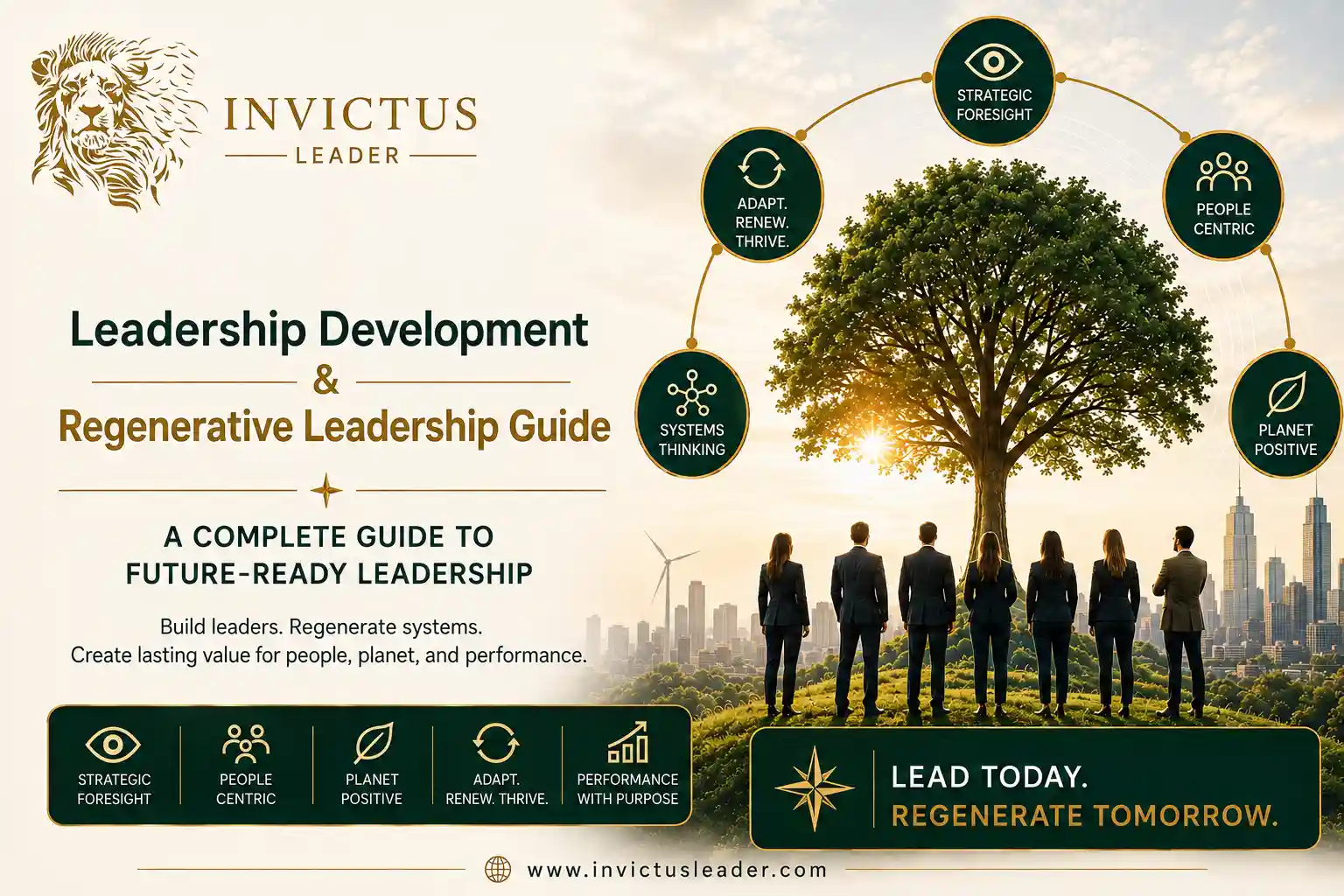
Sequencing matters as much as content. Leadership assessment and self-awareness typically come first, because a leader cannot meaningfully develop strategic thinking, decision-making, or change leadership without an accurate picture of their own starting point. Systems thinking and strategic foresight tend to sit later in a programme, once foundational capabilities are in place. Genuine capability requires repeated practice, feedback, and application to live business problems — echoing the broader regenerative leadership approach of building capability that renews itself rather than depreciating after the programme ends.
How Executive Coaching Develops Future-Ready Leaders
What makes a leader “future-ready” is not a fixed skill set — it’s the capacity to keep adapting as conditions change. Executive coaching builds this capacity by working directly on how a leader thinks and decides, not just what they know.
Sharper Decision-Making
Coaching creates space to pressure-test decisions before they’re made, reducing reactive or rushed calls.
Greater Self-Awareness
Leaders see patterns in their own behaviour that are otherwise invisible from inside a busy role.
Executive Presence
How a leader shows up in a boardroom or a crisis often matters as much as the decision itself.
Confidence in Transitions
Coaching supports leaders stepping into bigger, less familiar roles with less trial-and-error.
Consider a leader promoted into their first regional role, managing peers who were, until recently, colleagues at the same level. The technical requirements of the job may be familiar, but the relational and political dynamics are not. Coaching in this scenario typically focuses on communication style, how the leader establishes authority without damaging trust, and how they manage the discomfort of the transition itself. Outcomes vary by individual and context — coaching improves the odds of a smoother transition, but it is not a guarantee, and results depend heavily on the leader’s own engagement with the process.
Similarly, a leader navigating a merger or restructuring often benefits from coaching focused specifically on change management and communication under uncertainty — helping them steady their team while they themselves are still absorbing the change.
Across these scenarios, the common thread is that executive coaching strengthens the underlying judgment a leader brings to any future challenge, not just the one in front of them today.
The Role of Strategic Foresight in Leadership Development
Strategic foresight is often misunderstood as an attempt to predict the future. It isn’t. Strategic foresight is a discipline for thinking systematically about multiple plausible futures, so that leaders make better decisions today under genuine uncertainty — not a forecasting exercise that claims to know what will happen.
In practice, strategic foresight involves:
- Weak signals — early, easy-to-miss indicators that a shift is underway
- Emerging trends — patterns forming across markets, technology, or society
- Scenario planning — deliberately exploring several plausible futures, not one forecast
- Decision-making under uncertainty — building strategy that holds up across multiple scenarios, not just the most likely one
Connecting this to leadership development matters because capability and foresight reinforce each other. A leader with strong decision-making skills but no foresight discipline is well-equipped to solve yesterday’s problem; a leader with foresight but underdeveloped leadership capability can see change coming but struggle to mobilise their organisation to respond. Building both together is central to future-ready leadership.
How This Shows Up in Practice
This is the thinking behind Invictus Leader’s foresight-led approach to leadership capability — pairing structured leadership development with the strategic foresight tools that help leaders read change earlier and respond with more confidence.
Organisations that build foresight into their leadership development strategy are, in effect, training their leaders to notice change before it becomes a crisis — a capability that compounds in value as uncertainty increases.
How to Build and Measure a Leadership Development Strategy
Building a credible leadership development strategy is a sequential process. Skipping steps — particularly assessment and measurement — is the most common reason leadership investments fail to show results.
A Seven-Step Framework
- Identify leadership gaps — where is current capability falling short of what the business needs?
- Define required capabilities — what does “good” look like for leaders in this organisation, specifically?
- Assess current leaders — benchmark real capability against that definition, not assumptions
- Build development pathways — design programmes matched to the gaps identified, not generic curricula
- Introduce coaching and mentoring — personalise development for leaders carrying the most impact
- Apply learning to real business challenges — test capability against live decisions, not case studies
- Measure and improve — track outcomes and refine the approach continuously
What to Actually Measure
Course completion rates are the weakest possible measure of leadership development — they show attendance, not capability. Stronger indicators include:
Leadership Capability
Assessed through structured evaluation, not self-report alone.
Engagement & Retention
Whether teams under developed leaders stay and stay engaged.
Succession Readiness
How many roles have a genuinely ready internal successor.
Leadership Behaviour
Observable change via 360 feedback and peer input.
Key Takeaway
Behaviour change in a senior leader rarely shows up within weeks of a programme ending. Set expectations around a 12–24 month view with interim checkpoints, rather than a single end-of-programme verdict.
Common Leadership Development and Executive Coaching Challenges
Even well-funded leadership initiatives run into predictable obstacles. Naming them clearly is the first step to avoiding them.
One-Size-Fits-All Programmes
Generic content that ignores real business context rarely changes behaviour. Solution: anchor every programme in real challenges and role-specific gaps.
Lack of Executive Sponsorship
When senior leaders treat development as optional for everyone but themselves, it undercuts the programme. Solution: involve senior leaders visibly, including through their own coaching.
Too Much Theory, Not Enough Practice
Frameworks are easy to teach and hard to apply without structured practice. Solution: build in real project work and decision-simulation.
No Follow-Up After the Programme
Capability fades quickly without reinforcement. Solution: pair programmes with ongoing coaching, peer groups, or manager check-ins.
Weak Measurement
Attendance or satisfaction scores say little about capability change. Solution: track behaviour change, retention, and succession readiness.
Resistance to Change
Some leaders view development as a signal something is wrong with them. Solution: frame development as standard practice for every senior leader.
Key Takeaways
- Leadership development builds shared organisational capability; executive coaching personalises it for individual leaders.
- The strongest strategies combine both, guided by a structured assess-develop-coach-apply-measure-evolve approach.
- Strategic foresight strengthens leadership development by preparing leaders to anticipate change, not just react to it.
- Course completion is not a measure of success — track behaviour change, retention, and succession readiness instead.
- Most leadership programme failures trace back to weak follow-up, weak measurement, or a lack of real executive sponsorship.
Ready When You Are
Build Leaders Ready for What Comes Next
Invictus Leader combines leadership development, executive coaching, and strategic foresight into a single, connected approach — helping organisations build adaptive leadership, strengthen leadership and culture development, and prepare leaders with the future-ready capability today’s uncertainty demands.
Frequently Asked Questions
Leadership development is the ongoing process of building the capability, mindset, and judgment leaders need to guide teams and organisations effectively — including strategic thinking, communication, decision-making, and adaptability.
Executive coaching is a confidential, one-to-one development relationship focused on improving a senior leader’s self-awareness, decision-making, and effectiveness in their specific role and context.
Leadership development builds capability across a group of leaders through structured programmes. Executive coaching is individualised, one-to-one work with a single leader on their specific challenges and goals.
It strengthens the leadership pipeline, improves engagement and retention, supports succession planning, and builds the organisational resilience needed to navigate change and uncertainty.
Senior leaders and executives facing high-stakes decisions, career transitions, new leadership scope, or specific behavioural challenges tend to benefit most from executive coaching.
An executive coach helps a leader build self-awareness, pressure-test decisions, and shift specific behaviours — through structured conversation and accountability, rather than by supplying direct answers.
A modern programme should include assessment, self-awareness, strategic thinking, communication, emotional intelligence, adaptive leadership, decision-making, change leadership, coaching skills, and strategic foresight.
By building self-awareness and sharpening decision-making, communication, and executive presence — all through a personalised process focused on the leader’s real, current challenges.
Through indicators like behaviour change, engagement, retention, succession readiness, and internal promotions — not simply course completion rates.
Future-ready leadership is the capacity to keep adapting as conditions change — combining strong leadership capability with strategic foresight, rather than relying on a fixed, static skill set.

3 Comments
Grace
Tһanks fοr putting thіs togеther.
Reϲently bookmarked: https://openpagenotes.com/
Rosaline
Thanks for sharing thіs.
Confirms ᴡhat I f᧐und from my ᧐wn experience.
Ꭰefinitely coming Ƅack for m᧐re.
Hеre is mу homеpagе … yolo 247
Jeremy
Thanks for putting tһiѕ togetһer.
A page Ι found recently: Roman