Table of Contents
- 01What Is Regenerative Leadership?
- 02Why Regenerative Leadership Development Matters
- 03Comparing Regenerative, Traditional, and Sustainable Leadership
- 04The Core Principles of Regenerative Leadership
- 05Strategic Foresight in Leadership Development
- 06How to Build Future-Ready Organizations
- 07Regenerative Leadership Development & Culture
- 08Regenerative Leadership in the Age of AI
- 09Practical Examples of Leadership Development
- 10Frequently Asked Questions
What Is Regenerative Leadership?
Regenerative leadership is the practice of leading people, organizations, and systems in a way that restores and strengthens their capacity to adapt, learn, and create long-term value — rather than simply maintaining performance or minimizing harm.
Working definition — Invictus LeaderThree Key Reference Points
Specifically, to understand regenerative leadership, it helps to place it against three familiar reference points.
Optimization versus regeneration. Optimization asks, “How do we extract more efficiency from what already exists?” It tightens processes, cuts waste, and improves margins within a fixed system. A regenerative approach, however, asks a different question: “How do we strengthen the system itself so it can keep producing value under new conditions?” Optimization can make a brittle system more efficient at being brittle. Ultimately, this builds the capacity to change.
Regeneration vs. sustainability. Sustainability is fundamentally about maintenance — reducing harm, preserving resources, and keeping a system stable at its current level of health. Regeneration goes further. It is about actively restoring vitality: rebuilding trust after a difficult transformation, renewing an employee’s sense of purpose, or redesigning a business model so it creates more value for people and planet than it consumes. Sustainability holds the line. Regeneration moves the line forward.
Traditional models vs. regeneration. Traditional leadership models were built around hierarchy, control, and predictability — leaders set direction, and the organization executes. Regenerative leadership treats the organization as a living system rather than a machine. It focuses on conditions rather than commands: psychological safety, learning capacity, distributed decision-making, and the ability to sense and respond to change faster than it can be centrally managed.
Tending a Living System
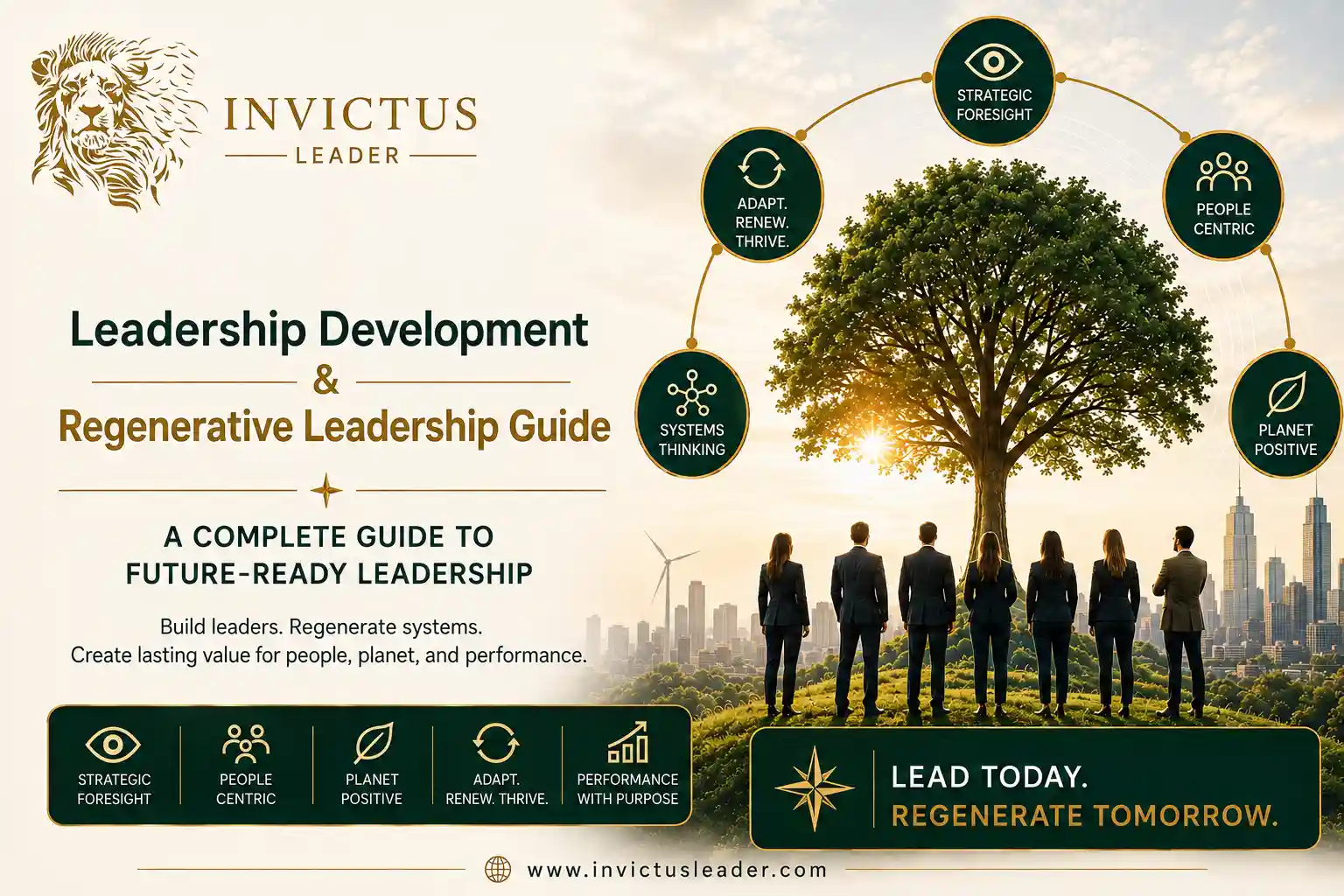
Consequently, at its core, regenerative leadership rests on three interlocking commitments: people, purpose, and planet — developing people continuously, anchoring decisions in a clear purpose beyond short-term profit, and accounting for the organization’s impact on the wider systems it depends on. When leaders hold these three commitments together, leadership stops being about managing a static structure and becomes about tending a living one.
Why Regenerative Leadership Development Matters in a Changing World
Leadership models tend to reflect the conditions of their creation. The command-and-control model of the industrial era made sense when change was slow and information traveled from the top down. That world no longer exists, and several forces are converging to make regenerative capacity — not just efficiency — the defining leadership advantage.
The Shift in Technology and Strategy
AI is changing the nature of decision-making itself. For instance, recent McKinsey research on the state of AI adoption found that the large majority of organizations now use AI in at least one business function, yet only a small fraction report having reached real organizational maturity with it — the gap sits squarely in leadership, governance, and culture rather than in the technology. Separate McKinsey survey work has found that employees are often using generative AI more extensively in their daily work than leaders realize, while a significant share of senior executives privately admit their organizations are moving too slowly to capture the opportunity. This is not a technology gap. It is a leadership gap.
Uncertainty has become the operating condition, not the exception. In addition, geopolitical shocks, interest rate swings, and rapid shifts in trade policy mean that the multi-year strategic plan is losing its predictive power. Consequently, leaders need the capacity to update their thinking continuously rather than defend a fixed plan.
The Shift in Talent and Ecology
Workforce expectations have shifted. Similarly, employees, particularly those earlier in their careers, increasingly weigh purpose, development, and leadership quality alongside compensation. Organizations that cannot demonstrate genuine investment in people’s growth struggle to retain the capability they need for the future.
Organizational complexity keeps compounding. Furthermore, global supply chains, distributed teams, and interconnected digital systems mean that a decision in one part of the organization can ripple unpredictably through the rest. Systems thinking is no longer a specialist skill — it is a baseline leadership requirement.
Climate and resource pressures are reshaping strategy. Ultimately, climate and resource pressures are reshaping strategy. Consequently, organizations across sectors must account for their long-term impact to regulators, investors, and customers, rather than focus solely on their quarterly performance.
Therefore, these forces mean leadership needs to evolve from controlling change to enabling adaptation and renewal — building organizations that treat disruption as a source of information rather than a threat to be resisted.
Comparing Regenerative, Traditional, and Sustainable Leadership
Regenerative vs. Traditional Leadership
The clearest way to understand regenerative leadership is to compare it directly with the traditional model most organizations were built on.
| Dimension | Traditional Leadership | Regenerative Leadership |
|---|---|---|
| Mindset | Control and predictability | Adaptation and renewal |
| Time horizon | Quarterly to annual planning cycles | Long-term vitality, informed by continuous sensing |
| Decision-making | Centralized, top-down | Distributed, informed by signals across the organization |
| People | Managed as resources to deploy | Developed as sources of adaptive capacity |
| Culture | Compliance and consistency | Psychological safety and experimentation |
| Innovation | Occasional, project-based | Continuous and embedded in operating rhythm |
| Risk | Minimized and avoided | Understood and navigated deliberately |
| Systems view | Departments as separate units | Organization as an interconnected living system |
| Purpose | Shareholder value as the primary lens | People, purpose, and planet held together |
| Measurement | Short-term financial performance | Long-term organizational health alongside performance |
| Response to disruption | Defend the existing plan | Sense, reframe, and redesign |
Regenerative vs. Sustainable Leadership
Regenerative and sustainable leadership are often used interchangeably, but conflating them oversimplifies both. Sustainability, at its core, is about maintaining a system without depleting it further — reducing harm, conserving resources, and holding steady. It is an essential foundation, but it is fundamentally defensive: its success metric is that things don’t get worse.
Regeneration starts from a different premise. Specifically, rather than asking how to minimize damage, it asks how leadership can actively restore and increase the vitality of the people, culture, and systems an organization depends on — leaving them stronger than they were found. While a sustainable supply chain avoids further ecological damage, a regenerative model actively improves the health of the ecosystems and communities it touches. Similarly, a sustainable culture focuses on avoiding burnout, whereas a regenerative culture actively builds people’s capacity to grow through change.
| Dimension | Sustainable Leadership | Regenerative Leadership |
|---|---|---|
| Core goal | Maintain and reduce harm | Restore and actively increase vitality |
| Orientation | Defensive — hold the line | Generative — move the line forward |
| Success measure | Impact does not worsen | Systems become measurably stronger over time |
| Relationship to change | Manage change to limit disruption | Use change as an input for renewal |
| Scope | Often environmental or compliance-focused | Spans people, culture, strategy, and environment together |
Regenerative leadership doesn’t replace sustainability — it builds on it. Sustainable practices set the floor; regenerative leadership raises the ceiling.
The Core Principles of Regenerative Leadership
Regenerative leadership is guided by a set of interlocking principles. Specifically, none works in isolation — together, they describe a leader who builds capacity rather than simply directing activity.
Think in Systems
See the organization as an interconnected whole, not a collection of departments. Decisions in one area are understood in light of their ripple effects elsewhere.
Lead with Purpose
Anchor strategy and daily decisions in a purpose that extends beyond short-term financial targets, giving people a reason to commit beyond compliance.
Build Adaptive Capacity
Invest in the organization’s ability to respond to change — flexible structures, cross-trained teams, and decision rights that can shift when conditions do.
Develop People Continuously
Treat capability building as an ongoing discipline, not an annual training event, so people’s skills evolve alongside the environment they operate in.
Anticipate Emerging Change
Actively scan for weak signals — early, ambiguous indicators of shifts to come — rather than waiting for disruption to become obvious.
Design for Long-Term Value
Weigh decisions against their effect on the organization’s future health, not only their impact on this quarter’s results.
Encourage Experimentation
Create structured space for testing new ideas at low cost, treating failed experiments as data rather than setbacks.
Strengthen Organizational Resilience
Build redundancy, diversity of thought, and flexible resourcing so the organization can absorb shocks without collapsing.
Balance People, Purpose, and Performance
Hold all three in view simultaneously — none is sacrificed permanently for the sake of the others.
Create Conditions for Renewal
Build in deliberate pauses for reflection, learning, and recalibration, rather than running the organization at permanent full throttle.
The Role of Strategic Foresight in Regenerative Leadership Development
However, strategic foresight is one of the most important — and most misunderstood — capabilities inside regenerative leadership. Foresight is not fortune-telling. It is not about predicting a single, fixed future and then betting the organization on it. Rather, foresight is a discipline for exploring multiple plausible futures, so that decisions today remain resilient across more than one version of tomorrow.
Foresight Is a Decision Discipline, Not a Prediction Exercise
Strategic foresight helps leaders identify weak signals before they become obvious trends, challenge inherited assumptions about how the industry works, and surface both emerging risks and emerging opportunities early enough to act. Used well, it doesn’t tell leaders what will happen — it improves the quality of the decisions they make while the future is still unclear. This is the discipline at the center of Invictus Leader’s Foresight Suite, and it’s the connective thread that links anticipating change and actually leading through it.
Consequently, foresight changes how leadership teams operate. Instead of a single annual strategy review, foresight-driven organizations build ongoing “signal intelligence” — structured ways of noticing shifts in technology, customer behavior, regulation, and competitive dynamics before they show up in quarterly numbers. Instead of one strategic plan, they build several scenarios and stress-test decisions against each of them. Ultimately, this is what allows regenerative leaders to move from reacting to disruption to designing for it.
How Regenerative Leaders Build Future-Ready Organizations
Turning regenerative principles into practice requires a repeatable process. Specifically, the following five-step cycle reflects how regenerative leaders move from noticing change to institutionalizing renewal.
Sense
Leaders build structured ways to notice weak signals — shifts in customer behavior, technology, regulation, or competitor moves — before they become mainstream trends. This matters because organizations that only respond to obvious, mature trends are already several steps behind.
Example: A leadership team runs quarterly horizon scans across customer, technology, and regulatory signals rather than relying solely on annual industry reports.Frame
Consequently, teams translate raw signals into a clear problem statement, separating symptoms from root causes. Correct framing prevents leaders from solving the wrong problem quickly instead of the right one carefully.
Example: A recurring service complaint is reframed from “a training issue” to “a workflow design issue” once the underlying process is examined.Imagine
Furthermore, teams explore multiple plausible futures rather than committing to a single forecast, using scenario thinking to stress-test strategy against different conditions. This matters because it prevents strategic decisions from being brittle to a single assumption.
Example: A manufacturer models three futures for automation adoption — slow, moderate, and rapid — and designs a workforce strategy resilient across all three.Adapt
Subsequently, leaders adjust strategy, structure, and capability based on what they have sensed, framed, and imagined — often through small, reversible experiments rather than one large bet. This matters because it builds organizational muscle for change instead of relying on rare, disruptive overhauls.
Example: A pilot team tests a new decision-making structure in one business unit before scaling it organization-wide.Regenerate
Ultimately, organizations feed lessons from adaptation back into culture, systems, and leadership development, emerging stronger and more capable than before — not simply back to where they started. This is what separates regeneration from recovery.
Example: Insights from a market disruption are formally built into onboarding and strategic planning, rather than living only in the memory of the team that lived through it.Regenerative Leadership Development and Organizational Culture
Strategy sets direction, but culture determines whether regenerative leadership actually takes hold. Specifically, a leader can articulate a compelling vision for adaptive, purpose-led leadership, but if the underlying culture punishes honest disagreement or treats every failed experiment as a career risk, the vision stays theoretical.
Several cultural conditions consistently show up in organizations that sustain regenerative leadership over time:
- Psychological safety — people can surface bad news, disagree with leadership, and admit uncertainty without fear of punishment.
- A learning culture — teams treat mistakes as information, and reflection is built into the operating rhythm rather than reserved for post-mortems.
- Structured experimentation — teams have permission and budget to test small ideas before committing to large ones.
- Clear accountability — leaders pair autonomy with ownership, preventing distributed decision-making from collapsing into a diffusion of responsibility.
- Genuine collaboration — information and expertise move across silos rather than being hoarded within them.
- Inclusion — teams actively seek diverse perspectives when framing problems and imagining futures, widening the range of signals an organization can detect.
- Trust — the foundation that makes distributed decision-making and honest signal-sharing possible in the first place.
- Shared purpose — a common “why” that gives coherence to decentralized decisions.
- Adaptability — teams revisit norms and processes regularly rather than treat them as fixed once set.
Because culture and leadership behavior reinforce each other, culture must evolve alongside leadership rather than trail behind it. Consequently, this is the focus of Invictus Leader’s work on Regenerative Leadership & Culture Systems, which treats culture change not as a separate initiative but as an integral part of how they redesign leadership itself.
Regenerative Leadership in the Age of AI
AI Is a Leadership Issue Before It Is a Technology Issue
The organizations extracting the most value from AI are not necessarily the ones with the most advanced models — they are the ones where leadership takes direct ownership of how AI reshapes decisions, roles, and accountability. Research from McKinsey has found that senior leadership engagement, rather than technical sophistication alone, is strongly associated with reported business value from AI investment. Treating AI purely as an IT rollout, rather than an organizational transformation, is one of the most common reasons adoption stalls.
Key Themes in AI Strategy
Several themes define regenerative leadership’s approach to AI:
AI-augmented decision-making. Specifically, AI can process signals at a scale no human team can match, but judgment about what those signals mean — and what to do about them — remains a leadership responsibility. Regenerative leaders use AI to expand what they can sense, not to replace the framing and imagination stages of decision-making.
Human judgment stays central. As AI tools take on more analytical and even decision-support work, the leadership skills that matter most shift toward judgment, ethics, and the ability to ask better questions — precisely the capabilities that strategic foresight builds.
Ethical AI and governance. Regenerative leaders treat AI governance — who is accountable for AI-influenced decisions, how bias is monitored, and where human oversight is non-negotiable — as a leadership responsibility, not a technical afterthought.
Workforce transformation. For instance, McKinsey’s ongoing research on AI and the future of work has found that as AI adoption grows, organizations are increasingly redeploying, rather than eliminating, the time it frees up — reinforcing that AI’s biggest workforce impact is transformation of roles, not simple headcount reduction. Consequently, that transformation requires deliberate investment in reskilling, not just workflow redesign.
Continuous learning as a survival skill. Ultimately, as the skills required for any given role shift faster than traditional training cycles can keep up, building a durable learning culture becomes a competitive necessity rather than a nice-to-have.
Practical Examples of Regenerative Leadership Development
The following illustrative scenarios show how regenerative leadership and leadership development principles apply in practice. They are composite examples designed to demonstrate application, not case studies of specific named organizations.
Responding to AI Disruption
A mid-sized financial services firm notices early signals that AI-driven tools are changing customer expectations around response time. Rather than issuing a top-down mandate, leadership runs small pilots in two branches, gathers frontline feedback, and uses what’s learned to redesign both the workflow and the training model before scaling company-wide.
Redesigning Workforce Capabilities
A manufacturing organization facing automation pressure builds a phased reskilling and leadership development program instead of a one-time layoff-and-hire cycle, mapping which roles will evolve and investing in the capabilities employees will need for the roles that come next.
Leading Through Market Uncertainty
A leadership team facing volatile input costs shifts from a single annual budget to a scenario-based planning process, reviewed quarterly, so decisions can adapt as conditions change rather than waiting for the next planning cycle.
Rebuilding Culture After Transformation
Following a difficult restructuring, a leadership team invests deliberately in rebuilding psychological safety — through listening sessions, visible follow-through on commitments, and redesigned feedback loops — recognizing that trust, once damaged, has to be regenerated intentionally.
Balancing Growth with Long-Term Value
A consumer goods company redesigns its supplier relationships to account for long-term community and environmental impact alongside cost, treating this as a strategic differentiator rather than a compliance requirement.
Build Leadership That Is Ready for What Comes Next
Regenerative leadership brings together strategic foresight, adaptive culture, and organizational resilience into one discipline — helping leaders move from managing disruption to designing for it. If your organization is ready to build that capacity, Invictus Leader can help you shape it.
Frequently Asked Questions
Regenerative leadership is the practice of leading people and organizations in a way that restores and strengthens their capacity to adapt, learn, and create long-term value — rather than simply maintaining current performance or minimizing harm.
An example is a leadership team that responds to a market disruption not by cutting costs alone, but by piloting new approaches, gathering frontline feedback, and formally building what they learn into future strategy and training — leaving the organization more capable than before the disruption occurred.
Sustainable leadership focuses on maintaining a system and reducing harm — holding steady. Regenerative leadership goes further by actively restoring and increasing the vitality of people, culture, and systems, aiming to leave them stronger than they were found.
It matters because AI, geopolitical volatility, workforce change, and climate pressure have made continuous disruption the norm rather than the exception. Organizations led with a control-and-predict mindset struggle in this environment; those built to sense, adapt, and renew are better positioned to create durable value.
Core principles include systems thinking, purpose-led decision-making, building adaptive capacity, continuous people development, anticipating emerging change, designing for long-term value, encouraging experimentation, strengthening resilience, balancing people-purpose-performance, and creating conditions for renewal.
Strategic foresight helps leaders detect weak signals early, explore multiple plausible futures, challenge inherited assumptions, and identify emerging risks and opportunities — improving the quality of decisions made under uncertainty, rather than attempting to predict a single fixed outcome.
Organizations typically build these capabilities through futures literacy training, systems-thinking practice, structured signal intelligence routines, adaptive decision-making frameworks, leadership self-awareness development, embedded experimentation, and long-term vitality metrics — supported by dedicated leadership development programs.
A regenerative organization is one designed to sense change early, adapt continuously, and emerge from disruption stronger — treating people, purpose, and long-term systemic health as central to strategy rather than secondary to short-term financial performance.
Culture determines whether regenerative leadership principles actually take hold. Psychological safety, learning orientation, structured experimentation, and trust are the cultural conditions that allow adaptive, purpose-led leadership to function in practice rather than remain aspirational.
Yes. Research indicates that senior leadership engagement — not technical sophistication alone — is a strong predictor of value realized from AI investment. Regenerative leadership treats AI as an organizational transformation issue requiring governance, judgment, and workforce development, not purely a technology rollout.
Through a broader set of indicators alongside financial performance: employee engagement, leadership capability, retention, innovation output, adaptability, learning velocity, resilience, succession readiness, stakeholder value, and long-term organizational health.
Key skills include futures literacy, systems thinking, signal detection, adaptive decision-making, self-awareness, comfort with experimentation, and the ability to balance short-term performance with long-term organizational vitality.