Most companies believe the goal of business is simple:
Build a product.
Market the product.
Sell the product.
But some companies understand something deeper.
The real strategic game is not selling the product.
The real game is engineering the behaviour that makes the product inevitable.
One of the most powerful examples of this strategy comes from a tyre company.
The Problem Michelin Faced
At the beginning of the twentieth century, Michelin founders André Michelin and Édouard Michelin faced a fundamental market challenge.
Around 1900, France had fewer than 3,000 automobiles.
Road infrastructure was weak. Travel was limited. Driving culture did not exist.
This resulted in:
- Very little movement
- Very little tyre wear
- Very little tyre replacement demand
In simple terms, there was no real market for tyres.
Most companies would respond with aggressive marketing and advertising.
Michelin asked a better question:
Why would people drive at all?
The Strategic Insight: Movement Drives Demand
Driving is not the goal.
Movement is.
People travel for:
- Food
- Experiences
- Discovery
- Meaning
Michelin realised that if they could increase travel behaviour, tyre demand would naturally follow.
They did not need to sell tyres.
They needed to create reasons to move.
This is called demand engineering.
Not selling the product.
But shaping the conditions that make the product necessary.
The Birth of the Michelin Ecosystem
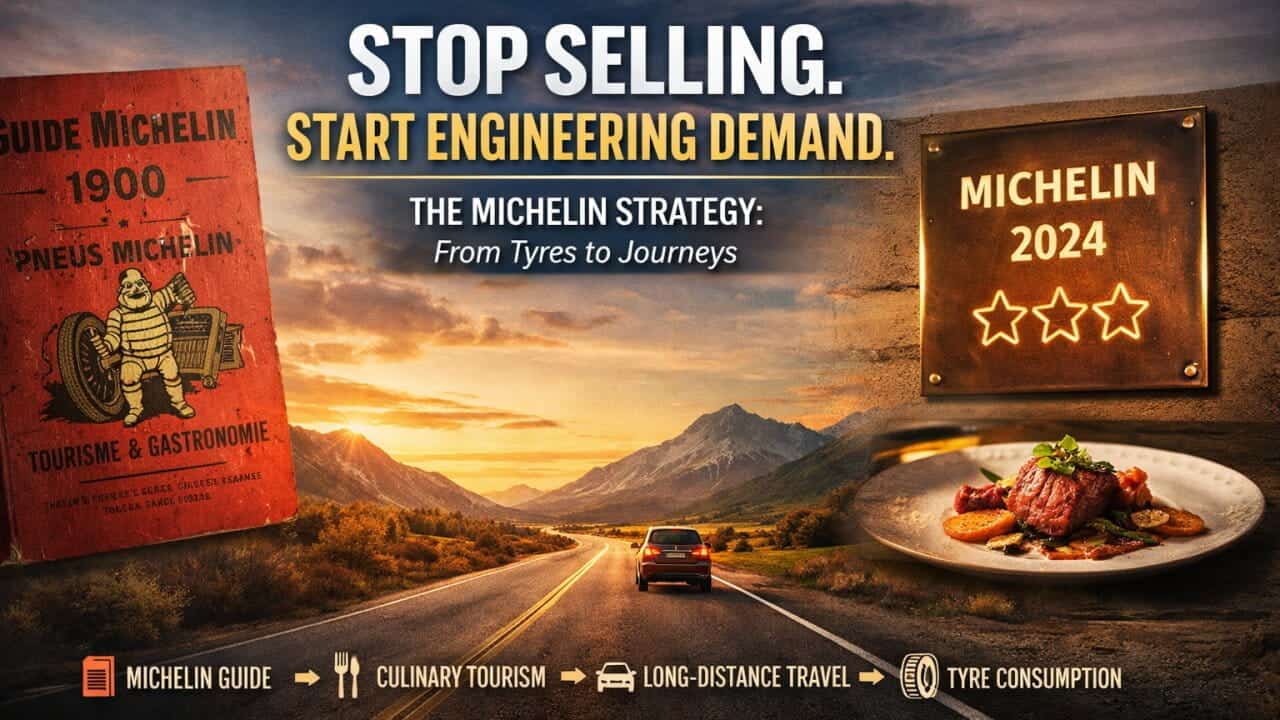
In 1900, Michelin launched the Michelin Guide.
It was not a product catalogue.
It was a travel ecosystem.
The guide helped drivers find:
- Places to visit
- Restaurants to eat at
- Hotels to stay
- Fuel stations
- Repair shops
It was distributed for free.
Because Michelin understood a key business principle:
If people travel more → cars move
If cars move → tyres wear
If tyres wear → tyres need replacement
They were not selling tyres.
They were building a mobility-driven demand ecosystem.
The Hidden Signal That Changed Everything
Over time, Michelin noticed something interesting.
People were willing to travel long distances for certain restaurants.
This was not obvious.
This was a behavioral signal.
Most organisations ignore signals.
Michelin acted on it.
The Michelin Star System: A Behavioural Trigger
In 1926, Michelin introduced the first Michelin Star.
By 1931, the three-star system was defined:
- ★ Very good
- ★★ Worth a detour
- ★★★ Worth a special journey
Look closely at the language:
“Worth a special journey.”
This is not just about food.
It is a behaviour trigger:
- Drive
- Travel
- Move
- Consume tyres
The Invisible Growth Strategy
Every Michelin star quietly drives:
- Culinary tourism
- Long-distance travel
- Road trips
- Increased tyre consumption
Michelin never said:
“Buy our tyres.”
Instead, they created a world where people said:
“Let’s go.”
Linear Thinking vs Strategic Foresight
Most businesses still follow a linear model:
Product → Marketing → Sales → Competition
This leads to:
- Price wars
- Feature comparisons
- Short-term growth tactics
Foresight-driven organisations operate differently:
Behaviour → Ecosystem → Demand → Product success
Michelin solved a tyre problem by solving a movement problem.
This is non-linear strategy thinking.
The Same Pattern Exists Today
This is not just history. It is a repeatable business pattern.
- Apple built an ecosystem, not just devices
- Amazon engineered habit through Prime
- Tesla enabled adoption through infrastructure
Each understood the same principle:
Products succeed when behaviour shifts.
Why Most Organisations Fail
Many business initiatives fail not because the idea is weak.
They fail because behaviour does not change.
- AI tools are implemented but unused
- Digital platforms are launched but ignored
- Innovation programmes deliver no impact
No behaviour shift → No demand → No results
The Most Important Strategic Question
Instead of asking:
“How do we sell more?”
Ask:
What behaviour must exist for our product to become inevitable?
Most leaders understand this concept.
Very few know how to apply it.
Because it requires:
- Deeper thinking
- Slower decision-making
- Strategic discomfort
Not theory.
Practice.
Invictus School of Future Foresight
This is exactly what I will be working on with a small group of leaders over the coming months.
A closed-room strategic intervention.
Not a workshop.
Not a lecture.
A space to challenge and rebuild thinking.
📍 Invictus School of Future Foresight
📅 Starting 8 April
🔁 Bi-weekly sessions
🕒 8:00 PM – 10:30 PM
👥 Limited to 5 participants
Each session focuses on your organisation:
- Identifying behaviour your business depends on
- Uncovering blocked demand
- Designing ecosystems that drive inevitability
This is not for everyone.
Only for those willing to think differently.
📩 If this resonates: vsravi@invictusleader.com
The Michelin Lesson
Michelin never created demand for tyres.
They created demand for movement.
And in doing so, they didn’t just grow a business.
They shaped behaviour at scale.
The companies that understand this don’t compete in markets.
They quietly design them.
Ravi VS
Invictus Leader