Most SMEs are asking the wrong question.
Not:
“How do we grow?”
Not even:
“How do we sustain?”
Because both questions assume something dangerous:
That your current business model deserves to exist in the future.
It doesn’t.
Not automatically.
Not anymore.
The Hidden Collapse Most SMEs Don’t See
Across industries, a consistent pattern is emerging in small and medium-sized enterprises (SMEs):
- Revenue is stable… but profit margins are shrinking
- Customers are buying… but not staying loyal
- Teams are working… but not thinking strategically
On paper, everything appears healthy.
In reality:
The business system is slowly depleting.
And sustainability will not fix depletion.
It will only slow it down.
Sustainability vs Regeneration: The Strategic Difference
Sustainability is defensive.
It focuses on:
- Preservation
- Optimisation
- Maintaining competitiveness
Regeneration is decisive.
It asks a far more critical question:
Should this business model even exist in the future?
This is not a comfortable question.
But it is the only one that matters.
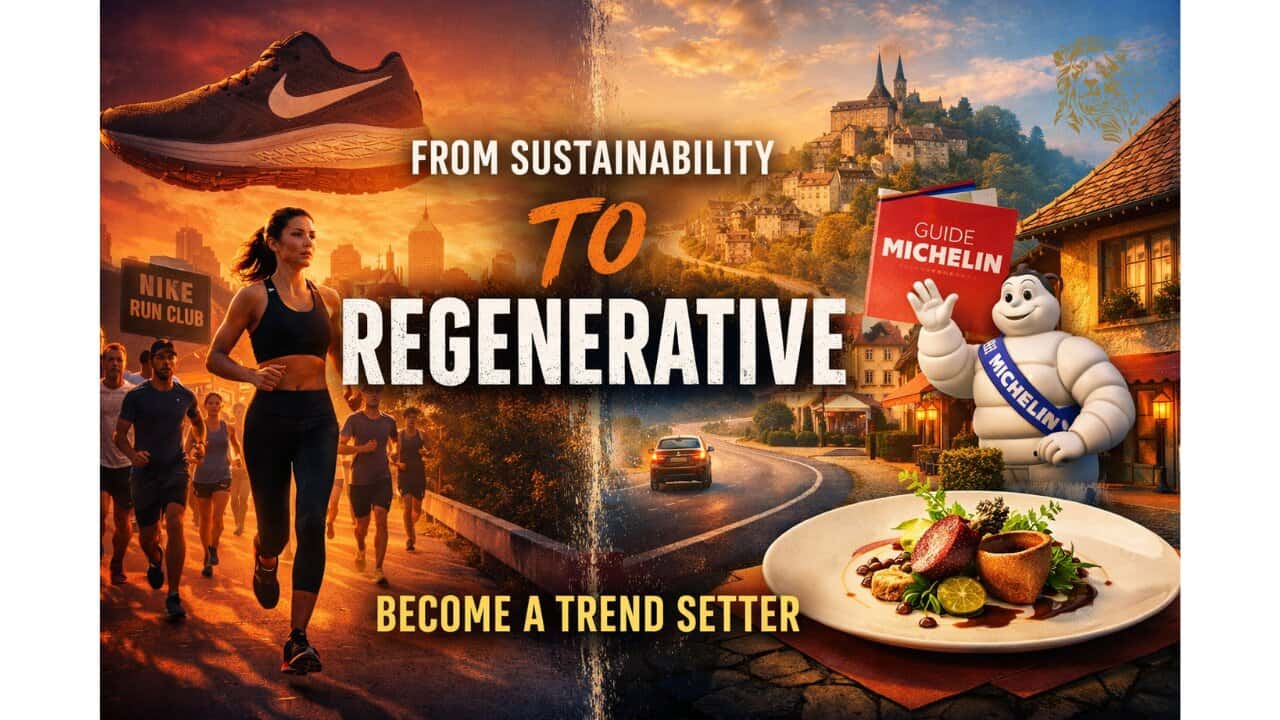
How Nike Created Behaviour, Not Just Product Demand
Before Nike, running was not a widespread habit.
They didn’t ask:
“How do we sell more shoes?”
They asked:
“How do we make running inevitable?”
So they built:
- Communities
- Identity
- Culture
Once behaviour existed → shoes were no longer a decision.
They became a consequence.

How Michelin Engineered Demand Through Behaviour
Michelin faced a fundamental issue:
People were not driving enough.
They didn’t redesign tyres.
They redesigned behaviour.
They created:
- Desire to travel
- Destination-driven thinking
- The Michelin Star system
More travel → more driving → more tyre usage
They didn’t compete.
They made competition irrelevant.

The Reality for SMEs Today
Let’s bring this into a real SME context.
A logistics SME client in Southeast Asia came with a common problem:
“We need more customers.”
But that was not the real issue.
The actual problem was:
Customers only engaged when they had an immediate need.
No behaviour.
No continuity.
No dependency.
The Strategic Shift: From Transactions to Behaviour
Instead of improving sales tactics, we asked:
“What behaviour must exist for customers to rely on you before they need you?”
This changed everything.
The Transformation
From:
- Transaction-based delivery model
To:
- Embedded logistics behaviour
They introduced:
- Predictive scheduling
- Subscription-based fulfilment
- Early-stage integration into client decisions
The Results: Behaviour Drives Business Outcomes
Within months:
- Fewer customers… but higher retention
- Lower customer acquisition costs
- Increased client dependency
Because now:
They were not just a vendor.
They became part of the system.
Where Most SMEs Go Wrong
Most SMEs continue to:
- Run promotions
- Compete on price
- Copy competitors
Which results in being:
- Late to market
- Smaller in scale
- Easily replaceable
Here’s the hard truth:
If your strategy depends on customers choosing you, you are already losing.
What Regenerative SMEs Do Differently
Regenerative SMEs focus on one thing:
Designing behaviour.
Not campaigns.
Not products.
Not messaging.
Behaviour.
Because:
- Behaviour creates demand
- Demand creates markets
- Markets create dominance
The Invictus Strategic Framework
This is not theory.
This is how transformation actually happens:
1. Sense (Signals)
Where is customer behaviour already shifting?
2. Frame (Real Problem)
Is the issue truly sales… or lack of behaviour?
3. Judge (Decision Logic)
Should we optimise… or redesign the system?
4. Shape (Strategy)
What must exist to make your product inevitable?
5. Shift (Behaviour)
What must customers start doing differently?
The Economic Reality SMEs Must Face
The cost of sustaining the wrong business model is not stagnation.
It is:
Slow collapse disguised as stability.
And by the time it becomes visible:
It is already too late.
Why Regeneration Is No Longer Optional
Large enterprises can absorb inefficiencies.
SMEs cannot.
SMEs must:
- Move earlier
- Think deeper
- Act differently
Not faster.
Differently.
Final Thought: The Future Belongs to Behaviour Designers
Most SMEs are trying to survive.
Some are trying to compete.
Very few are doing what actually works:
Designing the behaviour that makes them unavoidable.
If This Feels Uncomfortable, That’s the Point
Because this is not a marketing problem.
It is a thinking problem.
And thinking differently is not something most organisations can do alone.