Introduction
In times of uncertainty, leadership is often judged by how quickly decisions are made. The recent push toward work-from-home across Malaysia’s public sector, GLCs, and potentially the private sector appears, on the surface, decisive and necessary.
But true leadership is not defined by reaction speed.
It is defined by preparedness.
This moment invites a deeper reflection: is work-from-home a strategic response to evolving realities—or simply a reactive measure to pressures that were always foreseeable?
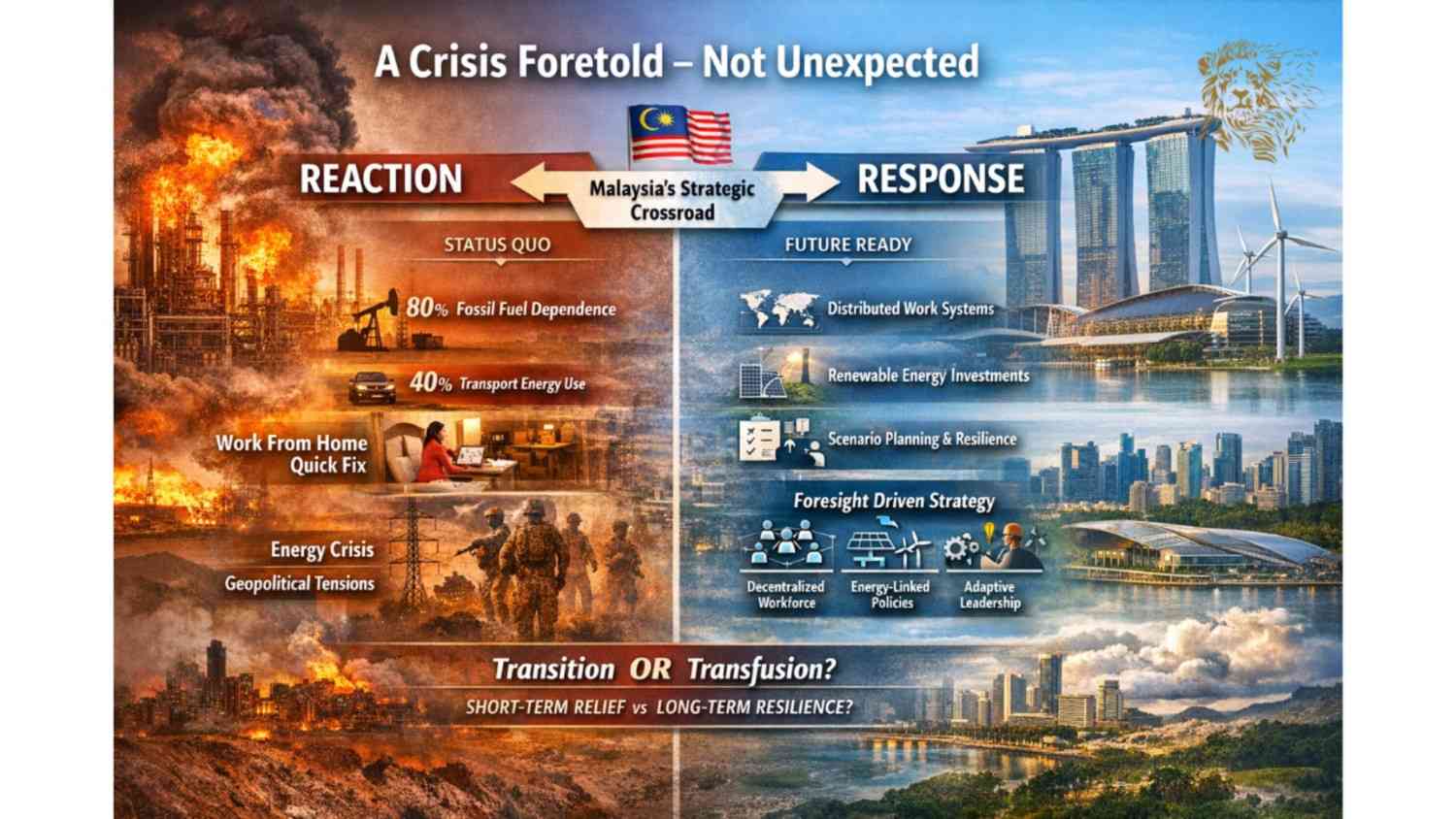
A Crisis Foretold, Not Unexpected
The current energy pressures linked to geopolitical tensions in the Middle East are not new shocks.
They are recurring patterns.
Malaysia remains structurally exposed:
- A significant majority of primary energy supply still comes from fossil fuels
- Transport remains one of the largest energy-consuming sectors, accounting for roughly a third to 40% of total demand
- Oil price volatility continues to transmit directly into national cost structures
Across ASEAN, the trajectory is similar.
According to the International Energy Agency (IEA) :
- ASEAN energy demand is projected to grow by more than 60% by 2040
- Fossil fuels continue to dominate over 70% of the energy mix
- Urbanisation is accelerating energy intensity, not reducing it
This was not unpredictable.
It was visible.
Work From Home: A Relief Valve, Not a Redesign
Encouraging remote work reduces commuting demand and provides short-term relief.
Yes.
But it does not fundamentally solve the problem.
Evidence observed during COVID-19, including studies referenced by the International Labour Organization (ILO) (https://www.ilo.org/), suggests:
- Transport-related energy usage declines
- Household energy usage increases
- Digital infrastructure demand rises significantly
The system does not consume less.
It consumes differently.
So let’s be clear:
This is not energy optimisation.
This is energy redistribution.
The Policy Illusion
When disruption becomes visible, policy tends to follow.
But response is not the same as readiness.
The World Economic Forum (WEF) consistently emphasises that resilience is built on:
- Distributed systems
- Scenario-based planning
- Workforce adaptability under constraint
Not post-event adjustments.
A reactive system adapts after impact.
A resilient system is designed before it.
A Case Study in Foresight: Singapore
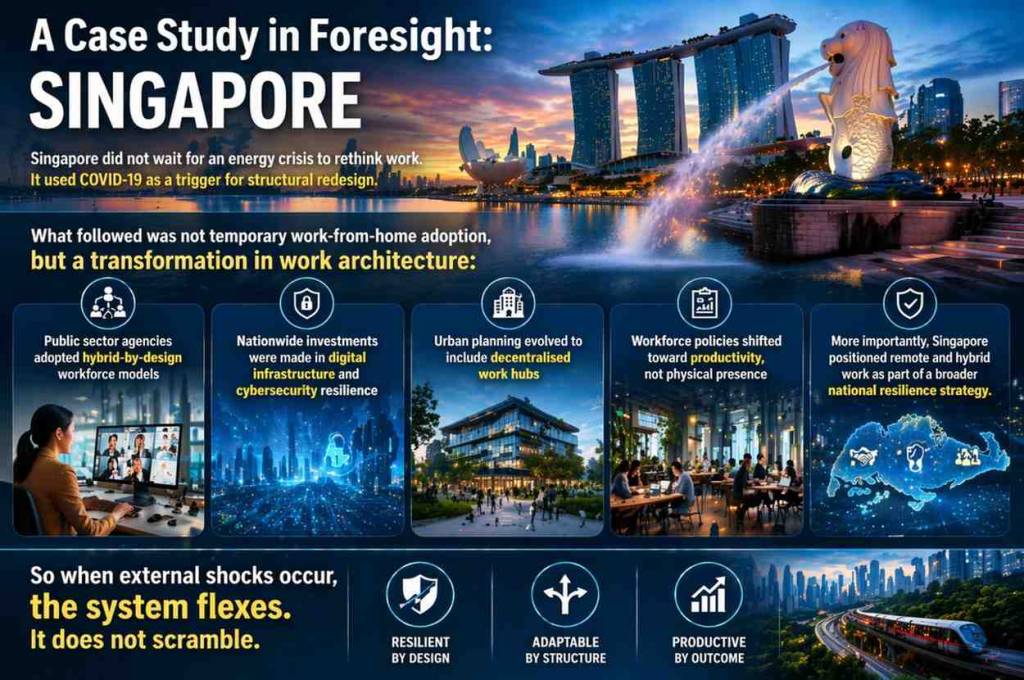
Singapore did not wait for an energy crisis to rethink work.
It used COVID-19 as a trigger for structural redesign.
What followed was not temporary work-from-home adoption, but a transformation in work architecture:
- Public sector agencies adopted hybrid-by-design workforce models
- Nationwide investments were made in digital infrastructure and cybersecurity resilience
- Urban planning evolved to include decentralised work hubs
- Workforce policies shifted toward productivity, not physical presence
More importantly, Singapore positioned remote and hybrid work as part of a broader national resilience strategy.
So when external shocks occur, the system flexes.
It does not scramble.
What a Foresight-Driven Response Would Look Like
A foresight-driven Malaysia would not be introducing work-from-home during a crisis.
It would have already embedded:
1. Distributed Workforce Architecture
Reducing dependency on centralised urban work models.
2. Energy-Linked Labour Policies
Aligning work patterns with national energy realities.
3. Scenario-Rehearsed Institutions
Ensuring ministries and GLCs are prepared to operate under:
- Energy shocks
- Supply chain disruptions
- Workforce displacement
4. Capability-Based Leadership
Where leaders manage outcomes under uncertainty—not attendance.
To explore how organizations can build such foresight-driven systems, visit:
👉 www.invictusleader.com
Reaction vs Response
A reaction asks:
How do we reduce pressure now?
A response asks:
Why were we exposed in the first place?
A reaction buys time.
A response builds advantage.
Malaysia’s Strategic Crossroad
This moment is not about work-from-home.
It is about whether Malaysia chooses to:
Continue operating within:
- Linear workforce assumptions
- Centralised infrastructure dependency
- Event-driven policy cycles
Or step into:
- Non-linear governance
- Distributed capability systems
- Foresight-led decision architecture
Because the next disruption will not be sequential.
It will be simultaneous.
Energy. AI. Workforce displacement. Supply chains.
All converging.
From Transition to Transfusion
We often speak of transition.
But transition assumes continuity.
What is required now is transfusion.
A fundamental replacement of how we:
- Design work
- Structure energy dependency
- Build capability
- Lead under pressure
Conclusion
Work-from-home, in this context, is not the story.
It is the signal.
A signal of deeper structural exposure, delayed system design, and reactive policy cycles. While it offers temporary relief, it does not address the root cause of vulnerability.
The real opportunity lies beyond the immediate response.
It lies in redesigning systems—how work is structured, how energy dependencies are managed, and how leadership operates under uncertainty.
Organizations and nations that embrace foresight-led strategies today will not just survive future disruptions—they will gain a competitive advantage from them.
Learn how foresight-driven leadership can transform your organization:
👉 www.invictusleader.com
Because the goal is not to react better.
It is to be ready before reaction is required.