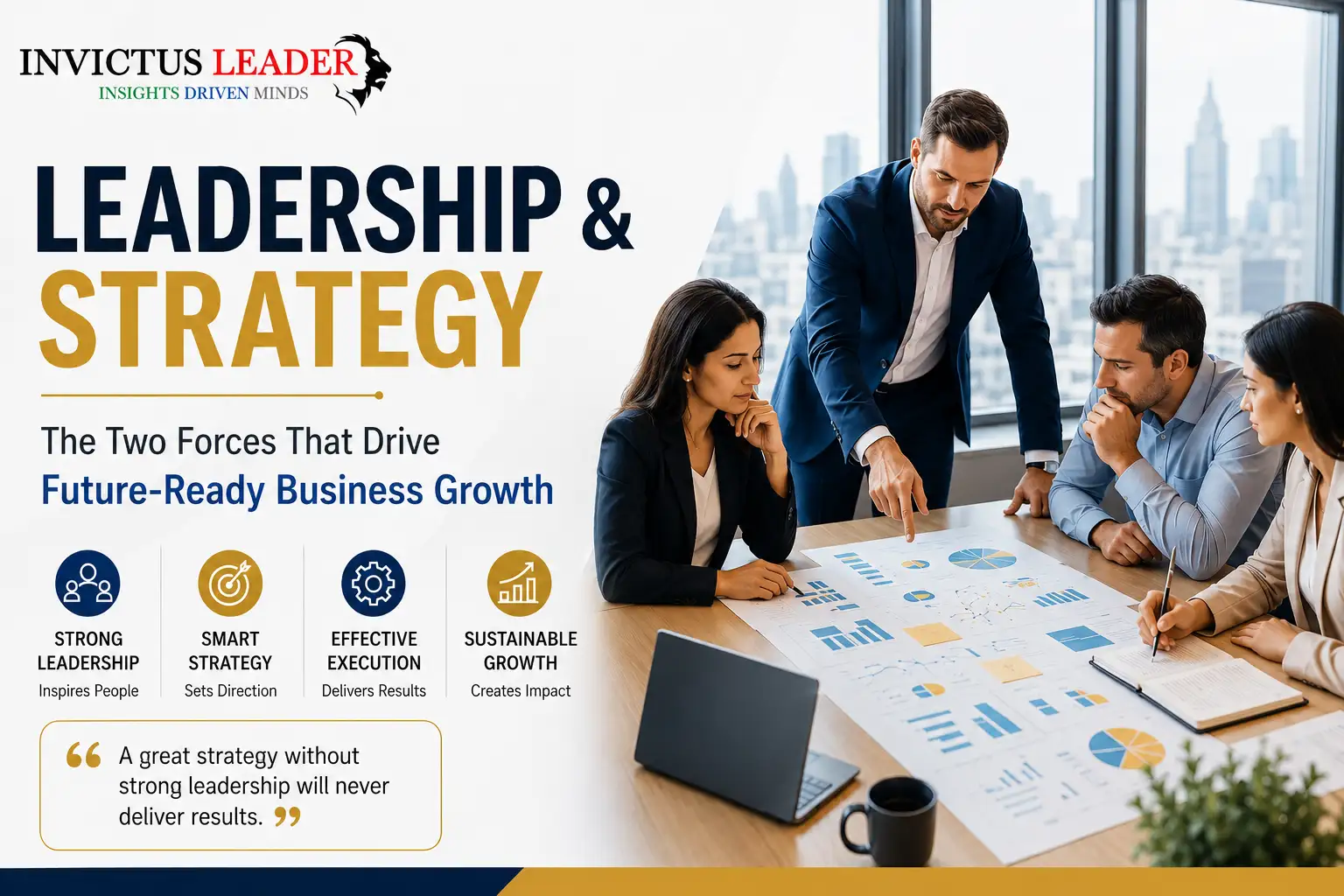
Leadership and Strategy are the two forces every business ultimately runs on. Companies don’t stall because they lack ambition — they stall when vision and execution stop talking to each other. Here’s why Strategic Leadership is the real differentiator between businesses that grow steadily and businesses that stay busy without going anywhere.
Table of Contents
- 1. Introduction
- 2. Understanding Leadership
- 3. Understanding Strategy
- 4. Why Leadership and Strategy Must Work Together
- 5. Essential Leadership Skills & Styles
- 6. Strategic Leadership in Modern Business
- 7. Leadership Challenges & Future Trends
- 8. Real-World Examples & Best Practices
- 9. Key Takeaways
- 10. Frequently Asked Questions
Introduction
Quick Summary: In modern commerce, sustainable Business Growth is driven by aligning executive direction with operational agility. While Strategy outlines the commercial destination, Leadership builds the execution framework, trust, and organizational alignment required to reach it. When both work in harmony, businesses adapt successfully to market changes.
Every organization eventually asks the same question: why do some companies keep growing through uncertainty while others stall the moment conditions shift? The answer almost always comes down to how well leadership and strategy work together.
A strategic plan is only as good as the leadership behind it. And leadership, without a clear strategic direction, is just energy with nowhere to go. The businesses that scale sustainably are the ones that treat leadership development and strategic planning as one continuous discipline — not two departments that meet once a year at a planning offsite.
Today’s business environment moves faster than ever. Markets shift, teams work across time zones, and customer expectations change quarterly instead of yearly. In this environment, strategic leadership isn’t a nice-to-have — it’s the mechanism that lets an organization adapt without losing its direction.
This guide breaks down leadership and strategy in practical terms: what each one actually means, how they depend on each other, and what modern executives need to do to build organizations that are genuinely future-ready.
At Invictus Leader, we work with executives who are past the theory stage and want a real framework for turning strategic intent into consistent execution.
Ready to Strengthen Your Leadership Strategy?
See how Invictus Leader helps executives align leadership behavior with long-term strategic outcomes.
Explore Strategic Leadership SolutionsUnderstanding Leadership
Leadership is the ability to influence, guide, and motivate people toward a shared outcome. It isn’t a title, and it isn’t reserved for the corner office. It shows up in daily decisions — how a manager handles a missed deadline, how an executive communicates a hard call, how a team lead gives feedback that actually lands.
Over time, these small moments compound into culture. And culture is what determines whether a strategy survives contact with reality. Strong leadership establishes the operational guardrails, ensuring that teams stay aligned to the core goals during times of change.
What Strong Leadership Looks Like in Practice
Clear Direction
Teams know what they’re working toward and why it matters.
Consistent Trust
People believe leadership will follow through on what it says.
Sound Judgment
Leaders make decisions under pressure without losing perspective.
Genuine Development
Leaders grow people, not just manage their output.
Accountability
Leaders own outcomes, including the ones that go wrong.
Executive Recommendation: Structural Talent Pipelines
To drive sustainable growth, organizations must treat Leadership Development as a key operational pillar. Senior executives should implement formal mentorship pathways that connect emerging talent with strategic planners. Aligning internal talent development with long-term commercial goals ensures your management capabilities scale alongside your revenue.
Leadership development is also not a one-time event. What works for leading a 10-person team rarely scales cleanly to a 500-person organization — the skills have to grow with the role.
Understanding Strategy
Strategy is the deliberate plan an organization follows to reach a long-term objective, given its resources, market position, and competitive environment. It answers three questions: where are we now, where do we want to go, and how are we getting there.
Good strategic planning isn’t about predicting the future with certainty. It’s about building a framework flexible enough to adapt while still moving toward a clear goal. A robust Business Strategy provides a standard framework that guides everyday resource allocation and investment decisions.
A sound business strategy typically includes:
- A clearly defined long-term vision
- An honest read on internal strengths and weaknesses
- Market and competitor analysis
- Resource allocation priorities
- Measurable milestones to track real progress
Business Best Practice: Dynamic Strategy Re-alignment
Successful enterprises shift away from static annual cycles. Instead, they incorporate a rolling 90-day review framework to evaluate their core assumptions against live market data. This regular testing of strategy against real-time operational data allows leaders to execute micro-pivots without losing sight of long-term milestones.
Strategic plans rarely fail because the thinking was wrong. They fail because execution was inconsistent — which is exactly where leadership comes back into the picture.
Why Leadership and Strategy Must Work Together
Strategy sets the destination. Leadership determines whether the organization actually arrives.
This is the core of strategic leadership: the ability to hold a long-term vision and translate it into decisions people can act on today. Below is a simple breakdown of how the two concepts differ, and why neither works well in isolation.
| Aspect | Leadership | Strategy |
|---|---|---|
| Primary Focus | People and influence | Direction and planning |
| Core Question | How do we inspire action? | Where are we headed? |
| Time Orientation | Ongoing, daily practice | Long-term, milestone-based |
| Measured By | Trust, engagement, retention | Market share, revenue, efficiency |
| Decision Method | Value alignment & consensus | Data models & trade-offs |
| Adaptability Role | Guiding team through change | Adjusting plans to markets |
| Risk If Missing | Disengaged, directionless teams | A well-organized plan with no buy-in |
Notice that neither column stands on its own. A brilliant strategic plan still stalls if leadership can’t rally people behind it. A highly motivated team without a coherent strategy just moves fast in the wrong direction.
Leadership Insight: Bridging Vision and Action
When a strategic initiative stalls, the cause is rarely the plan itself. It’s almost always a leadership gap somewhere in the communication chain. Leaders must active-listen to their teams, address execution bottlenecks, and align individual actions with the broader organizational roadmap.
Essential Leadership Skills & Styles
Strong leaders aren’t defined by one trait — they build a range of skills and adjust their approach based on the situation in front of them. The synthesis of varying leadership styles is crucial to steer teams through business complexities.
Core Leadership Skills Worth Developing
Communication
Clear, confident communication across all tiers.
Emotional Intelligence
Emotional intelligence and professional empathy.
Decisive Under Pressure
Strategic decision making under intense pressure.
Delegation
Delegation with structural accountability.
Conflict Resolution
Constructive conflict resolution.
Adaptability
Adaptability during rapid change and transformation.
Expert Tip: Cultivating Leadership Agility
Avoid relying on a single leadership archetype; modern environments demand situational versatility. Practice active inquiry with senior managers while using transformational patterns to inspire the workforce during structural shifts.
Common Leadership Styles Include
Transformational
Inspires teams through shared vision and purpose.
Servant
Prioritizes team needs and clears operational obstacles.
Democratic
Invites collaborative input before deciding.
Situational
Adjusts approach based on team maturity and context.
No single style is universally “best.” Executive leadership today usually blends several styles depending on the team, the industry, and the moment.
Leadership Development Checklist
- Seek regular feedback from peers and direct reports
- Practice active listening in every one-on-one
- Set aside time weekly for strategic thinking, not just task management
- Mentor at least one emerging leader on the team
- Review major decisions quarterly to spot blind spots
Strategic Leadership in Modern Business
Markets move faster than they used to, and strategic planning has had to evolve with them. Rigid five-year plans are giving way to adaptive strategy — shorter cycles, faster feedback loops, and leadership teams that can pivot without losing sight of the long-term vision. The execution of a dynamic Business Strategy requires an active commitment to Change Management.
Strategic leadership today means:
Market Sensing
Reading market signals early, before a crisis forces the issue.
Strategic Balance
Balancing short-term performance pressure with long-term culture and brand investment.
Informed Decisions
Making data-informed decisions without losing the human judgment data can’t replace.
Succession Security
Building a leadership bench deep enough that strategy doesn’t collapse when one person leaves.
Practical Example: Aligning Tech and Human Resources
A retail bank designed a mobile banking strategy to capture younger audiences. While the technology was solid, rollout stalled due to staff resistance. The initiative succeeded only after executives realigned the roadmap, training branch managers as advocates. Integrating change management with technical execution resolved the friction.
Building this kind of capability internally takes time and deliberate investment. This is where organizations often benefit from structured leadership capability development programs designed specifically to help executives sharpen decision-making and align day-to-day leadership behavior with long-term strategic goals.
Leadership Challenges & Future Trends
Today’s leaders face a different set of pressures than a decade ago. Chief among these challenges is cultivating a high-performing Organizational Culture within decentralized environments. Some of the most significant pressures include:
- Hybrid and remote team management — leading people you rarely see in person requires new communication habits and tools.
- Faster decision cycles — markets shift quickly, leaving less time to deliberate and requiring decentralization.
- Talent retention — younger workforces expect purpose-driven leadership, transparency, and personal growth plans.
- Technology integration — AI and automation are reshaping how strategic decisions get made and how tasks are executed.
- Generational shifts in expectations — flexibility, transparency, and growth opportunities matter more than ever.
Future Leadership Trends Worth Watching
Emotional Intelligence First
Greater emphasis on emotional intelligence over traditional authority-based management structures.
Data-Informed Decisions
Data-informed strategic decision making paired with long-term human judgment and oversight.
Continuous Development
Continuous leadership development models rather than static, one-time offsite training events.
Flatter Structures
Flatter organizational structures that push strategic ownership closer to client-facing teams.
Preparing Leaders for What’s Next
Explore how forward-looking organizations are building leadership benches ready for constant change.
Discover Strategic Leadership ProgramsReal-World Examples & Best Practices
Consider two companies in the same industry, facing the same market downturn. Company A has clear strategic priorities, but leadership fails to explain why difficult decisions are being made — layoffs feel arbitrary, and trust erodes fast. Company B faces the identical downturn, but leadership is transparent about the reasoning, involves teams in solving parts of the problem, and comes out the other side with stronger loyalty than before.
The strategy on paper might look nearly identical. The leadership execution is what determines the outcome.
Let’s look at historical corporate shifts:
Microsoft — Cultural Transformation
When Satya Nadella assumed leadership, he pivoted Microsoft’s strategy to cloud-first. Crucially, he focused on shifting the culture from a hyper-competitive, siloed format to a unified “growth mindset.” This leadership focus enabled Azure’s massive commercial success.
Netflix — Decentralized Strategy
Netflix transitioned from mailing DVDs to streaming, and eventually to producing original content. Rather than relying on top-down strategic planning, the business relied on a leadership style that prioritized context over control, pushing decision-making responsibility to product and creative managers.
Best Practices That Consistently Separate Strong Organizations
- Leadership explains the “why” behind every major strategic decision clearly
- Strategic plans get revisited quarterly, not just once a year
- Feedback flows both up and down the organization, not only top-down
- Leaders model the behavior they expect from their teams
- Decisions get documented and reviewed for lessons learned
Key Takeaways
- Leadership and strategy are two sides of the same coin — one sets direction, the other drives execution.
- Core leadership skills like communication, emotional intelligence, and adaptability directly shape strategic outcomes.
- Strategic planning needs to stay flexible enough to adapt to fast-changing markets without losing sight of the long-term goal.
- Organizations that align leadership development with strategic planning consistently outperform those that treat them as separate functions.
- Structured leadership development, like a proven leadership growth framework, helps turn strategic intent into consistent execution.
Conclusion
Leadership and strategy will always be intertwined. One without the other leaves an organization either directionless or paralyzed. The businesses that grow sustainably are the ones that invest in both — building leaders capable of executing a clear, adaptable strategy quarter after quarter, not just planning one.
If your organization is looking to close the gap between strategic vision and daily execution, explore how structured organizational leadership helps executives build that capability from the inside out.
Frequently Asked Questions
What is the difference between leadership and management?
Leadership focuses on inspiring people, developing talent, and defining direction, whereas management focuses on organizing resources, monitoring processes, and meeting short-term metrics.
Why is strategic leadership important for business growth?
Strategic leadership bridges vision and execution, ensuring that strategic plans are translated into consistent action by aligned and motivated teams.
What are the core components of a business strategy?
A business strategy includes a long-term vision, market analysis, resource allocation, and clear performance milestones.
How can leadership skills be developed over time?
Leadership skills are developed through 360-degree feedback, executive mentoring, coaching, and hands-on management of complex initiatives.
What leadership style works best for a growing company?
No single style is best. Growing companies benefit from a situational style that shifts between transformational and democratic methods.
How often should a strategic plan be reviewed?
Plans should be reviewed quarterly. A rolling 90-day strategy cycle allows organizations to adjust tactics based on market feedback without altering long-term goals.
What causes strategic plans to fail?
Most plans fail due to poor communication, lack of alignment between leadership tiers, and a failure to establish execution metrics.
How does emotional intelligence affect leadership effectiveness?
High emotional intelligence enables leaders to navigate conflicts, build trust, and improve team retention during complex organizational changes.
What is strategic decision making?
It is the practice of evaluating choices against long-term vision and data, rather than reacting to short-term operational pressure.
How is future leadership different from traditional leadership?
Future leadership focuses on transparency, decentralization, and continuous learning, departing from legacy hierarchies that slow down operations.
Can strategy exist without strong leadership?
A strategy on paper remains theoretical. Actual execution depends on leadership to mobilize talent and allocate capital effectively.
Turn Strategic Vision Into Consistent Execution
Invictus Leader helps executives build the leadership capability that makes strategy actually stick.
Explore The Invictus Edge