Table of Contents
Key Takeaways
- Executive coaching is one-on-one, personalized, and outcome-driven for senior leaders.
- Leadership training is group-based and skills-focused, ideal for scaling capability across teams.
- Leadership development is the umbrella strategy that combines coaching, training, and mentoring.
- Organizations that blend all three see the strongest, most sustainable business impact.
- Choosing the right approach depends on your leader’s seniority, goals, and organizational stage.
1. What Is Executive Coaching?
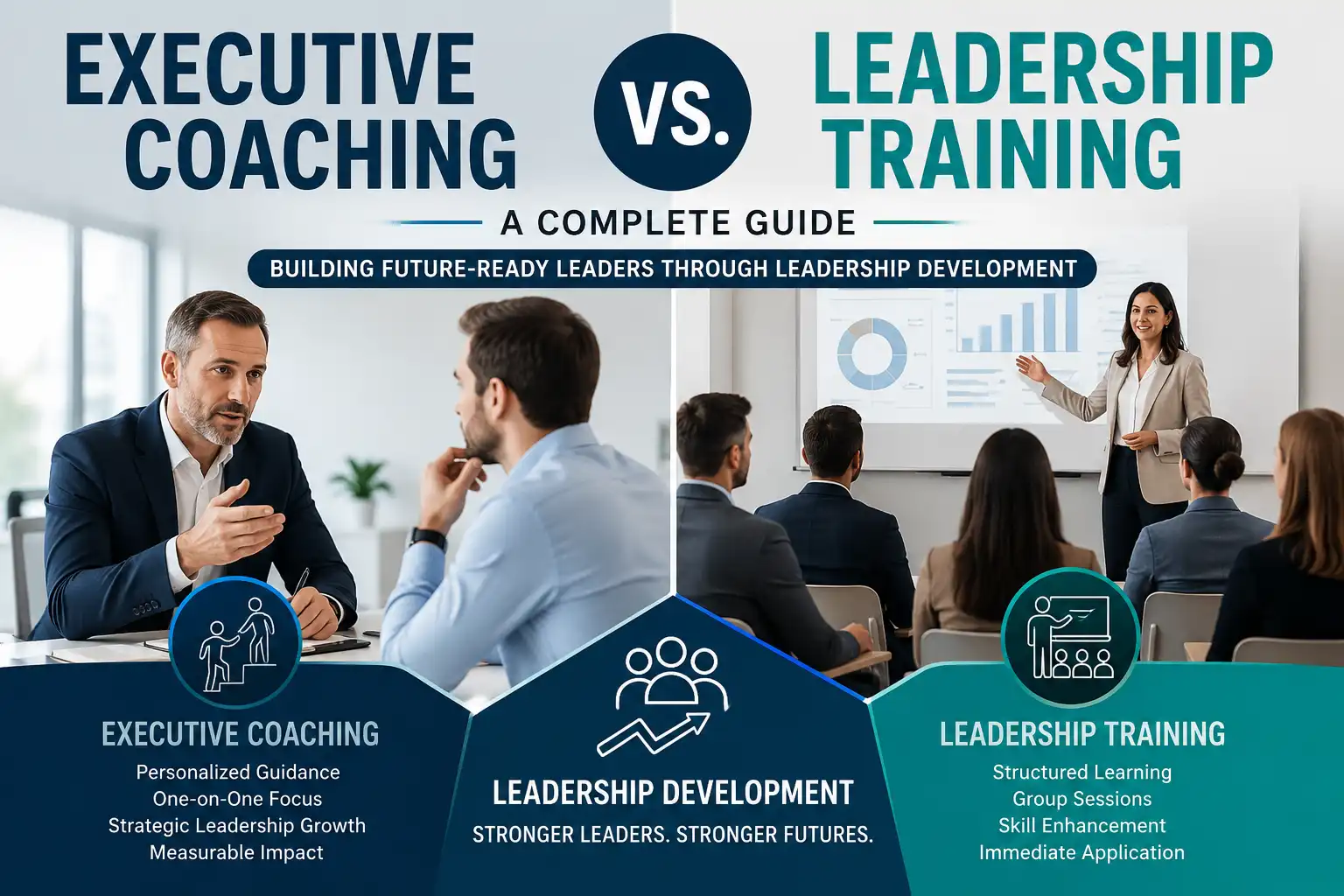
Executive coaching is a personalized, one-on-one partnership between a senior leader and a trained executive mentor. Unlike generic seminars, coaching is built entirely around the individual’s goals, blind spots, and business context.
A strong executive coaching engagement focuses on decision-making under pressure, emotional intelligence, communication style, and strategic thinking. Sessions typically run over three to twelve months, with measurable goals set at the outset.
Because it’s private and confidential, coaching gives executives a safe space to work through challenges they can’t openly discuss with their own team. This is why it’s often reserved for C-suite leaders, founders, and high-potential VPs preparing for bigger roles.
The most effective coaching engagements start with a 360-degree assessment. It gives both the coach and the leader an honest baseline before setting goals.
2. What Is Leadership Training?
Leadership training is structured, curriculum-based education delivered to groups of managers or emerging leaders. It typically covers foundational skills: communication, delegation, conflict resolution, feedback, and performance management.
Training is usually delivered through workshops, e-learning modules, or in-person sessions, and it’s designed to be repeatable across an entire management layer. This makes it a cost-effective way to raise the baseline capability of many leaders at once.
While training builds knowledge and frameworks, it doesn’t always account for an individual’s unique challenges. That’s the core distinction that shapes the rest of this guide.
Organizations that pair leadership training with follow-up coaching see significantly higher skill retention than training-only programs.
3. Leadership Development vs Leadership Training
Leadership development is the umbrella strategy. It’s a long-term, organization-wide approach that blends training, coaching, mentoring, stretch assignments, and succession planning into one continuous system.
Leadership training is one component inside that larger leadership development strategy, not a replacement for it. Companies that treat training as a one-time event rarely see lasting culture change.
Think of leadership development as the roadmap, and executive coaching and leadership training as two of the vehicles that get you there. Our Regenerative Leadership & Culture Systems approach is built around this exact philosophy.
4. Executive Coaching vs Leadership Training
Here’s the side-by-side breakdown business leaders ask for most: how executive coaching, leadership training, and leadership development actually compare on the factors that matter for decision-making.
| Factor | Executive Coaching | Leadership Training | Leadership Development |
|---|---|---|---|
| Purpose | Personal growth & performance | Skill-building at scale | Long-term capability strategy |
| Audience | Individual executives | Groups of managers | Entire organization |
| Duration | 3–12 months | Days to weeks | Ongoing, multi-year |
| Approach | One-on-one, confidential | Curriculum-based | Blended systems approach |
| ROI | High, individually measurable | Moderate, broad-based | Highest, compounding over time |
| Customization | Fully personalized | Standardized content | Tailored to org strategy |
| Business Impact | Stronger individual decisions | Consistent management practice | Cultural & succession strength |
“Leadership development isn’t a program you finish. It’s a system you build, and it compounds every year you invest in it.”
5. Benefits of Executive Coaching
Executive coaching delivers value that reaches far beyond the individual leader. Here’s what organizations consistently report:
Sharper Decision-Making
Leaders learn to slow down, weigh options, and act with more confidence under pressure.
Improved Team Trust
Coached leaders communicate more clearly, which increases trust and psychological safety.
Higher Retention
Investing in senior leaders signals long-term commitment, which reduces costly executive turnover.
6. When Should Organizations Choose Executive Coaching?
Executive coaching makes the most sense in a few clear situations: a leader is stepping into a bigger role, a high performer is struggling with a specific behavioral pattern, or the C-suite needs alignment during a period of major change.
It’s also the right call when confidentiality matters. Founders navigating board dynamics, or executives working through a difficult team conflict, often need a space that group training simply can’t provide.
If you’re building out Executive Coaching Solutions for your senior team, start by identifying which leaders are at true inflection points in their careers.
Pair every coaching engagement with a clear success metric, agreed on by the leader, their manager, and HR, before the first session starts.
7. Leadership Development Best Practices
Organizations that build strong leadership pipelines tend to follow the same core process. Here’s what that looks like in practice.
Assess Current Leadership Gaps
Use 360 reviews and performance data to identify where leaders are struggling most.
Design a Blended Program
Combine group training for foundational skills with 1:1 coaching for senior leaders.
Set Measurable Milestones
Track behavior change with quarterly check-ins, not just end-of-program surveys.
Reinforce Through Culture
Embed new leadership behaviors into performance reviews and promotion criteria.
8. Common Leadership Development Mistakes
Even well-funded programs fail when organizations treat leadership development as a one-time event rather than an ongoing system. A single workshop, however polished, rarely changes deep-rooted habits.
Another common mistake is applying the same training to every level of leadership. A first-time manager and a seasoned VP need fundamentally different support, and generic programs underserve both.
Finally, many organizations skip measurement entirely. Without clear before-and-after metrics, it’s impossible to prove ROI or justify future investment to the board.
Audit your current leadership programs against actual business outcomes, not just attendance or satisfaction scores, at least once a year.
9. Building Future-Ready Leaders
Future-ready leaders aren’t just technically skilled, they’re adaptable, self-aware, and capable of leading through ambiguity. Building this kind of leadership bench requires more than an annual training calendar.
It requires a system where coaching, training, mentoring, and real-world stretch assignments reinforce each other continuously. That’s the core idea behind sustainable leadership transformation.
Organizations that get this right build a genuine competitive advantage: a pipeline of leaders ready to step up, not just a list of names on a succession plan.
10. Conclusion
Executive coaching and leadership training aren’t competing choices, they’re complementary tools inside a broader leadership development strategy. Coaching sharpens individual senior leaders, training builds capability across your management layer, and development ties both together into lasting organizational strength.
The organizations that win on leadership don’t pick one approach. They build a deliberate system, measure it, and keep investing in it year after year.
Transform Leadership Into Long-Term Business Success
Whether you need targeted executive coaching, organization-wide leadership training, or a full leadership development strategy, the right system pays for itself many times over.
Explore Leadership SolutionsFrequently Asked Questions
What is the main difference between executive coaching and leadership training?
Executive coaching is one-on-one and personalized to an individual leader’s goals, while leadership training is group-based and focused on building shared skills across many managers.
Who should get executive coaching versus leadership training?
Senior executives and high-potential leaders facing specific, individual challenges benefit most from coaching, while entire management teams benefit from group leadership training.
How long does an executive coaching program usually last?
Most executive coaching engagements run between three and twelve months, with regular sessions and measurable milestones along the way.
Is leadership development the same as leadership training?
No. Leadership development is the broader, ongoing strategy that includes training, coaching, mentoring, and succession planning as connected parts.
What ROI can companies expect from executive coaching?
Most organizations report a strong positive ROI, driven by better decision-making, higher retention, and improved team performance under coached leaders.
Can small businesses benefit from executive coaching too?
Yes. Founders and small business leaders often benefit the most, since coaching helps them navigate growth decisions without a large internal support structure.
How do you measure the success of leadership development programs?
Track behavior change through 360 feedback, retention rates, promotion readiness, and business outcomes tied to the leaders who went through the program.
Should organizations combine coaching, training, and development?
Yes. The strongest results come from blending all three into one coordinated leadership strategy rather than choosing just one in isolation.