What Is Leadership Development?
Leadership development is the umbrella discipline: a deliberate, long-horizon process of building the mindsets, capabilities, and behaviors people need to lead effectively — now and at the next level they’re growing into. It is not a single event or a single tool. It is a system that combines structured learning, real-world stretch assignments, mentoring relationships, feedback loops, and often coaching, sequenced over months or years rather than days.
Where leadership training teaches a defined skill and executive coaching works one-to-one on an individual’s specific challenges, leadership development is the architecture that holds both together and points them at an organization’s actual talent pipeline. Done well, it answers a question far bigger than “what should this person learn next”: it answers “who does this organization need leading it in three, five, and ten years — and how do we build them deliberately rather than hope they emerge.”
The core building blocks
Most credible leadership development programs share a similar architecture, even when the branding differs:
Core Components of Leadership Development
- Assessment first. Structured diagnostics — 360 feedback, psychometrics, readiness reviews — establish where a leader or cohort genuinely stands before any intervention is designed.
- Structured learning pathways. Curated content, workshops, and experiential modules sequenced against real capability gaps, not a generic curriculum.
- Stretch assignments. Real projects with real stakes, deliberately chosen to build judgment under pressure rather than theoretical fluency.
- Mentoring and sponsorship. Access to more senior leaders who can model decision-making and open doors within the organization.
- Feedback and measurement. Ongoing review cycles that track behavior change, not just attendance or satisfaction scores.
The distinguishing feature of leadership development is duration and integration. A single workshop can teach a technique. Only a sustained development pathway can change how someone actually leads.
Why the umbrella framing matters
It’s tempting to treat “leadership development” as a marketing label rather than a distinct discipline. That’s a mistake. The label matters because it sets expectations for scope, timeline, and ownership. A leadership development program is typically owned at the organizational level — by HR, talent, or the executive team — because it is explicitly tied to succession planning and workforce strategy, not just individual growth. That ownership shapes everything downstream: budget cycles, measurement frameworks, and how success gets reported to the board.
It’s also worth being honest about what leadership development is not. It is not a single certification, not a personality assessment handed out once a year, and not a leadership offsite that ends with a group photo and no follow-through. Those things can be useful inputs into a broader development strategy, but mistaking any one of them for the whole system is one of the most common — and most expensive — errors organizations make.
A capability-first lens
The organizations that build genuinely effective leadership development programs tend to start from capability, not curriculum. Instead of asking “what course should we run,” they ask “what does a leader in this organization need to be able to do two levels above where they are today — and what’s the honest gap between that and where our bench currently stands.” That capability-first lens is what separates a leadership development strategy with measurable business impact from a well-intentioned training calendar that quietly fades by year end.
Why Leadership Development Matters
The business case for leadership development has moved well past the “nice to have” era. Organizations facing constant market disruption, hybrid workforces, and generational shifts in what people expect from work are discovering that leadership capability is now a direct driver of retention, resilience, and revenue — not a soft-side afterthought.
Figures reflect commonly observed ranges across industry workforce research and are directional, not organization-specific guarantees.
Beyond the numbers, leadership development matters because leadership gaps compound. A single undertrained manager affects a team of ten. A leadership vacuum at the senior level affects an entire strategy. Organizations that invest early and continuously in leadership capability tend to absorb disruption rather than be flattened by it — because the people making decisions under pressure have already built the judgment to do so.
Key Takeaway
Leadership development isn’t a cost center reacting to attrition — it’s a forward investment that determines how well an organization performs under future conditions nobody can fully predict yet.
The cost of doing nothing
It’s worth naming the alternative directly. Organizations that skip deliberate leadership development don’t avoid the cost of leadership failure — they just pay it later, and usually with interest. A manager who was never taught how to give direct feedback will avoid difficult conversations until small problems become resignations. A high-potential leader who was never stretched into bigger responsibility will eventually be recruited by a competitor who offered that stretch instead. None of these costs show up on a training budget line, which is exactly why they’re so easy to underestimate until the damage is already visible in engagement scores and exit interviews.
The organizations that treat leadership skills development as strategic infrastructure — rather than a discretionary line item that gets cut in a tight year — are consistently the ones that navigate leadership transitions, market shocks, and structural change with far less disruption to the business.
What Is Executive Coaching?
Executive coaching is a confidential, one-to-one relationship between a senior leader and a trained coach, focused on that individual’s specific goals, blind spots, and decisions. Unlike training, which delivers content to a group, coaching is entirely personalized: the agenda is set largely by the executive’s real, current challenges — a difficult stakeholder relationship, a strategic pivot, a pattern of behavior that’s holding them back from the next level.
A good executive coach doesn’t hand over answers. They ask sharper questions, reflect patterns the executive can’t see from inside their own perspective, and hold the individual accountable to commitments they set for themselves. The relationship typically runs for a defined engagement — often three to twelve months — with regular one-to-one sessions building on each other over time.
Coaching doesn’t teach leaders what to think. It sharpens how they think — under exactly the pressure they’re already facing.
— Invictus Leader Coaching Philosophy
Who executive coaching is for
Executive coaching tends to deliver the most value for leaders who already have strong technical and functional capability but are navigating a specific inflection point: a promotion into a broader remit, a difficult team dynamic, a founder scaling past their comfort zone, or a senior leader preparing for a board-level or C-suite transition.
What a typical engagement looks like
Most executive leadership development coaching engagements open with a structured discovery phase — often including stakeholder interviews and a 360-style feedback process — so the coach and the executive share a clear, honest picture of current strengths and gaps before setting goals. From there, sessions typically run every two to four weeks, each one grounded in whatever is genuinely live in the executive’s world that month: a hiring decision, a conflict with a peer, a strategic bet they’re unsure about.
Because the relationship is confidential, executives often say things to a coach they wouldn’t say internally — not out of secrecy, but because the coach has no stake in the organization’s politics. That neutrality is precisely what makes the coaching relationship valuable: it creates a space where an executive can think out loud without managing how it will be perceived.
Benefits of Executive Coaching
Sharper Self-Awareness
Structured reflection surfaces blind spots that peer feedback and performance reviews rarely reach.
Faster Decision Quality
A neutral thinking partner accelerates clarity on complex, high-stakes calls under time pressure.
Stronger Executive Presence
Coaching refines how leaders communicate, negotiate, and hold a room — skills rarely taught formally.
Improved Retention at the Top
Senior leaders who feel genuinely invested in are significantly less likely to disengage or exit.
Healthier Team Dynamics
As leaders shift behavior, the effect cascades — teams report calmer, clearer, more consistent leadership.
Confidential, Judgment-Free Space
Executives rarely have anywhere internal to think out loud honestly — coaching provides exactly that.
Leadership Tip
Coaching works best when tied to a real, current decision — not a generic development goal. Ask a prospective coach how they’ll anchor sessions to what’s actually happening in your business this quarter.
What Is Leadership Training?
Leadership training is the most tactical of the three: structured, often group-based instruction designed to build a specific, definable skill within a defined timeframe. Think workshops on giving feedback, running effective meetings, managing conflict, or leading through change. It is content-driven, typically shorter in duration, and easier to scale across large groups of managers at once.
Training earns its place when the gap is genuinely a knowledge or skill gap — new managers who have never formally learned how to delegate, for instance, or a leadership population that needs a shared vocabulary and shared standards ahead of a major transformation. It is not designed to resolve deep individual behavioral patterns, and it rarely produces change on its own without reinforcement afterward.
Common Mistake
Treating a single training workshop as a complete leadership solution. Without reinforcement, application, and follow-up, most training content decays from memory within weeks — the classic “training and hope” trap.
Where corporate leadership training earns its keep
Despite that caution, corporate leadership training remains one of the most cost-efficient ways to raise a baseline across a large group quickly. When a company is rolling out a new performance management process, for instance, every manager needs the same working knowledge on the same timeline — that’s a training problem, not a coaching problem. The same is true when an organization is establishing a shared leadership language after a merger, or equipping a first cohort of new managers with the fundamentals of delegation, feedback, and time management before they’re thrown into the deep end.
The best training programs are designed with application built in from the start — practice scenarios, peer role-play, manager check-ins after the session — rather than treating the workshop itself as the finish line. Training that ends with a takeaway PDF and no structured follow-up is training that mostly evaporates.
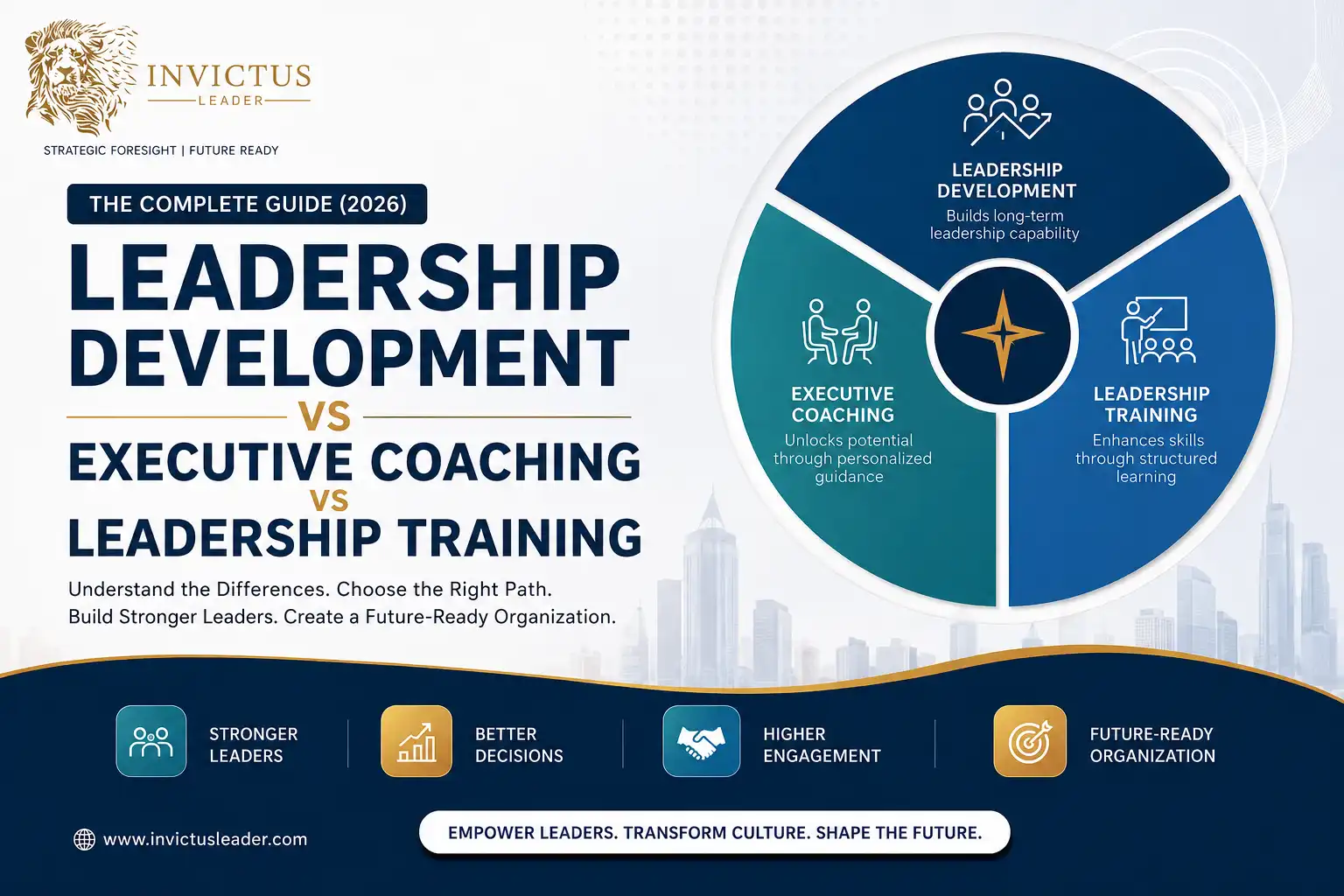
Leadership Development vs Executive Coaching vs Leadership Training
Here’s the side-by-side view that most organizations wish they’d seen before their first budget conversation. Use it as a working reference rather than a rigid rulebook — the right answer for your organization often draws from more than one column at once.
| Dimension | Leadership Development | Executive Coaching | Leadership Training |
|---|---|---|---|
| Primary Focus | Long-term capability & succession pipeline | Individual growth & specific challenges | Defined skill acquisition |
| Format | Blended, multi-modal, ongoing | One-to-one, confidential sessions | Group workshops or courses |
| Duration | 6 months to several years | 3–12 months typically | Hours to a few days |
| Best Suited For | Building bench strength & culture | Senior leaders at an inflection point | New or mid-level managers, large cohorts |
| Customization | Highly personalized to the organization | Fully personalized to the individual | Standardized content, lightly tailored |
| Typical Outcome | Stronger leadership pipeline & retention | Sharper judgment, self-awareness, presence | Consistent skills & shared vocabulary |
| Investment Level | Higher, sustained investment | Moderate to high, per individual | Lower, scalable per person |
Important Note
These three approaches are not competitors — they’re complementary layers. Most mature leadership strategies use training to build shared foundations, coaching to sharpen individual senior leaders, and development to hold the whole system together over time.
How to Choose the Right Leadership Solution
The right choice depends less on preference and more on diagnosis. Before selecting a leadership coaching benefits program, a training workshop, or a full development pathway, get precise about what problem you’re actually solving.
Start by asking these questions
- Is this a skill gap or a judgment gap? Skill gaps respond well to training. Judgment and behavioral gaps respond better to coaching.
- Is this an individual or a population? One senior leader navigating a transition needs coaching. Two hundred new managers need scalable training.
- What’s the time horizon? Immediate skill needs point to training; multi-year succession planning points to a full development strategy.
- What’s already been tried? If training hasn’t produced lasting change, the missing layer is usually reinforcement — often coaching or structured practice.
- What does the culture actually reward? A development strategy that ignores how leaders are promoted and recognized internally will struggle to stick.
In practice, most organizations that get this right don’t pick one lane permanently. They sequence: training to establish shared standards, coaching for leaders navigating real inflection points, and a development framework threading it all into a coherent leadership development strategy tied to business outcomes.
A simple sequencing model
A practical way to think about sequencing is by organizational altitude. At the broadest level — new and frontline managers — training builds the fundamentals fastest and most cost-effectively. One level up, where managers are stepping into cross-functional or larger-team responsibility, a blend of training and structured mentoring tends to close the gap. At the senior and executive level, where the challenges are increasingly unique to the individual and the stakes are highest, executive coaching for executives becomes the higher-leverage investment. Threaded through all three altitudes, a leadership development framework keeps the organization’s succession pipeline visible and intentional rather than accidental.
Budget conversations get easier once this sequencing is explicit. Instead of debating “training or coaching” in the abstract, the conversation becomes “which altitude has the biggest gap right now, and what’s the right tool for that altitude” — a far more productive question for any leadership team or board to work through together.
Common Leadership Challenges
Even well-funded leadership strategies run into the same recurring obstacles. Naming them early makes them far easier to design around. None of these challenges are unusual or a sign of a poorly run organization — they show up almost everywhere leadership is treated as an afterthought rather than a deliberate discipline. The difference between organizations that stall on these issues and those that work through them is rarely budget. It’s usually clarity about which challenge they’re actually facing.
The First-Time Manager Cliff
Technical experts are promoted into people management with almost no preparation for the shift.
Training Without Reinforcement
A great workshop with no follow-up rarely survives contact with a busy calendar.
Coaching Without Business Context
Generic coaching disconnected from real strategic priorities feels pleasant but changes little.
Thin Succession Benches
Organizations discover leadership gaps only after a critical departure, when it’s too late to build calmly.
Culture-Strategy Mismatch
Programs teach collaborative leadership while promotion criteria still reward individual heroics.
No Way to Measure Change
Without behavioral tracking, it’s impossible to know whether leadership investment actually worked.
Most of these challenges share a common root cause: leadership investment that’s reactive rather than designed. A deliberate leadership development strategy — one that pairs the right intervention with the right gap, and builds in reinforcement and measurement from day one — addresses nearly all six at once, because it forces the organization to be explicit about what it’s actually trying to build.
Leadership Trends in 2026
Leadership development, executive coaching, and leadership training are all evolving fast alongside how organizations actually operate. A few shifts stand out heading further into 2026, and each one has direct implications for how leadership investment should be designed going forward.
From episodic to continuous
The single annual workshop model is giving way to continuous, always-on development — shorter, more frequent touchpoints reinforced through coaching check-ins, peer cohorts, and applied projects rather than one big event.
Judgment over information
As information becomes commoditized and widely accessible, the differentiator for leaders is shifting toward judgment: the ability to make sound decisions amid ambiguity, competing priorities, and incomplete data — precisely the terrain executive coaching for executives is built to strengthen.
Human skills as the durable advantage
As automation and AI absorb more routine analytical work, the leadership capabilities gaining relative value are unmistakably human: empathy, trust-building, adaptive communication, and the ability to hold a team steady through uncertainty.
Leadership at every level, not just the top
Organizations are pushing leadership skills development further down the org chart — equipping individual contributors and team leads with decision-making capability once reserved for senior roles, distributing leadership rather than concentrating it.
Measurement becomes non-negotiable
Boards and CFOs increasingly expect leadership investment to show measurable behavioral and business impact, not just attendance figures — pushing coaching and training providers toward clearer outcome tracking. Expect more organizations to pair leadership programs with pre- and post-behavioral assessments, retention data, and internal mobility metrics, treating leadership investment with the same rigor applied to any other strategic capital allocation.
Hybrid and global cohorts as the default
With leadership teams increasingly distributed across regions and time zones, both coaching and training are adapting to hybrid delivery as the default rather than the exception. This shift is expanding access — leaders in smaller markets or remote roles now routinely get the same caliber of coaching and training once reserved for headquarters — while also raising the bar for how well virtual formats can hold attention and drive genuine behavior change.
Key Takeaway
The organizations pulling ahead in 2026 aren’t the ones spending the most on leadership — they’re the ones sequencing training, coaching, and development deliberately, and measuring what actually changes.
Build the Leadership Your Organization Will Need Next
Invictus Leader partners with organizations to design leadership development, executive coaching, and training strategies built around your actual challenges — not a generic template. Let’s talk about where your leadership pipeline needs the most strength.
Frequently Asked Questions
Leadership development is a broad, long-term organizational system covering many leaders and building future capability. Executive coaching is a focused, one-to-one relationship addressing one individual’s specific goals and challenges. Coaching is often one component inside a larger development strategy.
Most executive coaching engagements run between three and twelve months, with structured sessions every two to four weeks. Shorter engagements can address a single decision or transition; longer ones support sustained behavioral change.
Leadership training builds valuable foundational skills, but on its own — without reinforcement, coaching, or applied practice — much of that content fades quickly. Training works best as one layer inside a broader leadership development strategy.
Senior individual leaders navigating a specific transition, challenge, or inflection point typically benefit most from coaching. Larger groups of new or mid-level managers who need a shared skill base are better served by structured training.
Effective measurement combines behavioral indicators — 360 feedback shifts, promotion readiness, retention of high-potential talent — with business outcomes like team engagement scores, productivity trends, and succession bench strength over time.
Yes. Coaching can be scoped to focused, shorter engagements or offered selectively to a few critical leaders rather than the full executive team, making it accessible well beyond large enterprise budgets.
Success comes from alignment: the program must connect to real business priorities, be reinforced through practice and feedback over time, and be supported by leadership and promotion criteria that actually reward the behaviors being taught.
Virtual coaching has proven highly effective for most leaders, offering greater scheduling flexibility and access to specialized coaches regardless of location, while preserving the depth of the one-to-one relationship.
Core leadership skills benefit from reinforcement every six to twelve months, with shorter refresher touchpoints in between — rather than treating training as a single event that never gets revisited.
Yes — and for most mature organizations, combining all three is exactly the point. Training builds shared foundations, coaching sharpens individual senior leaders, and a development framework holds the entire system together over time.